
Sourdough Thai Green Curry and Coconut Bread Bowl
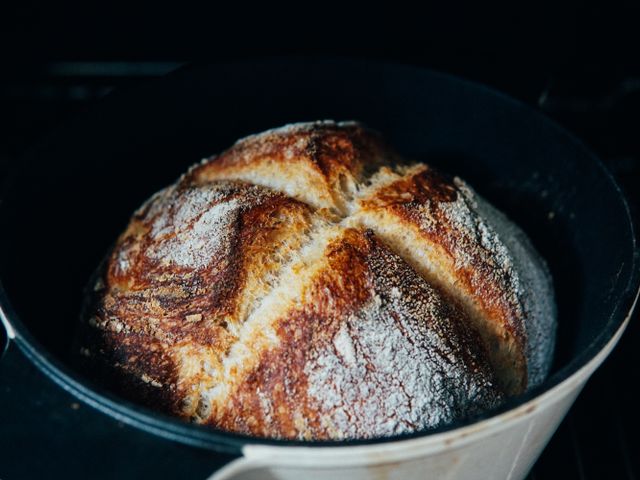
A hollowed sourdough boule infused with toasted coconut and baked until crispy, then filled with silky Thai green curry made with chicken, coconut milk, and fragrant kaffir lime leaves. The bread serves as both vessel and edible utensil for scooping the aromatic, creamy curry.
- Prep
- 30 min
- Cook
- 45 min
- Wait
- 15 min
- Total
- 1 hr 30 min
- Makes
- 4 bread bowls with 2 cups curry filling
Steps
Before you start
- Preheat oven to 375°F (190°C) 20 minutes before baking the bread bowls
- Have sourdough boules at room temperature or slightly cool
- Prepare all curry ingredients before you begin cooking
- Toast the shredded coconut lightly in a dry pan and set aside
Prepare bread bowls
- Slice off the top ¼ of each sourdough boule with a serrated knife, setting aside the tops.
- Using a small knife and your hands, carefully hollow out the interior of each boule, leaving a ½-inch (1.3 cm) thick shell.
- Reserve the removed bread for another use (breadcrumbs, croutons).
- Brush the inside and rim of each hollow boule lightly with melted butter, then sprinkle the toasted shredded coconut inside each bowl, pressing gently so it adheres to the butter.
+ Show details− Hide details
Ready when: Bread bowls are hollowed and coconut-lined, ready for baking
Tip: Don't make the shell too thin or it will cave in when filled with hot curry. Keep at least ½ inch of bread intact.
Toast bread bowlsOven 375°F / 190°C
- Place the hollowed bread bowls on a baking sheet, standing upright.
- Put in a preheated 375°F (190°C) oven for 12–14 minutes until the exterior is golden and the inside feels dry and slightly crisp when you tap the shell.
- The coconut inside should smell fragrant.
- Remove from oven and set aside to cool for 5 minutes before filling.
+ Show details− Hide details
Ready when: Bread bowls are golden and dry inside, coconut is fragrant
Tip: Watch toward the end—sourdough can darken quickly. Aim for a light golden color, not deep brown.
Bloom curry paste
- Heat 1 tablespoon of neutral oil in a 12-inch (30 cm) skillet over medium heat.
- Once shimmering, add the green curry paste and stir constantly for 2–3 minutes, breaking it apart and allowing it to darken slightly and become fragrant.
- This blooming step deepens the curry's flavor.
- Be careful not to let it scorch.
+ Show details− Hide details
Ready when: Curry paste is fragrant and slightly darker, with visible darker edges
Tip: Don't skip this step—blooming the paste in oil brings out deep, complex flavors that won't develop if you add it directly to liquid.
Add chicken to curry
- Increase heat to medium-high.
- Add the chicken breast cubes to the skillet, stirring constantly to coat them with the curry paste.
- Cook for 4–5 minutes, stirring occasionally, until the outside of the chicken turns opaque and begins to brown in places.
- The chicken does not need to be fully cooked through at this stage.
+ Show details− Hide details
Ready when: Chicken is mostly opaque outside with some golden edges
Tip: Keep the heat moderately high so the chicken develops a bit of color, which adds depth to the curry's flavor.
Deglaze and add coconut milk
- Pour the coconut milk into the skillet, stirring well to dissolve any browned bits on the bottom of the pan.
- The mixture will become thick and creamy.
- Bring to a gentle simmer over medium heat, stirring occasionally, for 2 minutes to combine the flavors.
+ Show details− Hide details
Ready when: Mixture is simmering gently and colors are evenly distributed
Tip: Stir thoroughly when adding the coconut milk to ensure the curry paste dissolves completely into the sauce.
Simmer with kaffir lime leavesOven 165°F / 75°C
- Add the torn kaffir lime leaves, fish sauce, and palm sugar to the curry.
- Stir well.
- Reduce heat to medium-low and simmer gently for 8–10 minutes, stirring occasionally, until the chicken is cooked through (internal temperature 165°F/74°C) and tender.
- The sauce should be creamy and fragrant.
+ Show details− Hide details
Ready when: Chicken is opaque throughout and tender; sauce is creamy
Tip: Keep the heat low to prevent the coconut milk from breaking or separating. A gentle simmer is all you need.
Add vegetables and finish
- Stir in the red bell pepper pieces (and Thai eggplant if using).
- Simmer for another 5–6 minutes until the pepper is tender-crisp and the eggplant is soft.
- Remove from heat and stir in the fresh Thai basil and lime juice.
- Taste and adjust seasoning with additional fish sauce or lime juice to balance heat, salt, and brightness.
+ Show details− Hide details
Ready when: Pepper is tender-crisp; basil is wilted slightly; curry smells bright and herbaceous
Tip: Add the basil and lime juice at the very end to preserve their fresh, aromatic qualities. Overcooking basil makes it bitter.
Assemble and serve
- Carefully ladle the hot curry (about ½ cup per bowl) into each toasted bread bowl.
- Place each bread bowl on a serving plate or shallow bowl to catch any drips.
- Serve immediately, tearing pieces from the bread bowl rim to scoop the curry, and eating the coconut-infused bread as you go.
+ Show details− Hide details
Ready when: Bread bowls are hot and filled, ready to serve
Tip: Fill the bread bowls just before serving so the bread stays as crispy as possible. The contrast between crispy bread and creamy curry is essential to this dish.
Good to know
Tips
- If you don't have four identical sourdough boules, buy a larger round sourdough loaf and cut it into four equal pieces before hollowing. Adjust baking time as needed based on size.
- Toasting the bread bowls in advance gives them structure and prevents them from becoming soggy when filled with hot curry. Do not skip this step.
- Palm sugar has a complex, subtle sweetness that complements Thai curry better than white sugar, but light brown sugar works as a substitute.
- The key to creamy Thai curry is using full-fat coconut milk and keeping the heat gentle; high heat or prolonged simmering can cause the coconut oil to separate from the liquid.
Make ahead
The curry can be made up to 2 days ahead and refrigerated in an airtight container. Reheat gently on the stovetop over medium-low heat, stirring occasionally, until warmed through (about 8–10 minutes). Do not toast the bread bowls ahead of time; they are best served fresh from the oven.
Storage & reheating
Leftover curry keeps for 3 days in the refrigerator in an airtight container. Reheat gently on the stovetop over medium-low heat. Bread bowls become soft when stored; they are best eaten fresh. Curry can be frozen for up to 3 months; thaw in the refrigerator overnight, then reheat on the stovetop.
Substitutions
- fresh or frozen kaffir lime leaves, bruised → Zest of 1 lime, added at the end instead of leaves. Kaffir lime leaves are difficult to find in some areas; fresh lime zest provides a similar bright citrus note, though the flavor is slightly different. Add zest just before serving.
- Thai green curry paste → 2 tablespoons homemade green curry paste (blended fresh green chilies, shallots, garlic, ginger, coriander root, and salt). For a fresher, custom curry, make your own paste using a food processor or mortar and pestle. Adjust heat level by the number of chilies used.
- boneless, skinless chicken breasts → 1 pound (450 g) firm fish such as cod or mahi-mahi, cut into 1-inch cubes. Fish cooks faster than chicken; reduce the simmering time in Step 6 to 4–5 minutes. Check that fish flakes easily and is opaque throughout.
- fresh Thai basil → Fresh cilantro or mint leaves. Thai basil has a distinctive anise flavor; cilantro or mint provide different herbaceous notes but will work in a pinch. Use the same amount.
More curries
See all →



Find more like this
- Meal
- Dinner
- Cuisine
- Thai
- Main ingredient
- Chicken Breast
- Diet
- Gluten-FreeHalal