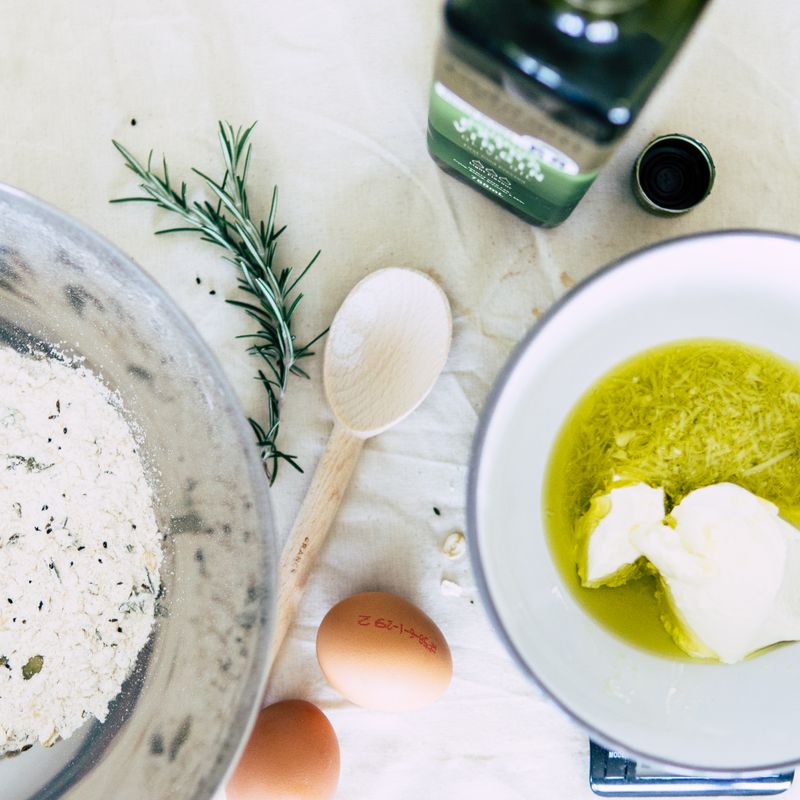
Sourdough Simple Rosemary Olive Oil Crackers
Thin, crispy crackers made from active sourdough discard, perfumed with fresh rosemary and finished with fruity olive oil and coarse salt. These rustic, Mediterranean-inspired crackers require just a handful of ingredients and minimal technique. The sourdough adds subtle tang and a slight puff, while the minimal crumb keeps them snappy and elegant. Perfect as an appetizer, served with dips, or alongside a cheese board.
- Prep
- 20 min
- Cook
- 15 min
- Wait
- 15 min
- Total
- 50 min
- Makes
- Makes about 24–30 crackers
Steps
Before you start
- Have sourdough discard at room temperature, active and bubbly (fed 4–6 hours prior or used overnight)
- Preheat oven to 425°F (220°C)
- Line a baking sheet with parchment paper, or plan to roll dough directly on parchment
Mix dough ingredients
- In a medium bowl, combine the room-temperature sourdough discard, 2 tablespoons olive oil, and 2 tablespoons finely chopped fresh rosemary.
- Stir with a wooden spoon or spatula for about 2 minutes until well blended and the rosemary is evenly distributed throughout.
- The dough will be slightly sticky and wet, like soft clay—there should be no dry streaks and rosemary should be visible throughout the mixture.
- The texture will be too sticky to knead; this is correct.
+ Show details− Hide details
Ready when: Mixture is uniform with no dry streaks; rosemary is evenly dispersed throughout
Tip: Don't overmix; just ensure the rosemary is distributed evenly. Resist the urge to add flour at this stage.
Roll out dough
- Lay a sheet of parchment paper on your counter or directly on your baking sheet.
- Dust the parchment lightly with about 1 tablespoon all-purpose flour.
- Transfer the sourdough mixture onto the floured parchment.
- Using a rolling pin, roll the dough from the center outward to approximately 1/8-inch (3 mm) thickness, working gently and dusting with additional flour as needed to prevent sticking.
- If the dough springs back and resists, let it rest for 1–2 minutes and continue rolling.
- The dough should cover most of the standard baking sheet and be roughly even in thickness.
+ Show details− Hide details
Ready when: Dough is thin and roughly 1/8-inch thick throughout; it covers most of the baking sheet
Tip: Don't worry about perfect edges or uniform shape; rustic, uneven crackers are part of the charm. Resist adding excess flour, which will toughen the crackers.
Cut crackers
- Using a sharp knife or pizza cutter, cut the dough into roughly 2×3-inch (5×8 cm) rectangles, or break it into organic, rustic-shaped pieces—uniformity is not important.
- You should get about 24–30 crackers depending on their size.
- If you rolled the dough on a separate parchment on the counter, transfer the parchment (with cut crackers) to your baking sheet now, spacing crackers slightly apart if they touch.
+ Show details− Hide details
Ready when: All dough is cut into 24–30 pieces and arranged on the baking sheet
Tip: Cut with a sharp, clean knife rather than tearing to keep edges neat. A pizza cutter works especially well for rustic, straight cuts.
Brush and season
- Using a pastry brush, lightly brush the top surface of each cracker with the remaining 1 tablespoon olive oil.
- Sprinkle the coarse sea salt evenly over all the crackers, using about 1/2 teaspoon total, or to taste.
- A light hand is better than heavy—the crackers taste better slightly undersalted than overly salty.
+ Show details− Hide details
Ready when: All crackers are lightly oiled and topped with visible salt crystals
Tip: Go easy on the salt. It's easier to add more at the table than to remove it from the crackers.
Bake until crispyOven 425°F / 220°C
- Place the baking sheet in the preheated 425°F (220°C) oven.
- Bake for 13–15 minutes, until the crackers are golden brown at the edges and lightly golden throughout.
- Halfway through baking (around 6–7 minutes), rotate the baking sheet front-to-back for even browning.
- The crackers should sound crispy and crunchy when tapped with a finger.
- They should be golden-brown, not dark brown.
+ Show details− Hide details
Ready when: Crackers are golden brown at the edges, light golden throughout, and sound crispy when tapped
Tip: Don't let them darken too much; they'll continue to firm and crisp as they cool, so remove them while still slightly soft-looking.
Cool completely
- Remove the baking sheet from the oven and let the crackers cool on the sheet for 5 minutes.
- Then transfer them to a wire cooling rack or clean countertop to cool completely, about 10 more minutes.
- As they cool, they will firm up and become fully crispy.
- Once completely cooled, they should be crunchy throughout and sound crispy when bitten or tapped.
+ Show details− Hide details
Ready when: Completely cooled and fully crispy throughout when bitten or tapped
Tip: Cooling is crucial for crispness. Warm crackers may feel crispy but will soften as they cool. Wait until fully cooled before storing or serving.
Good to know
Tips
- The sourdough discard must be active and bubbly—a fed starter at peak rise (4–6 hours after feeding) is ideal. This gives the crackers subtle tang and helps them puff slightly during baking.
- The dough is deliberately slightly sticky; resist the urge to add excess flour. Dust lightly and work on parchment to ease handling. Over-flouring toughens the crackers.
- Rolling thin and evenly is key to uniform, crispy results—thicker patches will remain chewy. Aim for consistent 1/8-inch thickness throughout.
- Crackers continue to crisp as they cool, so slightly underbaked (golden rather than deep brown) is better than overdone. Patience during cooling is essential; warm crackers feel crispy but soften as they cool.
Make ahead
You can prepare the rolled, cut, and oiled crackers up to 4 hours ahead; cover loosely with plastic wrap and set aside at room temperature, then bake when ready. Alternatively, make the dough up to 12 hours ahead, refrigerate covered, bring to room temperature, and proceed with rolling and baking.
Storage & reheating
Room temperature: Store in an airtight container for up to 5 days; they will gradually soften slightly but remain mostly crispy. Refrigerator: Not recommended; cold storage accelerates staling. Freezer: Layer crackers between parchment in an airtight freezer-safe container for up to 1 month. Thaw at room temperature for 30 minutes, or warm in a 300°F (150°C) oven for 5–10 minutes to restore crispness. Reheat: Warm in a 350°F (175°C) oven for 5 minutes to restore full crispness.
Substitutions
- Fresh rosemary → Fresh thyme, oregano, or basil. Use the same amount; swap any fresh Mediterranean herb for slightly different flavor profiles. Thyme is particularly lovely in these.
- Coarse sea salt → Fleur de sel or Maldon sea salt. Any coarse salt works; Maldon or fleur de sel yield the most elegant, delicate finish.
- Sourdough discard (fed starter) → Active sourdough starter (fed and bubbly) or whole-wheat sourdough discard. Use the same amount; whole-wheat discard may require slightly more flour for dusting and rolling.
- Extra-virgin olive oil → Avocado oil or light neutral oil. Olive oil provides the best Mediterranean flavor and character, but neutral oils work fine. Avoid heavily flavored oils like nut oils, which overpower these simple crackers.
More finger food
See all →


Find more like this
- Meal
- Snack
- Cuisine
- Mediterranean
- Method
- Oven