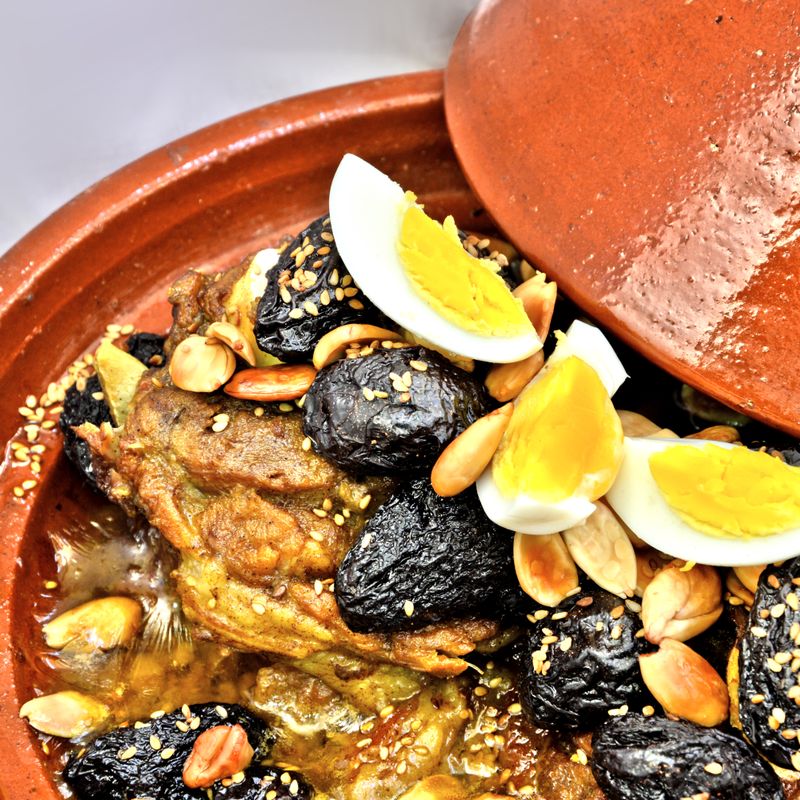
Sourdough Moroccan Tagine Spiced Apricot and Almond Bread
A tender, moist sourdough bread infused with warm tagine spices—cinnamon, ginger, and cumin—studded with plump dried apricots and roasted almonds. The sourdough discard creates a tangy crumb that balances the sweetness of apricots and the earthiness of North African spices. Perfect for breakfast toasted with butter or as an afternoon snack with tea.
- Prep
- 20 min
- Cook
- 50 min
- Wait
- 1 hr 30 min
- Total
- 2 hr 40 min
- Makes
- 1 loaf (10–12 slices)
Steps
Before you start
- Have active, bubbly sourdough discard at room temperature (fed 4–8 hours prior)
- Preheat oven to 350°F (175°C) about 15 minutes before baking
- Line a 9×5-inch (23×13 cm) loaf pan with parchment paper or grease it well
- Toast the sliced almonds in a dry skillet over medium heat for 3–4 minutes, stirring often, until fragrant; set aside to cool
Mix the dry ingredients
- In a large mixing bowl, whisk together the all-purpose flour (190 g), whole wheat flour (60 g), baking powder (7.5 g), baking soda (2.5 g), fine sea salt (3 g), ground cinnamon (3.5 g), ground ginger (1.5 g), ground cumin (1 g), and ground nutmeg (0.5 g).
- Make sure the spices and leavening agents are evenly distributed throughout the flour.
- Set aside.
+ Show details− Hide details
Ready when: Spices are visibly dispersed throughout the flour mixture
Tip: Whisk thoroughly to ensure the baking soda doesn't create ammonia-like pockets; evenly distributed leavening gives an even crumb.
Combine wet ingredients
- In a medium mixing bowl, whisk together the sourdough discard (240 ml), honey (110 g), vegetable oil (45 ml), large eggs (100 g), vanilla extract (5 ml), and almond extract (1.25 ml, if using).
- Whisk until the mixture is smooth, honey is fully incorporated, and no streaks of egg white remain.
- The mixture should be pourable and pale.
+ Show details− Hide details
Ready when: No streaks of egg or honey visible; mixture is homogeneous
Tip: Room-temperature eggs incorporate more smoothly and help create a tender crumb; cold eggs can create lumps.
Combine wet and dry
- Pour the wet ingredient mixture into the bowl with the dry ingredients.
- Using a wooden spoon or silicone spatula, stir gently until just combined.
- The batter should be thick, slightly shaggy, with no flour streaks visible.
- Do not overmix—lumpy batter will yield a tender crumb; overmixed batter becomes dense.
+ Show details− Hide details
Ready when: No visible streaks of flour; batter appears thick and slightly lumpy
Tip: Gently fold rather than stir to avoid gluten development, which makes the bread tough. A few small lumps are fine.
Fold in apricots and almonds
- Gently fold the chopped dried apricots (160 g) and toasted almonds (90 g) into the batter using 8–10 slow, deliberate strokes with a spatula.
- The apricots and almonds should be evenly distributed, but do not overmix the batter.
+ Show details− Hide details
Ready when: Apricots and almonds visible throughout; no streaks of dry flour remain
Tip: Add fruit near the end to prevent overmixing the base batter, which toughens the bread.
Transfer to loaf pan
- Pour the batter into the prepared 9×5-inch (23×13 cm) loaf pan, using a spatula to smooth the top level.
- Tap the pan gently on the counter 3–4 times to release any large air pockets.
- The batter should fill the pan about three-quarters full.
+ Show details− Hide details
Ready when: Batter is level and fills the pan three-quarters full
Tip: Parchment paper makes removal easier and prevents sticking without affecting texture.
First rise
- Let the batter sit at room temperature for 30 minutes.
- This short rise allows the baking powder and baking soda to begin activating, and the sourdough discard to mellow the batter.
- You'll notice the surface become slightly puffy and may see small bubbles forming.
+ Show details− Hide details
Ready when: Surface appears slightly domed and puffy
Tip: This rest develops better flavor and texture; don't skip it. A warm kitchen will speed the rise slightly.
Preheat ovenOven 350°F / 175°C
- During the final 10 minutes of the rest, preheat your oven to 350°F (175°C).
- Position the rack in the center of the oven.
- This moderate temperature allows the inside to bake through before the outside over-browns.
+ Show details− Hide details
Ready when: Oven reaches 350°F (175°C)
Tip: Use an oven thermometer to verify temperature; home ovens often run hot or cool.
Bake the breadOven 350°F / 175°C
- Place the loaf pan in the preheated 350°F (175°C) oven on the center rack.
- Bake for 48–52 minutes.
- The bread is done when a golden-brown crust has formed, a wooden skewer or toothpick inserted into the center comes out clean or with just one or two moist crumbs (not wet batter), and the internal temperature reaches 205°F (96°C).
- If the top begins to brown too quickly after 35 minutes, loosely tent with aluminum foil.
+ Show details− Hide details
Ready when: Golden-brown crust; skewer comes out clean; internal temp reaches 205°F (96°C)
Tip: Tenting with foil prevents the top from over-browning while the inside finishes. Start checking at 45 minutes.
Cool in pan
- Remove the loaf from the oven and let it cool in the pan for 15 minutes.
- You'll hear it settle and crackle slightly as it cools.
- This resting period allows the crumb to set and prevents the bread from being too moist when sliced.
+ Show details− Hide details
Ready when: Bread has pulled slightly away from the pan sides; it is cool enough to handle
Tip: Don't unmold too early or the bread may fall apart; the crumb needs time to firm up.
Turn out and cool completely
- Turn the loaf out onto a wire rack or clean kitchen towel by inverting the pan.
- If using parchment paper, gently peel it away.
- Let the bread cool completely to room temperature, about 45 minutes.
- During this time, moisture will redistribute throughout the loaf, improving the texture and flavor.
+ Show details− Hide details
Ready when: Loaf is cool to the touch and no longer steaming
Tip: Slicing warm bread will compress the crumb and cause it to tear. Cool completely for clean slices and best flavor.
Slice and serve
- Using a serrated bread knife, slice the cooled loaf into ½-inch (1.25 cm) thick slices.
- Serve at room temperature, or toast slices and top with butter, jam, or cream cheese.
- The bread's tangy sourdough notes balance beautifully with the warm spices and sweet apricots.
+ Show details− Hide details
Ready when: Slices are clean and even
Tip: A serrated knife with a gentle sawing motion prevents squashing the soft crumb. Store unused slices wrapped or in an airtight container.
Optional: Toast for servingOven 350°F / 175°C
- For a warm, crispy exterior and soft, warm interior, toast whole slices or halves in a toaster oven at 350°F (175°C) for 4–5 minutes, or in a regular toaster on a medium-high setting until golden.
- Serve immediately with butter, honey, or ricotta if desired.
+ Show details− Hide details
Ready when: Toast is light golden and aromatic
Good to know
Tips
- Sourdough discard must be freshly fed and bubbly for best rise and tang. If your discard seems sluggish, feed it again and wait 4–6 hours before using.
- Toast the almonds just before baking to maximize their fragrance and nuttiness. Raw almonds can taste slightly bitter and add moisture; toasting drives off volatile compounds that improve flavor.
- Warm spices lose potency over time. If your cinnamon, ginger, or cumin are older than 6 months, increase quantities slightly (add 25% more) to achieve the intended Moroccan warmth.
- This bread pairs beautifully with strong teas—mint tea, black tea, or herbal blends—and with savory accompaniments like sheep's cheese or dukkah-spiced labneh for a North African-inspired breakfast.
Make ahead
The batter can be prepared through step 4 (after folding in apricots and almonds) and refrigerated in the loaf pan for up to 12 hours. Before baking, let it sit at room temperature for 45 minutes to 1 hour (it will rise less than fresh batter), then proceed with baking. Alternatively, bake the bread fully and freeze it, wrapped well, for up to 3 months; thaw at room temperature for 2–3 hours before serving.
Storage & reheating
Room temperature: Store the completely cooled loaf wrapped in parchment and placed in an airtight container or zip-top bag for up to 3 days. Refrigerator: Keep wrapped for up to 5 days; the bread will firm up slightly. Freezer: Wrap in plastic wrap and then foil, or place in a freezer bag, for up to 3 months. To reheat from frozen, thaw at room temperature for 2–3 hours, then toast slices or warm in a 300°F (150°C) oven for 10 minutes. To refresh day-old slices, toast them or wrap the loaf in foil and warm in a 325°F (163°C) oven for 10 minutes to restore softness.
Substitutions
- dried apricots, soft and plump → dried figs, dried dates, or dried cherries, chopped to a similar size. Figs and dates will add more subtle sweetness; cherries add tartness. Adjust honey by ¼ tablespoon if using very sweet fruit.
- raw sliced almonds → toasted pistachios, walnuts, or pumpkin seeds (pepitas), roughly chopped. Pistachios add color and a subtle earthiness; walnuts bring deeper flavor; seeds add texture. Toast in the same manner as almonds.
- ground cinnamon → use ½ tsp ground cassia cinnamon if true cinnamon is not available. Cassia is sharper; use less to avoid overpowering the other spices.
- honey → maple syrup or agave nectar in a 1:1 ratio. Maple adds earthiness; agave is more neutral. Slight texture changes may occur, but crumb structure remains tender.
More quick breads
See all →



Find more like this
- Meal
- Breakfast
- Cuisine
- Moroccan
- Method
- Oven
- Quick & Easy
- Make Ahead