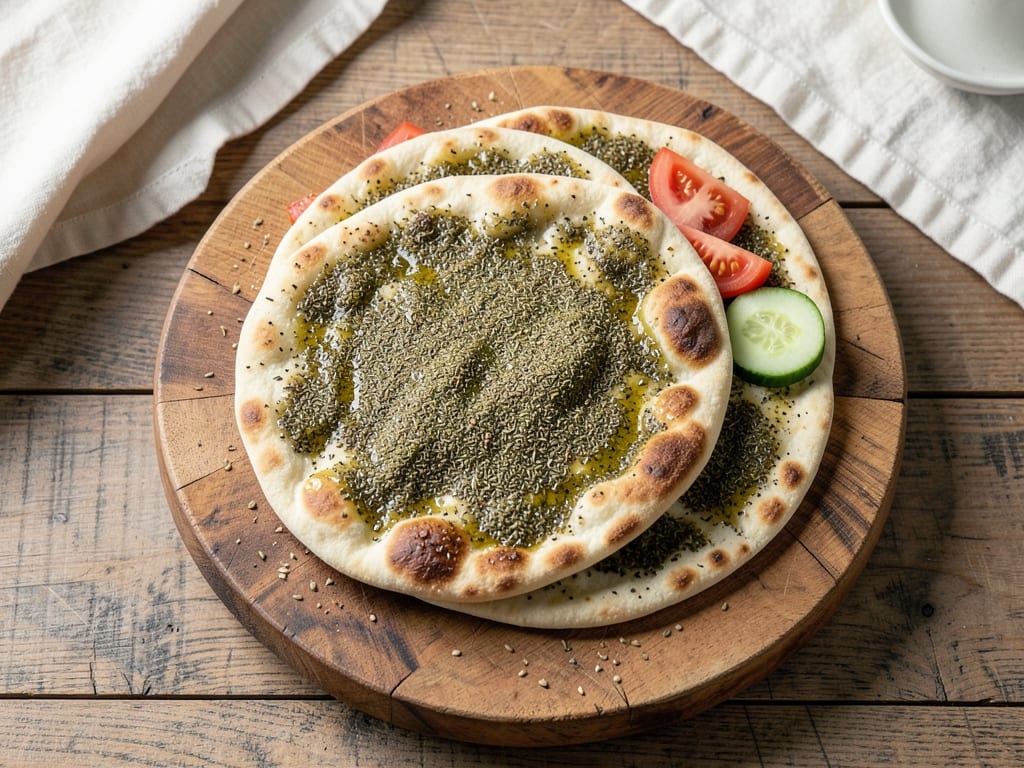
Sourdough Manakish with Za'atar
Soft, chewy, lightly tangy sourdough flatbreads dimpled and slathered with a fragrant za'atar and olive oil paste, then baked hot until the edges blister and the herbs smell toasty. Serve warm for breakfast with tomato, cucumber and mint.
- Prep
- 45 min
- Cook
- 20 min
- Wait
- 5 hr 35 min
- Total
- 6 hr 40 min
- Makes
- 8 manakish (6-inch / 15 cm rounds)
Steps
Before you start
- Feed your starter 4 to 8 hours ahead so it is bubbly, domed and has doubled. It should float when a spoonful is dropped in water.
- Plan on about 6½ hours from start to table, most of it hands-off fermentation. Bulk fermentation times assume a kitchen around 75°F (24°C); it takes longer in a cooler room.
- Place a baking steel, pizza stone, or an upside-down heavy baking sheet on the oven's middle rack and start preheating 45 minutes before baking.
- Use a za'atar blend you like the smell of. Blends with sumac and sesame are the most traditional; if yours is very salty, taste before using.
Mix the shaggy dough
- In a large bowl, whisk the water, starter, yogurt and sugar until the starter is mostly dissolved and the mixture looks milky.
- Add the bread flour and stir with a spatula, then squeeze with wet hands until no dry flour remains.
- Do not add the salt or oil yet.
- Cover the bowl with a damp towel.
+ Show details− Hide details
Ready when: Dough looks rough and sticky with no dry patches of flour
Tip: Mixing the salt in later makes the dough easier to work and helps the starter get going.
Knead in salt and oil
- Sprinkle the salt over the dough and pour in the 2 tbsp (30 ml) olive oil.
- Squeeze and fold the dough in the bowl for 2 minutes to incorporate, then turn it onto an unfloured counter and knead for 5 to 6 minutes, pushing, folding and turning.
- Add only a teaspoon of water if it feels stiff, or a light dusting of flour if it sticks badly.
+ Show details− Hide details
Ready when: Dough is smooth, soft and slightly tacky, and springs back slowly when poked
Bulk ferment with folds
- Return the dough to the bowl, cover, and leave at about 75°F (24°C).
- At 30 minutes and again at 60 minutes, wet your hand, grab the edge of the dough, stretch it up and fold it over the center; rotate the bowl a quarter turn and repeat 4 times each set.
- Then leave it undisturbed.
+ Show details− Hide details
Ready when: Dough has risen by about 75%, has a domed top, visible bubbles at the edges, and jiggles when the bowl is shaken
Tip: In a cool kitchen this can take up to 6 hours. Judge by the dough, not the clock.
Divide and restOven 475°F / 245°C
- Turn the dough onto a lightly floured counter and cut it into 8 pieces of about 125 g each.
- Shape each into a tight ball by cupping your hand over it and dragging it in small circles on the counter.
- Place the balls 2 inches (5 cm) apart on a lightly floured tray, cover with a damp towel, and rest.
- Put your baking steel, stone or upside-down baking sheet in the oven and preheat to 475°F (245°C) now, letting it heat for at least 30 minutes.
+ Show details− Hide details
Ready when: Balls are puffy and relaxed and hold a fingertip dent for a moment before slowly filling
Tip: A properly preheated baking surface gives the bottom a good crust and the edges a good puff.
Make the za'atar paste
- In a small bowl, stir together the za'atar and 6 tbsp (90 ml) olive oil until it forms a loose, spreadable paste, like wet sand.
- Let it sit while you shape the dough so the herbs soften.
+ Show details− Hide details
Ready when: Paste is glossy and spoonable, not dry or soupy
Tip: Stir again right before using, because the herbs settle and the oil rises to the top.
Shape, dimple and top
- Work in two batches of 4.
- On a lightly floured counter, roll or pat each ball into a 6-inch (15 cm) round about ¼ inch (6 mm) thick.
- Place on parchment.
- Press your fingertips firmly all over the surface to dimple it, leaving a ½-inch (1 cm) border.
- Stir the paste and spread about 1 heaping tablespoon (17 g) over each round up to the border.
+ Show details− Hide details
Ready when: Each round is evenly dimpled and covered with a thin, even layer of paste with a clean border
Tip: Keep the second batch covered with the damp towel so it doesn't dry out while the first bakes.
Bake the first batchOven 475°F / 245°C
- Slide the parchment with 4 topped rounds onto the hot steel, stone or sheet.
- Bake at 475°F (245°C) for 8 to 10 minutes.
- Remove with the peel or a sheet pan and brush the edges lightly with some of the finishing oil.
+ Show details− Hide details
Ready when: Edges are puffed and golden brown with darker blisters, the bottom is browned and the za'atar smells toasty
Tip: If the za'atar starts to smell scorched or turn dark before the dough is golden, move the tray down one rack.
Bake the second batchOven 475°F / 245°C
- While the first batch cools slightly, roll, dimple and top the remaining 4 balls if you haven't already.
- Bake as before at 475°F (245°C) for 8 to 10 minutes, then brush the edges with the remaining finishing oil.
+ Show details− Hide details
Ready when: Same as the first batch: golden, blistered edges and a browned underside
Cool and serve
- Let the manakish cool on a rack for 5 minutes so the topping settles.
- Serve warm, whole or folded in half, with the tomato wedges, cucumber rounds and mint leaves alongside.
+ Show details− Hide details
Ready when: Bread is warm, not scalding, and the topping no longer looks wet
Tip: Fold a manousheh around a few mint leaves and tomato for the classic way to eat it.
Good to know
Tips
- Weigh the ingredients, particularly the flour and water, for consistent dough.
- Dimple the dough firmly. If you skip this, the oil runs off and the center puffs up like a pita.
- Do not overload the topping. A thin layer toasts evenly; a thick layer turns bitter and can burn.
- For a cheese version, sprinkle shredded Akkawi or mozzarella over some rounds instead of za'atar and bake the same way.
Make ahead
Make the dough through step 3 and refrigerate it covered for 8 to 18 hours after the second fold; the cold slows fermentation. Let it sit at room temperature for 45 minutes, then divide, rest 30 minutes, and continue from step 4. You can also bake the manakish fully, cool, and reheat later.
Storage & reheating
Room temperature: 1 day in a covered container or wrapped in a towel. Fridge: up to 4 days in an airtight container. Freezer: up to 2 months, layered with parchment in a freezer bag. Reheat in a 350°F (175°C) oven for 5 to 7 minutes (10 from frozen) until warm and the edges are slightly crisp.
Substitutions
- bread flour → all-purpose flour. Gives a slightly softer, less chewy bread; reduce the water by 1 to 2 tbsp (15–30 ml) if the dough feels very wet.
- plain whole-milk yogurt → additional water plus 1 tbsp more olive oil. Use 60 ml water and 1 extra tbsp olive oil; the crumb will be slightly less tender.
- za'atar blend → 2 tbsp dried thyme, 2 tbsp toasted sesame seeds and 2 tbsp ground sumac, with a pinch of salt. Homemade stand-in makes about 6 tbsp; adjust the salt to taste.
- fresh mint leaves → fresh flat-leaf parsley or arugula. Adds a similar fresh, green contrast.
More manakish
See all →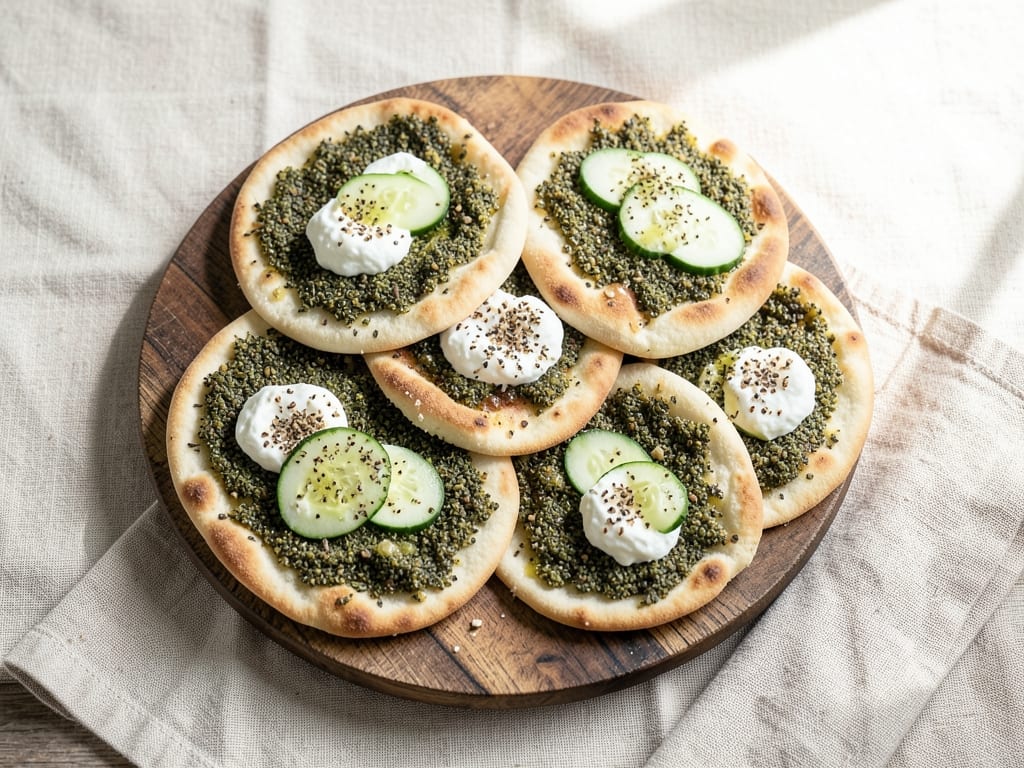
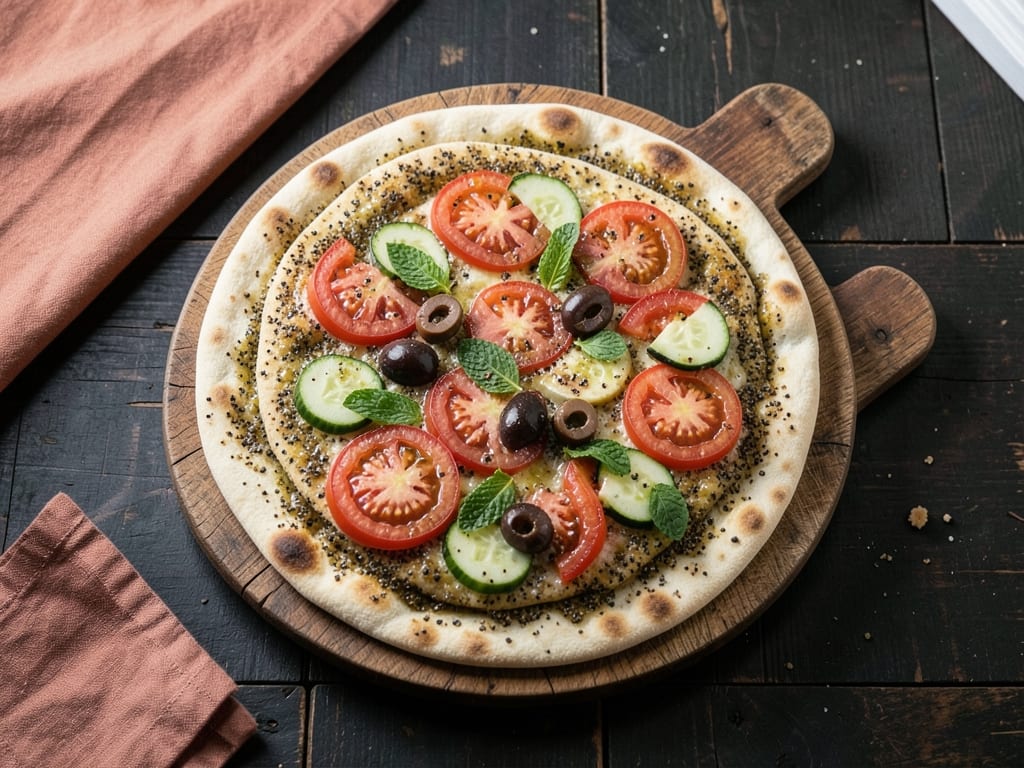
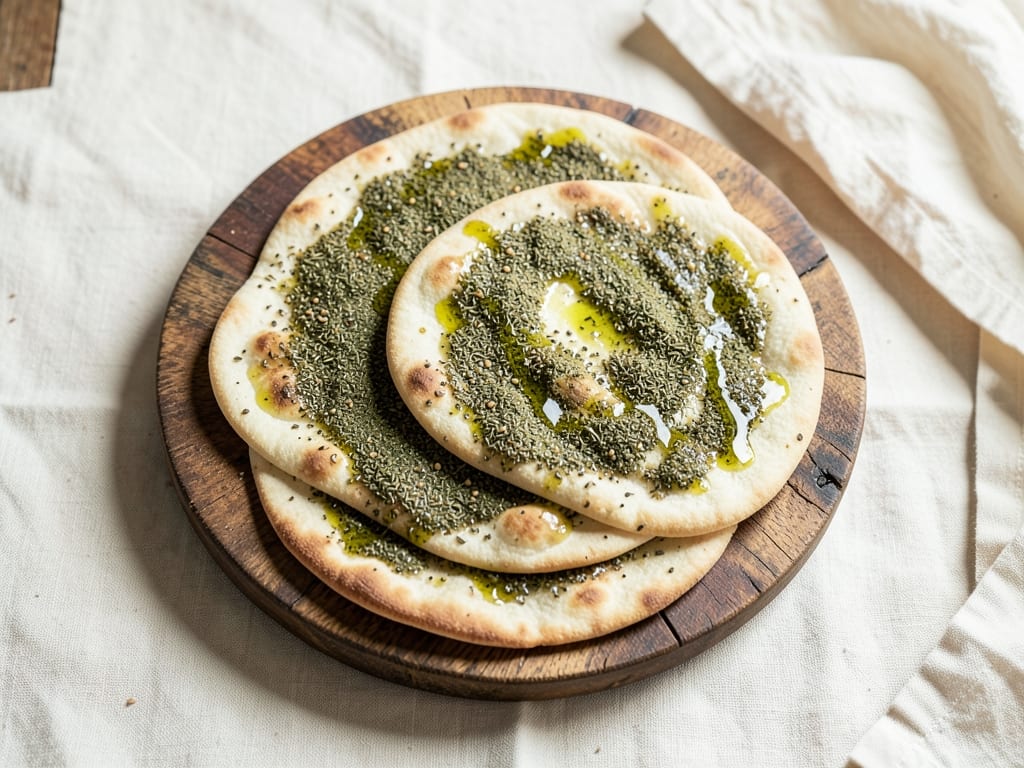
Find more like this
- Meal
- Breakfast
- Cuisine
- Lebanese
- Diet
- VegetarianHalal
- Method
- Oven
- Quick & Easy
- Freezer Friendly