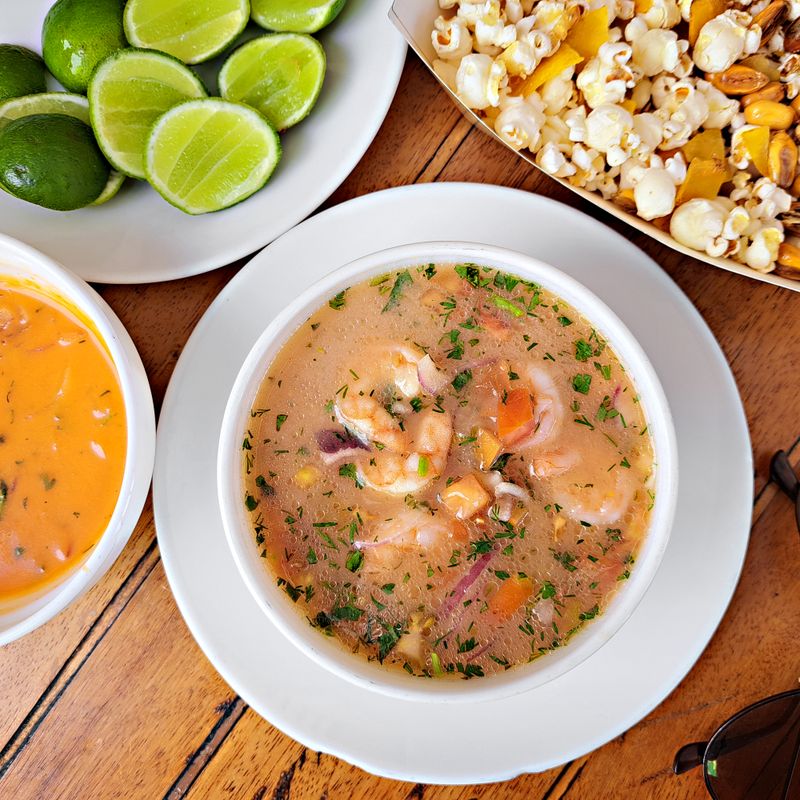
Sourdough Ecuadorian Ceviche-Inspired Seafood and Lime Crackers
Crispy, thin sourdough crackers infused with dried shrimp, lime zest, cilantro, and warm cumin spice. These savory crackers capture the bright, briny essence of Ecuadorian ceviche in an unexpected, crunchy form. Perfect for snacking or serving alongside soups and ceviches. The tangy sourdough base complements the seafood flavors, while the natural fermentation adds depth and digestibility.
- Prep
- 25 min
- Cook
- 35 min
- Wait
- 8 hr
- Total
- 9 hr
- Makes
- 48 crackers (about 8 oz / 225 g)
Steps
Before you start
- Ensure your sourdough starter is active and bubbly (fed 4–8 hours prior)
- If using whole dried shrimp, pulse them into small fragments in a food processor
- Line two baking sheets with parchment paper
- Preheat oven to 375°F (190°C) about 20 minutes before baking
Mix dough and rest
- In the bowl of a stand mixer (or a medium mixing bowl), combine the active sourdough starter (1 cup / 240 ml), bread flour (1.5 cups / 180 g), and fine sea salt (¾ teaspoon / 4 g).
- If using a stand mixer, attach the dough hook and mix on medium speed for 8–10 minutes until the dough comes together into a smooth, elastic mass.
- If mixing by hand, stir vigorously with a wooden spoon for 12–15 minutes until the dough is cohesive and slightly tacky.
- Cover the bowl with a damp kitchen towel and let rest at room temperature for 8 hours or overnight.
- The dough will rise slightly and develop a subtle fermented aroma.
+ Show details− Hide details
Ready when: Dough is slightly risen and smells pleasantly sour
Tip: This long, cool fermentation without added yeast relies on the starter's natural culture and develops complex flavor without over-rising.
Add seafood and spices
- Transfer the fermented dough to a clean work surface.
- Sprinkle the dried shrimp (½ cup / 55 g), lime zest (2 tablespoons / 12 g), fresh cilantro (¼ cup / 15 g), ground cumin (¾ teaspoon / 1.5 g), and black pepper (¼ teaspoon / 0.5 g) over the dough.
- Gently knead by hand for 3–4 minutes, folding the dough over itself repeatedly to distribute the ingredients evenly throughout.
- Work carefully so the shrimp fragments stay intact rather than crushing into dust.
- Drizzle the olive oil (2 tablespoons / 30 ml) over the dough and knead for another 1–2 minutes until the oil is fully incorporated and the dough feels silky.
+ Show details− Hide details
Ready when: All ingredients are evenly distributed throughout the dough with no dry patches
Tip: Pat the cilantro leaves dry with a paper towel before chopping—excess moisture can make the dough sticky and the herbs less evenly distributed.
Divide into portions
- Divide the dough into two equal portions (about 6.5 oz / 185 g each).
- Shape each portion into a rough ball and place on a separate piece of parchment paper.
- Cover both loosely with plastic wrap and let rest for 15 minutes at room temperature.
- This brief rest relaxes the gluten, making the dough easier to roll out without snapping back.
+ Show details− Hide details
Ready when: Dough is slightly softer and easier to manipulate
Roll thin and transferOven 375°F / 190°C
- Preheat the oven to 375°F (190°C).
- Working with one dough portion at a time, place it on a lightly floured work surface.
- Using a rolling pin, roll the dough into a thin sheet approximately ⅛ inch (3 mm) thick and roughly 12×10 inches (30×25 cm).
- The dough should be thin enough to be almost translucent in places.
- Carefully transfer the rolled dough onto the parchment-lined baking sheet, patching any tears with a small piece of dough from the edge.
- Repeat with the second dough portion, placing it on the second baking sheet.
+ Show details− Hide details
Ready when: Dough is uniformly thin and translucent, roughly the size of a standard baking sheet
Tip: If the dough springs back and won't roll thin easily, let it rest under a towel for 5 minutes and try again. Rolling between two sheets of parchment can reduce sticking and make transfer easier.
Score and season
- Using a dough scraper or bench knife, lightly score each sheet of dough into 24 roughly equal rectangles (about 2×2.5 inches / 5×6.5 cm), cutting most of the way through but not severing the dough completely—this allows crackers to break apart cleanly after baking.
- Lightly brush or spray the top of each sheet with a thin coating of olive oil (about 1 teaspoon per sheet).
- If desired, sprinkle a light layer of fleur de sel or coarse sea salt over the top.
+ Show details− Hide details
Ready when: Surface is scored into sections and lightly moistened with oil
Tip: Don't oversaturate with oil—too much will make the crackers greasy rather than crisp. A light mist from a spray bottle gives the most even coating.
Bake until goldenOven 375°F / 190°C
- Place both baking sheets into the preheated 375°F (190°C) oven on the upper and middle racks.
- Bake for 20–25 minutes, rotating the sheets front-to-back and swapping rack positions halfway through (around the 12-minute mark) to ensure even browning.
- The crackers are done when the edges begin to turn deep golden brown and the surface has lost its damp appearance.
- The thinner sections should be crispy, and the thicker sections should feel firm when pressed.
+ Show details− Hide details
Ready when: Edges are deep golden brown, surface is dry, and crackers feel firm when pressed
Tip: If one sheet is browning faster than the other, tent it loosely with foil to slow browning. Watch closely in the final 5 minutes—they can go from golden to burnt quickly.
Cool and break apartOven 375°F / 190°C
- Remove the baking sheets from the oven and let the crackers cool on the sheets for 5 minutes.
- While still slightly warm, break the dough along the scored lines into individual crackers, using a dough scraper or your hands to separate them cleanly.
- If the dough has cooled too much and won't break easily, return the sheet to the 375°F (190°C) oven for 2 minutes to warm it slightly.
- Transfer the broken crackers to a wire cooling rack and let them cool completely to room temperature, about 15–20 minutes.
- As they cool, they will continue to crisp up.
+ Show details− Hide details
Ready when: Crackers are cool to the touch and snap cleanly when bent
Tip: Breaking the crackers while warm keeps the scored lines clean and prevents cracking unevenly. If they cool before you can break them, a brief warm-up works perfectly.
Good to know
Tips
- Active sourdough starter is crucial—it should be fed 4–8 hours before mixing and be bubbly and at peak rise. An inactive starter will not provide enough fermentation to flavor the dough properly.
- Dried shrimp can be found in Asian grocery stores and many online specialty retailers. Look for ones labeled 'dried sea shrimp' or 'dried prawns.' Avoid those that are overly salty or have an off smell.
- The scoring step makes all the difference: pre-scoring the dough while raw allows crackers to separate cleanly and bake with uniform thickness, rather than breaking jaggedly after baking.
- These crackers pair beautifully with classic Ecuadorian ceviche, hot seafood stews (encebollado), or simply served as a savory snack with drinks. They also complement fresh guacamole or spicy salsas.
Make ahead
Yes. The dough can be prepared through Step 1 up to 2 days ahead: after the 8-hour fermentation, cover and refrigerate. The cold fermentation will deepen the flavor. Remove the dough from the fridge 30 minutes before proceeding with Step 2. Baked, fully cooled crackers can be made 3–4 days ahead and stored in an airtight container at room temperature.
Storage & reheating
Room temperature: Store in an airtight container for up to 4 days. The crackers will gradually lose crispness over time. To restore crispness, spread on a baking sheet and warm in a 300°F (150°C) oven for 5 minutes. Freezer: Place cooled crackers in a freezer-safe airtight container or bag for up to 2 months. Thaw at room temperature for 10 minutes before serving, or warm in a 300°F oven for 3 minutes to restore crispness.
Substitutions
- dried shrimp, finely chopped or pulsed → Finely minced salt-cured anchovies (use 3 tablespoons / 30 g). Anchovies deliver a more assertive brininess. Rinse and pat dry before mincing to control saltiness, and reduce the added salt by ⅛ teaspoon (0.6 g).
- fresh cilantro, finely chopped → Fresh flat-leaf parsley (use 3 tablespoons / 12 g) mixed with 1 tablespoon (3 g) finely chopped fresh mint. Parsley and mint offer freshness without cilantro's polarizing flavor. Mint adds a subtle cooling note that complements the lime.
- ground cumin → Ground coriander (use ½ teaspoon / 1 g) or a mix of cumin (½ teaspoon) and ground turmeric (¼ teaspoon / 0.3 g). Coriander is brighter and more floral; turmeric adds earthiness and a gentle golden hue.
- lime zest, finely grated → Fresh lemon zest (use the same amount, 2 tablespoons / 12 g) plus ¼ teaspoon (0.5 g) of finely grated ginger. Lemon zest is less aromatic than lime; the ginger adds warmth and a hint of spice reminiscent of traditional ceviche marinades.
More party snacks
See all →

Find more like this
- Meal
- Snack
- Main ingredient
- Shrimp
- Method
- Oven
- Quick & Easy
- Make Ahead