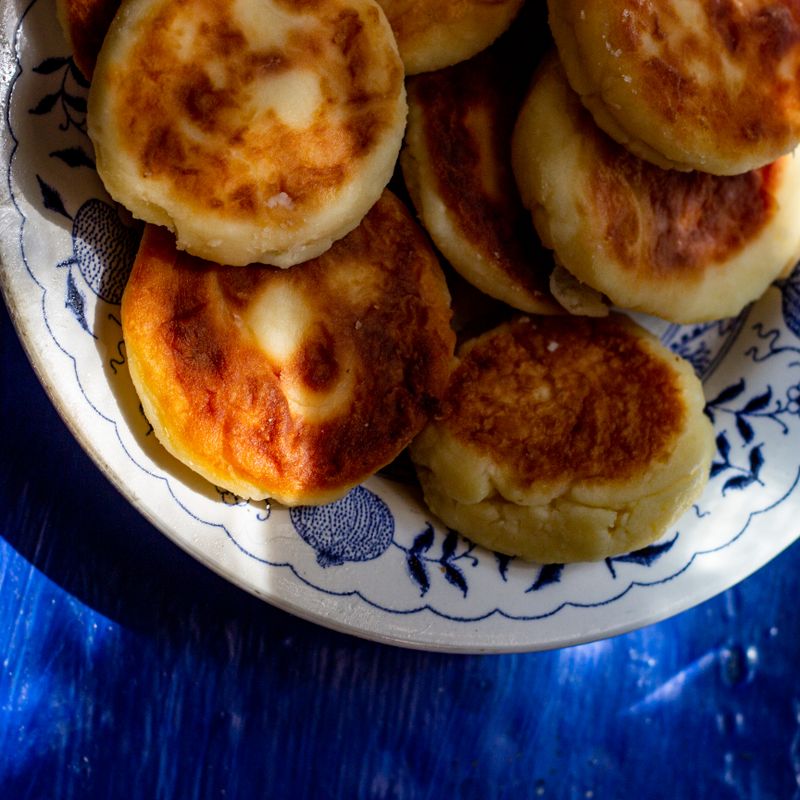
Sourdough Discard Cottage Cheese Pancakes
These fluffy pancakes combine tangy sourdough discard with protein-rich cottage cheese, creating a tender crumb and subtle sour flavor that deepens with a longer rest. They're quick to make, use common pantry staples, and are a perfect way to use sourdough starter discard. Great for breakfast or brunch, and easily made ahead.
- Prep
- 8 min
- Cook
- 12 min
- Wait
- 5 min
- Total
- 25 min
- Makes
- 12–14 pancakes (serves 4)
Steps
Before you start
- Have sourdough discard active and bubbly at room temperature (fed 4–8 hours before if needed).
- Bring eggs and sourdough discard to room temperature for even mixing and better rise.
- Gather butter, spatula, and toppings (maple syrup, berries, yogurt, etc.) before you start cooking.
- Read through the cooking step so you know when to flip.
Blend cottage cheese until smooth
- If your cottage cheese is chunky, blend it in a blender until mostly smooth with minimal visible curds, or mash it finely with a fork.
- This helps distribute it evenly through the batter and creates a more tender crumb.
- Transfer to a bowl and set aside.
+ Show details− Hide details
Ready when: Cottage cheese is mostly smooth with minimal visible curds
Tip: Blending the cottage cheese ensures even distribution and a tender crumb; chunky pieces can create large holes in the pancakes
Whisk flour, sugar, and leavening
- In a medium bowl, whisk together the all-purpose flour, granulated sugar, baking powder, and fine sea salt.
- Stir until combined and no lumps remain.
- Set aside.
+ Show details− Hide details
Ready when: Mixture is uniform; no visible lumps of baking powder or salt
Whisk sourdough, cottage cheese, and eggs
- In a large bowl, whisk together the sourdough discard (active at room temperature), blended cottage cheese, large eggs, melted unsalted butter, and pure vanilla extract.
- Whisk until well combined and smooth.
- The mixture will be slightly lumpy from the cottage cheese, which is fine.
+ Show details− Hide details
Ready when: Wet ingredients are combined and smooth, with only small cottage cheese pieces visible
Tip: Don't overmix at this stage; small lumps are fine and will cook out as the pancakes bake
Combine wet and dry ingredients
- Add the flour mixture to the wet mixture and stir gently with a spatula or wooden spoon until just combined.
- Stop as soon as you don't see dry flour streaks; the batter will be thick and slightly lumpy, which is correct.
- Do not overmix.
- If the batter is too thick to pour (thicker than cake batter), add whole milk or water 1 tablespoon at a time until you reach a thick but pourable consistency.
+ Show details− Hide details
Ready when: Batter is thick but pourable; visible flour streaks are acceptable
Tip: Overmixing develops gluten and creates tough pancakes; stop stirring as soon as flour is incorporated
Let batter rest and thicken
- Let the batter rest at room temperature for 5 minutes without stirring.
- The batter will thicken slightly as the flour hydrates.
- This short rest improves the texture and fluffiness of the pancakes.
+ Show details− Hide details
Ready when: Batter is noticeably thicker but still pourable
Tip: This rest is quick but important; it improves texture without overactivating the sourdough tang
Preheat griddle to medium heatOven 350°F / 175°C
- While the batter rests, heat a 12-inch (30 cm) griddle or large skillet over medium heat until the surface temperature reaches about 350°F (175°C).
- You can test this by sprinkling a few drops of water on the surface—they should sizzle gently and evaporate completely in 2–3 seconds.
- Lightly butter the hot griddle (about ½ tablespoon / 8 g).
+ Show details− Hide details
Ready when: Water droplets sizzle and evaporate in 2–3 seconds; griddle is evenly heated
Tip: A griddle that's too hot will scorch the outside of the pancake before the inside cooks; too cool and they'll be pale and dense
Pour, cook, flip, and repeat
- Working in batches, pour about ¼ cup (60 ml) of batter onto the hot griddle for each pancake, cooking 3–4 pancakes at a time with space between them.
- Do not move them.
- Cook for 2–3 minutes on the first side.
- You'll see tiny bubbles forming on the top surface, and the edges will look set and light brown.
- Using a spatula, flip each pancake carefully and cook for 1–2 minutes on the second side until the bottom is golden brown.
- The second side cooks faster, so watch carefully.
- Transfer finished pancakes to a warm plate and cover loosely with foil to keep warm.
- Lightly butter the griddle again between batches (it dries out), and repeat until all batter is cooked.
+ Show details− Hide details
Ready when: First side: tiny bubbles cover the top and edges look set and light brown. Second side: bottom is golden brown, pancake is cooked through
Tip: Resist flipping too early; wait until the top is covered with broken bubbles and looks mostly set. If the second side burns quickly, lower the heat slightly for the next batch
Serve pancakes warm
- Serve the warm pancakes immediately while they're still fluffy.
- Top with your favorite toppings such as maple syrup, fresh berries, a dollop of Greek yogurt, or a pat of butter.
Good to know
Tips
- Make sure your sourdough discard is active and bubbly (recently fed, with a fresh fermented aroma) for the best rise and tang. Sluggish or unfed discard will result in denser, less flavorful pancakes.
- Don't skip blending or mashing the cottage cheese; this ensures it distributes evenly and prevents large pockets from forming in the pancakes.
- These pancakes have a subtle sourdough tang. For more sourness, let the batter rest for 15–20 minutes before cooking. For less tang, cook immediately after combining the wet and dry ingredients.
- Cottage cheese adds protein and moisture, making these pancakes remarkably tender and helping them stay moist even after cooling.
Make ahead
Prepare the batter up to 4 hours ahead and refrigerate in a covered container. If refrigerated, let the batter come to room temperature for 10 minutes before cooking, as cold batter may not cook evenly. Cooked pancakes can be frozen for up to 3 months and reheated in a 350°F (175°C) oven for 7–10 minutes or in a toaster.
Storage & reheating
Room temperature: Cooked pancakes keep covered on the countertop for up to 2 hours. Refrigerator: Store cooked pancakes in an airtight container for up to 3 days; reheat in a toaster, toaster oven at 350°F (175°C) for 5 minutes, or microwave for 20–30 seconds per pancake. Freezer: Freeze cooled pancakes in a single layer on a baking sheet, then transfer to a freezer bag for up to 3 months; reheat in a toaster (high setting) or oven at 350°F (175°C) for 7–10 minutes.
Substitutions
- sourdough discard (active starter) → buttermilk. Use a 1:1 ratio. You may need to reduce the baking powder to ½ teaspoon since buttermilk is less acidic than sourdough discard.
- full-fat cottage cheese → Greek yogurt or ricotta cheese. Use 1 cup (240 g) Greek yogurt for a lighter, airier texture, or ¾ cup (180 g) ricotta for a similar richness.
- all-purpose flour → whole wheat flour or spelt flour. Use ¾ cup (90 g) for a nuttier, denser pancake. Whole wheat and spelt absorb more liquid, so use slightly less flour.
- granulated sugar → honey or maple syrup. Use 1½ tablespoons (20 g) honey or maple syrup. Reduce milk slightly (by 1 tablespoon) if the batter is too thin.
More pancakes & waffles
See all →


Find more like this
- Meal
- Breakfast
- Cuisine
- American
- Diet
- VegetarianHalal
- Method
- Stovetop
- Quick & Easy
- 30-MinuteEasyMake Ahead