
Sourdough Discard Chinese Scallion Pancakes
Crispy, flaky Chinese scallion pancakes made with sourdough discard for extra tang and complexity. These hand-stretched flatbreads are brushed with sesame oil, filled with fresh scallions and salt, then pan-fried until golden and blistered. Serve warm with your favorite dipping sauce or alongside soups and stir-fries.
Steps
Before you start
- Have your sourdough discard at room temperature
- Slice scallions and set aside before mixing dough
- Let finished pancakes rest 10 minutes so the layers set up properly before eating
Mix the dough
- In a large bowl, combine the sourdough discard, warm water, and all-purpose flour.
- Stir until a shaggy dough forms and no dry flour remains.
- Let rest for 5 minutes to allow the flour to fully hydrate.
+ Show details− Hide details
Ready when: No dry flour visible; dough is cohesive
Tip: Don't overmix—you're just bringing it together, not developing gluten yet.
Knead and salt the dough
- Add the kosher salt (for the dough) to the bowl and knead the dough by hand for 8–10 minutes, stretching and folding it back onto itself repeatedly.
- The dough will go from sticky to smooth and slightly elastic.
- It should feel soft but not sticky when you stop.
+ Show details− Hide details
Ready when: Dough is smooth, passes the windowpane test (a small pinch stretches thin without tearing), and springs back slowly when poked
Tip: If the dough is very sticky, lightly wet your hands instead of adding more flour—sourdough discard is wet by nature.
First rise
- Shape the dough into a ball and return it to the bowl.
- Cover loosely with a kitchen towel or plastic wrap.
- Let rise at room temperature for 20 minutes until puffy but not doubled.
+ Show details− Hide details
Ready when: Dough is noticeably puffed and feels airy when poked
Tip: This short rest makes the dough easier to stretch and improves flavor without over-proofing.
Divide dough into quarters
- Turn the dough out onto an unfloured work surface.
- Use a bench scraper or knife to divide it into 4 equal pieces.
- Roll each piece into a tight ball by stretching the edges underneath and towards the center.
- Place seam-side down on the work surface.
+ Show details− Hide details
Ready when: Four smooth, evenly-sized balls; they feel slightly springy when poked
Tip: Tight shaping helps the pancakes develop layers. Work gently so you don't deflate all the air you've built up.
Stretch and oil the first pancake
- Take one dough ball and gently stretch it into an 8-inch (20 cm) round by pressing from the center outward with your fingertips.
- If it resists, let it rest 1–2 minutes and try again.
- Brush the top generously with sesame oil (use about 1.5 teaspoons for the first side).
+ Show details− Hide details
Ready when: Dough is stretched thin enough that you can almost see light through it, but it still holds together
Tip: Don't worry about perfect circles—rustic, uneven shapes are traditional and taste just as good.
Roll and spiral the first pancake
- Starting at the edge closest to you, tightly roll the oiled dough round into a rope.
- Coil this rope into a spiral, tucking the end underneath.
- Gently flatten the coil back into a 4-inch (10 cm) round by pressing with your palm.
- This should take about 2 minutes of gentle pressing.
- The dough will be layered and slightly thick.
+ Show details− Hide details
Ready when: Spiral is tightly coiled and flattened disk is compact with visible layers
Tip: The layers are what create the crispy, flaky texture—don't overwork the flattened disk or you'll lose them.
Fill and fold into quarters
- Brush the top of the flattened spiral with a tiny bit of sesame oil (about 0.25 teaspoon).
- Sprinkle one-quarter of the sliced scallions and one-quarter of the kosher salt filling evenly over the surface.
- Fold the disk in half, then in half again to form a triangle or quadrant.
- Press gently to seal.
+ Show details− Hide details
Ready when: Folds are sealed and scallions and salt are distributed inside
Tip: Don't overfill—the layers need room to steam and crisp without the filling leaking out during cooking.
Final stretch and cook the first pancake
- Gently stretch the triangle or quadrant back out to a 6-inch (15 cm) round by pressing lightly from the center outward.
- Heat a 9-inch (23 cm) cast-iron skillet or nonstick pan over medium-high heat and add 0.5 tablespoon of neutral oil.
- Once the oil shimmers, carefully place the stretched pancake in the pan.
- Cook for 3–4 minutes until the bottom is deep golden brown and blistered in spots.
- Flip, add another 0.5 tablespoon of oil to the pan, and cook the other side for 2–3 minutes until equally golden and crispy.
+ Show details− Hide details
Ready when: Both sides are deep golden brown with blistered spots; the pancake is crispy and sounds hollow when tapped
Tip: Don't move the pancake in the pan until you flip it—let it develop a crust undisturbed. If it browns too fast, lower the heat slightly.
Transfer and finish cooking remaining pancakes
- Transfer the cooked pancake to a wire rack.
- Repeat steps 5–8 with the remaining three dough balls, stretching, filling, and frying each one.
- You'll use about 2 tablespoons of neutral oil total (0.5 tablespoon per pancake on each side).
+ Show details− Hide details
Ready when: All four pancakes are golden, crispy, and blistered on both sides
Tip: Keep the skillet on medium-high; if the pan is too hot, the outside will burn before the inside crisps. Adjust the heat if needed between pancakes.
Rest and serve
- Let the pancakes cool on the wire rack for 10 minutes.
- This allows the steam to escape and the layers to firm up.
- Cut each pancake into wedges or strips.
- Serve warm, garnished with the reserved dark green scallion tops if desired.
+ Show details− Hide details
Ready when: Pancakes are cool enough to handle and no longer steaming
Tip: Eating them right away means maximum crispiness, but they stay delicious warm for up to 2 hours.
Good to know
Tips
- Sourdough discard brings tang and complexity to these pancakes—there's no need to feed or refresh the starter first, use it straight from the fridge if needed (just bring it to room temperature).
- For extra flaky layers, chill the shaped but unfilled spirals in the freezer for 15 minutes before the final stretch and fill. The cold dough creates better steam-separation between layers.
- Serve these with soy sauce mixed with rice vinegar and a touch of sesame oil, or with chili oil for dipping. They also pair wonderfully with egg drop soup or any stir-fry.
- If your sourdough discard is very thick and stiff, add an extra tablespoon of water to the dough. If it's very thin and runny, reduce the water by 1 tablespoon. Discard consistency varies widely, so adjust to get a soft, slightly sticky dough.
Make ahead
Divide the dough into balls, cover, and refrigerate up to 8 hours. Let them come to room temperature for 15 minutes before stretching and frying. You can also prepare the scallions and salt filling ahead and store in an airtight container for up to 1 day.
Storage & reheating
Store cooled pancakes in an airtight container at room temperature for up to 2 days. Reheat in a dry skillet over medium heat for 1–2 minutes per side, or wrap in foil and warm in a 300°F (150°C) oven for 5–7 minutes. Do not freeze—the layers become tough upon thawing.
Substitutions
- toasted sesame oil → infused neutral oil (garlic, chili, or herb-infused oil). You'll lose the toasted sesame aroma but gain other flavor dimensions. Use the same amount.
- scallions (green onions) → Chinese chives (garlic chives), finely chopped. Chinese chives have a subtle garlic flavor and are traditional in some regions. Use the same weight.
- all-purpose flour → bread flour (add 1 teaspoon more water to adjust hydration). Bread flour will give you slightly chewier pancakes with more gluten strength. The dough may require a touch more water.
- neutral oil (vegetable or peanut) → peanut oil. Peanut oil has a higher smoke point and adds a subtle nuttiness. Use the same amount.
More flatbreads
See all →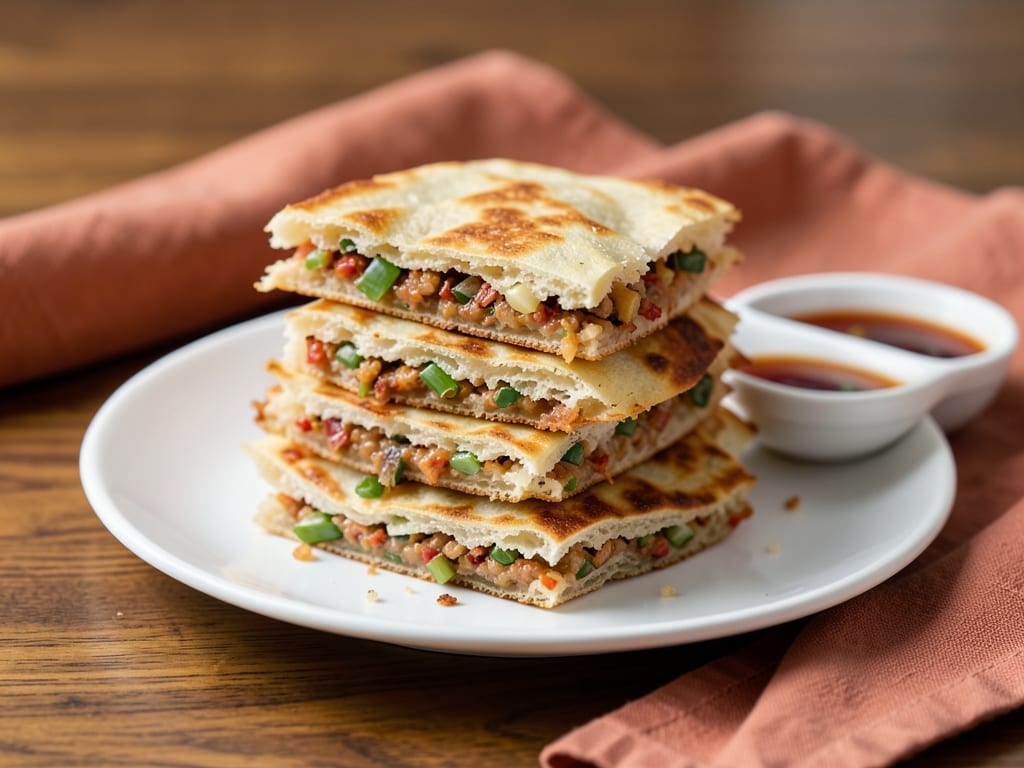
Find more like this
- Meal
- Snack
- Cuisine
- Chinese
- Method
- Stovetop
- Quick & Easy
- 5 Ingredients or Less