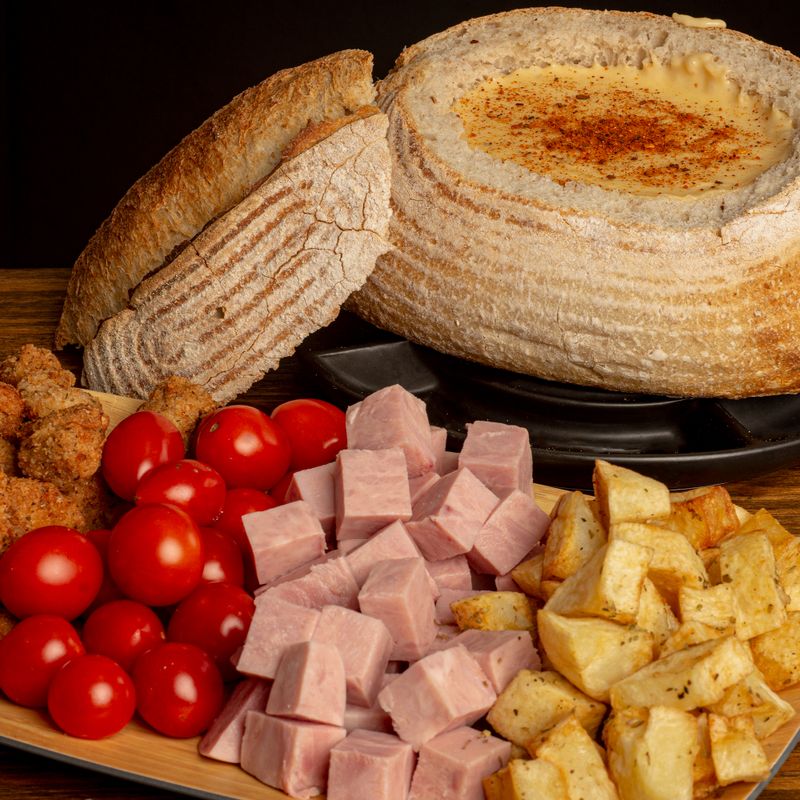
Sourdough Colombian Ajiaco Corn and Potato Bread Bowl
Golden sourdough bread bowls filled with a vibrant Colombian-inspired ajiaco—corn, potatoes, cilantro, and aromatics in a rich chicken broth base. The tangy sourdough pairs beautifully with the warm, comforting soup. Perfect for an impressive yet approachable dinner that doubles as edible tableware.
- Prep
- 30 min
- Cook
- 1 hr 15 min
- Wait
- 7 hr
- Total
- 8 hr 45 min
- Makes
- 4 bread bowls with soup
Steps
Before you start
- Have sourdough starter at full strength (bubbly and active) at least 4 hours before mixing
- Gather all ingredients and measure them—bread dough requires precision
- Set out bowls and a warm spot (70–75°F / 21–24°C) for proofing
- Preheat oven to 450°F (232°C) about 20 minutes before the second bake
Mix sourdough dough
- In a large mixing bowl, combine 150g active sourdough starter, 330g bread flour, and 230ml room-temperature water.
- Stir with a wooden spoon or your hand until all flour is hydrated and no dry bits remain—about 2 minutes.
- Cover the bowl and let rest for 30 minutes at room temperature (autolyse).
- This resting period allows the flour to fully absorb water and develops gluten naturally.
+ Show details− Hide details
Ready when: Dough is shaggy and cohesive
Tip: Don't skip autolyse—it improves extensibility and reduces kneading time.
Add salt and oil, develop dough
- Sprinkle 7g salt and 10ml olive oil over the rested dough.
- Using wet fingers or your hand, pinch and fold the dough onto itself repeatedly for 8–10 minutes, rotating the bowl a quarter turn between folds.
- The dough should become smoother, slightly elastic, and start to hold its shape.
- You're building strength without aggressive kneading.
+ Show details− Hide details
Ready when: Dough is smooth, elastic, and springs back slightly when poked
Tip: Keep your hand wet to prevent sticking. Pinch-and-fold is gentler than kneading and preserves sourdough's open crumb.
Bulk fermentation (stretch and fold)
- Transfer the dough to a lightly oiled bowl.
- Over the next 3 hours, perform four sets of "stretch and fold" at 45-minute intervals.
- For each set: wet your hand, grab the dough from one side, stretch it up and fold it over the center, then rotate the bowl and repeat from the other three sides.
- After four sets (3 hours total), the dough should be puffy, jiggly, and about 50% larger.
- The dough should feel alive and hold a gentle indent when poked.
+ Show details− Hide details
Ready when: Dough has visibly increased in volume (roughly 50% rise), feels airy, and jiggles slightly when the bowl is moved
Tip: Room temperature matters: aim for 70–75°F (21–24°C). Too cool and fermentation stalls; too warm and it over-proofs.
Shape into four rounds
- Lightly flour a clean work surface.
- Turn the dough out and divide it into four equal pieces (roughly 200g each).
- Using a bench scraper, gently pre-shape each piece into a loose round by pulling the edges toward the center and rolling it slightly toward you.
- Rest the rounds seam-side up on a floured surface or in a proofing basket for 20 minutes.
+ Show details− Hide details
Ready when: Rounds are relaxed but still hold their shape; they spring back slowly when poked
Tip: Handle gently—you're not degassing the dough, just organizing it into four pieces.
Final proof in bowls
- Place each pre-shaped round seam-side up in a lightly oiled 6–8 inch oven-safe bowl.
- Cover each bowl loosely with plastic wrap or a towel.
- Proof at room temperature (70–75°F / 21–24°C) for 2–2.5 hours, or until the dough rises above the rim of the bowl and springs back slowly when gently poked.
- The dough should feel airy but still have some tension.
+ Show details− Hide details
Ready when: Dough rises above the bowl rim; a gentle poke leaves a shallow indent that slowly springs back halfway
Tip: If proofing is taking much longer than 2.5 hours, your sourdough starter may not be active enough. The starter should be bubbly and at its peak.
Preheat oven and score doughOven 450°F / 230°C
- Preheat your oven to 450°F (232°C) about 20 minutes before baking.
- Remove the plastic wrap from one of the proofed dough bowls.
- Using a sharp knife or bread lame, score the top of the dough with a single slash about ¼ inch (6 mm) deep and 3–4 inches (7.5–10 cm) long.
- This controls how the bread expands and creates the classic sourdough ear.
+ Show details− Hide details
Ready when: Oven is hot and ready; score is clean and visible
Tip: A confident, quick slash prevents tearing. Hesitant cuts result in ragged openings.
Bake first two bowlsOven 450°F / 230°C
- Place two of the scored dough-filled bowls directly on the middle oven rack (don't remove them from their bowls—they'll bake inside).
- Bake at 450°F (232°C) for 35–40 minutes, until the bread is deep golden brown and sounds hollow when tapped on the bottom.
- The internal temperature should reach 205–210°F (96–99°C) when measured with an instant-read thermometer inserted through the side.
+ Show details− Hide details
Ready when: Bread is deep golden brown, sounds hollow when tapped, and internal temperature reads 205–210°F (96–99°C)
Tip: If browning too quickly, tent loosely with foil after 25 minutes. The bread needs time to cook through.
Cool and bake remaining bowlsOven 450°F / 230°C
- Remove the first two baked bread bowls and place them on a wire rack to cool for 10 minutes.
- Meanwhile, score the remaining two rounds of dough and bake them at 450°F (232°C) for 35–40 minutes, using the same doneness cues.
- Once all four breads are baked and cooling, prepare the ajiaco soup.
+ Show details− Hide details
Ready when: All four breads are golden, hollow-sounding, and at 205–210°F (96–99°C) internally
Tip: Cooling bread on a rack allows steam to escape and prevents a soggy bottom.
Prepare the ajiaco base
- While the bread bakes, heat the chicken broth in a medium saucepan over medium-high heat.
- Once simmering, add the diced onion and garlic.
- Stir occasionally and let simmer for 3 minutes until the aromatics soften and release their flavor.
+ Show details− Hide details
Ready when: Onion is translucent and releases a fragrant aroma
Tip: Don't skip softening the aromatics—it builds the foundational flavor layer.
Add potatoes and spices
- Add the diced Yukon Gold potatoes, russet potatoes, and 0.5 teaspoon ground cumin to the simmering broth.
- Stir well and reduce heat to medium.
- Simmer uncovered for 12–15 minutes, stirring occasionally, until the potatoes are just becoming tender but still hold their shape.
- They should break apart slightly if poked but not be mushy.
+ Show details− Hide details
Ready when: Potatoes are tender but still hold their shape; a fork pierces them with slight resistance
Tip: Using two types of potato gives you a nice mix of textures—waxy Yukon Golds stay firm, while russets add a creamy component as they break down slightly.
Add corn and finish soup
- Stir in the corn kernels and half of the chopped cilantro (about 7g).
- Simmer for another 3–4 minutes until the corn is heated through and tender.
- Taste and season with salt and freshly cracked black pepper to your preference.
- The soup should taste balanced—savory from the broth, slightly herbaceous from the cilantro, and warm-spiced from the cumin.
+ Show details− Hide details
Ready when: Corn kernels are tender and no longer starchy; cilantro is fragrant and infused into the broth
Tip: Add cilantro in two stages—half during cooking to meld with the broth, half at the end for bright, fresh flavor.
Hollow the bread bowls
- Once the baked breads are cool enough to handle (about 15 minutes), carefully cut away and remove the top quarter of each loaf, creating a bowl shape.
- Using a spoon, gently scoop out some of the interior crumb to create a cavity large enough to hold about 1.5 cups (360ml) of soup.
- Leave at least ½ inch (1.3 cm) of bread on all sides and the bottom for structural integrity.
- Discard excess crumb or reserve for croutons.
+ Show details− Hide details
Ready when: Bread bowl has a hollow interior cavity and sturdy walls
Tip: Go slowly when hollowing—you're creating edible tableware. Thicker walls prevent the bread from soaking up soup too quickly.
Assemble and serve
- Ladle about 1.5 cups (360ml) of hot ajiaco soup into each hollowed bread bowl.
- Garnish each bowl with the remaining fresh cilantro, a squeeze of fresh lime juice, and additional cracked black pepper.
- Serve immediately while the bread is still warm and slightly crispy on the outside.
+ Show details− Hide details
Ready when: Soup is steaming and bread bowl is warm; cilantro and lime are fragrant
Tip: The bread bowl softens as it absorbs soup—this is intentional. Serve immediately for the best textural contrast between crispy exterior and tender interior.
Good to know
Tips
- Sourdough timing is temperature-dependent. If your kitchen is cool (below 68°F / 20°C), add 30–60 minutes to bulk fermentation and final proof times. Use a thermometer to monitor dough temperature and aim for 76–78°F (24–26°C) during bulk fermentation.
- Your sourdough starter is critical: it should be fed 4–8 hours before mixing and at peak activity (dome visibly risen, bubbly throughout, not collapsed). A weak starter will result in flat, dense loaves.
- The ajiaco is highly adaptable: add shredded chicken breast for a heartier meal, or serve extra soup on the side in bowls alongside the bread for those who want more liquid.
- For a vegetarian version, substitute vegetable broth for chicken broth and add diced tomatoes and a splash of lime juice in step 9 to deepen the flavor.
Make ahead
Sourdough dough can be cold-proofed: after bulk fermentation (step 3), divide and shape the dough (steps 4–5), then refrigerate the four dough-filled bowls for up to 12 hours. Bake directly from the refrigerator, adding 8–10 minutes to bake time. The ajiaco soup can be made up to 2 days ahead and reheated gently on the stovetop; do not add the cilantro garnish until serving.
Storage & reheating
Baked bread bowls: store in an airtight container at room temperature for up to 2 days, or freeze for up to 1 month (thaw and warm in a 350°F / 175°C oven for 10 minutes before serving). Ajiaco soup: refrigerate in a sealed container for up to 3 days; reheat gently over medium heat, stirring occasionally, until steaming (do not boil). Freezer: ajiaco keeps for up to 3 months in a freezer-safe container; thaw in the refrigerator overnight and reheat as above.
Substitutions
- bread flour → all-purpose flour (use 350g instead to account for lower protein content and slightly higher hydration). All-purpose flour will yield a less open crumb and slightly less chewy texture, but the bread will still bake successfully.
- fresh or frozen corn kernels → diced green beans or diced zucchini. Maintains the fresh, vegetable character of the ajiaco while adjusting texture. Use the same weight.
- fresh cilantro → fresh parsley (flat-leaf). Parsley is milder and less floral but still adds fresh herbaceous notes. Use the same amount.
- ground cumin → 0.5 teaspoon ground coriander. Coriander is brighter and more citrusy than cumin; it complements the potatoes and corn beautifully.
More chicken soups
See all →
Find more like this
- Meal
- Dinner
- Cuisine
- American
- Main ingredient
- Whole ChickenPotatoesCorn
- Method
- Oven
- Quick & Easy
- Make Ahead