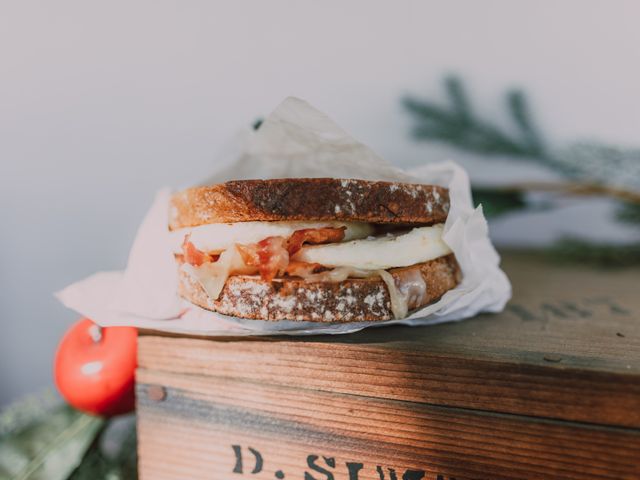
Soft Scrambled Eggs, Fontina and Truffle Oil on Focaccia
A luxurious Italian-inspired breakfast sandwich featuring silky soft scrambled eggs, melted fontina cheese, and a drizzle of aromatic truffle oil on warm focaccia. The eggs are cooked low and slow to achieve a creamy custard-like texture, while the fontina melts into the warm bread. Perfect for a special brunch or leisurely morning.
Steps
Before you start
- Bring eggs to room temperature for even cooking
- Have all ingredients measured and ready before you start cooking
- Warm your focaccia in the oven at 350°F (175°C) for 2–3 minutes while you cook the eggs
Warm the focacciaOven 350°F / 175°C
- Preheat your oven to 350°F (175°C).
- Slice the focaccia loaf horizontally to create two sandwich-sized halves.
- Place them cut-side up on a baking sheet and warm in the oven for 2–3 minutes until they are heated through and slightly crispy on the edges.
- Remove and set aside.
+ Show details− Hide details
Ready when: Focaccia is warm and slightly crispy at the edges
Tip: Warming the bread helps melt the cheese and keeps the eggs warm longer once assembled
Whisk the eggs
- Crack the 4 cold eggs into a small bowl.
- Add a pinch of salt and a grind of black pepper.
- Whisk vigorously with a fork until the yolks and whites are completely combined and slightly frothy, about 30 seconds.
- The mixture should be uniform pale yellow.
+ Show details− Hide details
Ready when: Eggs are completely combined and uniform in color
Tip: Whisking the eggs thoroughly ensures they cook evenly and creates a custard-like texture
Heat the skillet
- Place a medium non-stick skillet (8–10 inches / 20–25 cm) over medium-low heat.
- Add the 1.5 tablespoons (21 g) of cold butter cut into small pieces.
- Allow the butter to melt slowly, about 1 minute.
- Tilt the pan gently to coat the bottom evenly.
- The butter should foam slightly but not brown.
+ Show details− Hide details
Ready when: Butter is melted and foamy, not browned
Tip: Using medium-low heat and cold eggs is the secret to creamy scrambled eggs—high heat makes them rubbery
Cook the eggs slowly
- Pour the whisked eggs into the warm, buttered skillet.
- Let them sit undisturbed for 10–15 seconds, then using a wooden spoon or rubber spatula, gently push the eggs from the edges to the center, tilting the pan so uncooked egg flows to the edges.
- Repeat this slow, deliberate motion every 15–20 seconds.
- The goal is large, soft curds, not a dry scramble.
- After about 3–4 minutes total, when the eggs are still slightly wet on top but hold together, remove the pan from heat.
- The residual heat will continue to cook them gently.
+ Show details− Hide details
Ready when: Eggs are soft, creamy curds with a slight sheen—not dry or runny
Tip: Pull the pan from heat while the eggs still look slightly underdone; they will finish cooking from residual heat and stay silky
Add the fontina
- Immediately while the eggs are still in the warm pan off the heat, scatter the 3 ounces (85 g) of sliced or torn fontina cheese over the eggs.
- Gently fold the warm cheese into the eggs using your spatula, allowing the residual heat to melt it completely.
- The cheese will soften and create a creamy texture within 30 seconds.
+ Show details− Hide details
Ready when: Fontina is melted and fully combined with the eggs
Tip: Add the cheese off the heat so it melts gently without breaking down or becoming stringy
Assemble the sandwiches
- Divide the warm scrambled eggs and fontina mixture evenly between the two warm focaccia halves, spooning them onto the bottom halves.
- Place the top halves gently on top of each sandwich.
- Press down lightly so the toppings settle into the bread.
+ Show details− Hide details
Ready when: Sandwiches are assembled and the toppings are nestled into the warm bread
Tip: Work quickly so the eggs stay warm and the cheese remains melted
Finish with truffle oil and garnish
- Transfer the assembled sandwiches to serving plates.
- Drizzle the ½ teaspoon (2.5 ml) of black truffle oil over each sandwich, allowing it to seep into the bread and coat the eggs lightly.
- If using fresh chives, sprinkle the chopped chives over the top as a garnish.
- Serve immediately.
+ Show details− Hide details
Ready when: Truffle oil is distributed and sandwich is ready to eat
Tip: Add the truffle oil at the end so its delicate aroma remains prominent
Good to know
Tips
- The key to silky scrambled eggs is low heat, patience, and removing the pan from heat slightly before the eggs look fully done—carryover cooking will finish them perfectly
- Always use cold eggs straight from the fridge and add them to melted (not hot) butter; this creates large, tender curds instead of small, dry ones
- Fontina Val d'Aosta (from northern Italy) has a superior texture and flavor compared to standard fontina; it's worth the extra cost for this elegant dish
- Truffle oil is potent—a little goes a long way. Add it after the sandwich is assembled so its aroma is not lost to heat
Storage & reheating
Best served immediately. Leftover scrambled eggs can be refrigerated in an airtight container for up to 1 day and reheated gently in a non-stick skillet over low heat with a splash of milk or cream to restore creaminess, but the texture will be less luxurious. Do not freeze the assembled sandwich.
Substitutions
- fontina val d'aosta cheese → taleggio, brie, or gruyère cheese. These cheeses melt smoothly and offer a creamy, slightly nutty flavor similar to fontina. Use the same weight.
- black truffle oil → white truffle oil or a drizzle of good-quality extra-virgin olive oil with a pinch of fleur de sel. White truffle oil offers a lighter, more delicate flavor. Plain olive oil with fleur de sel is a simpler but still elegant alternative.
- focaccia bread → ciabatta, brioche, or thick slices of sourdough bread. These breads have enough structure to support the creamy eggs. Warm them the same way.
- fresh chives → fresh parsley, tarragon, or a tiny pinch of fleur de sel. Parsley and tarragon add fresh herbal notes. Fleur de sel adds a subtle finish without moisture.