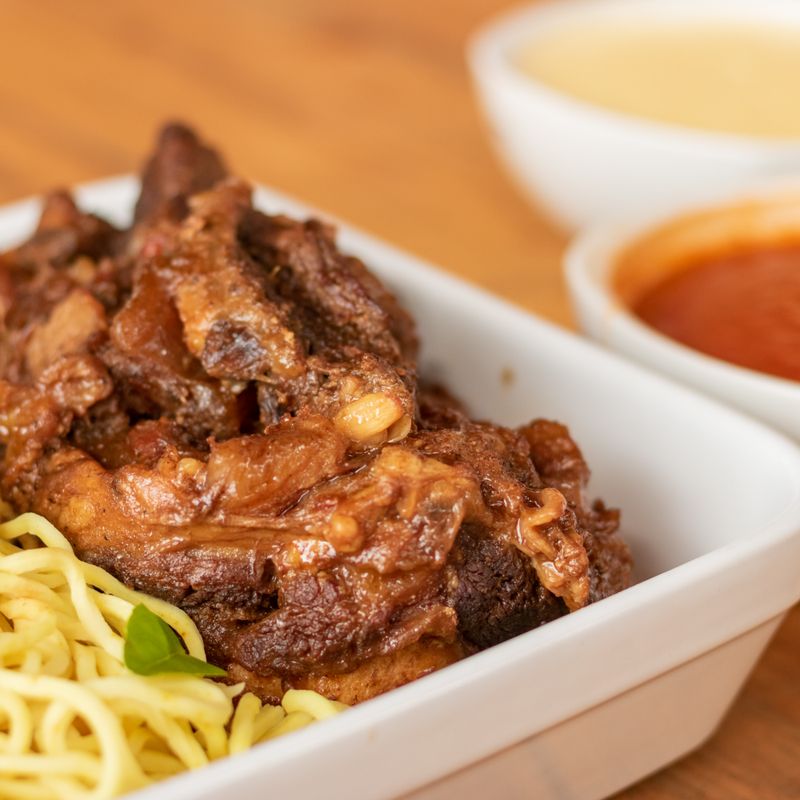
Slow Cooker Braised Oxtail and Tomato Lasagna
A unique Caribbean-inspired lasagna where tender, fall-apart slow-cooked oxtail in a deep tomato and spice sauce layers with pasta sheets and creamy ricotta. The oxtail braises low and slow until it becomes melt-in-your-mouth meat that infuses the tomato sauce with rich, savory depth. This is comfort food with serious flavor—best made in stages, with the braising done a day ahead if time allows.
- Prep
- 25 min
- Cook
- 45 min
- Wait
- 8 hr
- Total
- 9 hr 10 min
- Makes
- One 9×13-inch (23×33 cm) lasagna, 6 servings
Steps
Before you start
- Pat the oxtail pieces dry with paper towels before browning to ensure proper searing
- Have all your ingredients measured and the slow cooker available—the oxtail will cook 8 hours on low
- If making ahead, braise the oxtail a full day before, then chill the sauce overnight to lift off solidified fat
- Preheat the oven to 375°F (190°C) 15 minutes before you assemble and bake the lasagna
Sear the oxtail
- Heat the olive oil in a large heavy skillet over medium-high heat until it shimmers, about 2 minutes.
- Season the oxtail pieces evenly with the kosher salt and black pepper.
- Working in two batches to avoid crowding, sear the oxtail for 4–5 minutes per side until a deep brown crust forms.
- Transfer the seared pieces to your 6-quart slow cooker using a slotted spoon.
+ Show details− Hide details
Ready when: Each piece has a deep golden-brown crust on both sides
Tip: Don't skip the browning step—this builds the flavor foundation. Work in batches so the meat browns rather than steams.
Build the braising liquid
- In the same skillet (don't wash it), add the halved onion, smashed garlic, and tomato paste.
- Sauté over medium heat for 2 minutes, stirring, until the tomato paste darkens slightly and the aromatics soften.
- Pour in the crushed tomatoes and beef stock, scraping the bottom of the pan to release any browned bits.
- Stir in the dried thyme, bay leaves, allspice berries, and the whole scotch bonnet chile.
- Pour this mixture over the oxtail in the slow cooker.
+ Show details− Hide details
Ready when: The tomato paste has darkened and the liquid covers the oxtail by at least 2 inches
Tip: Crush the garlic by laying the flat side of a knife blade on each clove and pressing down—this releases more flavor than mincing. Leave the scotch bonnet whole and remove it before shredding the meat so you get heat without overpowering spice.
Braise the oxtail low and slow
- Cover the slow cooker and cook on the low setting for 8 hours.
- The oxtail is done when the meat is fall-apart tender and easily shreds with a fork, and the liquid has reduced and darkened to a rich sauce.
- You should have about 4 cups of sauce when finished.
+ Show details− Hide details
Ready when: Meat shreds easily when tested with two forks; sauce is dark and thickened
Tip: Do not lift the lid repeatedly—let the slow cooker do its work. If you want to make this ahead, chill the entire contents overnight and lift off the solidified fat from the top before proceeding.
Shred the oxtail and finish the sauce
- Using a slotted spoon, transfer the oxtail pieces to a cutting board, leaving the sauce in the slow cooker.
- Remove and discard the bay leaves, whole onion halves, and whole scotch bonnet.
- Once the oxtail is cool enough to handle, shred the meat with two forks, discarding any bones and excess fat.
- Stir the shredded meat back into the sauce in the slow cooker.
- Taste and adjust seasoning with salt and pepper as needed.
- You should have approximately 5 cups of oxtail sauce.
+ Show details− Hide details
Ready when: All meat is shredded and incorporated; bones and fibrous bits are discarded
Tip: The oxtail may be very hot—let it cool for 5–10 minutes for easier handling. Save any collagen and bone marrow that has fallen apart; these add richness to the sauce.
Make the ricotta filling
- In a medium bowl, combine the ricotta, egg, chopped fresh basil, 0.5 cup (50 g) of the Parmigiano-Reggiano, kosher salt, and black pepper.
- Mix gently with a wooden spoon until just combined—do not overmix or the ricotta will become grainy.
- The filling should be creamy and hold together loosely.
+ Show details− Hide details
Ready when: All ingredients are evenly distributed with no lumps of ricotta visible
Tip: Make this filling just before assembly so the egg doesn't have time to separate.
Hydrate the pasta sheets (if needed)
- If using traditional dried lasagna sheets rather than no-boil, pour about 3 cups of hot water into a shallow bowl or dish.
- Working one at a time, briefly submerge each pasta sheet (about 2–3 seconds per side) just until pliable but still firm to the touch.
- Lay them out on a clean towel or parchment paper to prevent sticking.
- If using no-boil sheets, skip this step—they will hydrate in the oven.
+ Show details− Hide details
Ready when: Sheets are flexible and bend without cracking, but retain slight firmness
Tip: Overly soft pasta will fall apart when handling. Keep sheets barely underdone if hydrating—they will cook further in the oven.
Assemble the lasagnaOven 375°F / 190°C
- Preheat the oven to 375°F (190°C).
- Spread 1 cup of the oxtail sauce across the bottom of a 9×13-inch baking dish.
- Arrange a layer of 4 pasta sheets over the sauce, overlapping slightly (break sheets if needed to fit).
- Spread half of the ricotta filling (about 1 cup) over the pasta.
- Scatter 1 cup of the shredded mozzarella over the ricotta.
- Top with 1.5 cups of oxtail sauce.
- Repeat the layers: 4 pasta sheets, remaining ricotta filling, 0.75 cup mozzarella, and 1.5 cups oxtail sauce.
- Top with the final 4 pasta sheets, remaining oxtail sauce, remaining 0.25 cup mozzarella, and the remaining 0.25 cup Parmigiano-Reggiano.
+ Show details− Hide details
Ready when: Layers are even and tightly packed; top is covered with cheese and sauce
Tip: Ensure each layer of sauce touches the pasta so it can hydrate and cook through. A slight overhang of pasta sheets hanging over the dish edge will tuck down as it cooks.
Bake the lasagnaOven 375°F / 190°C
- Cover the baking dish loosely with aluminum foil (spray it with cooking spray first so the cheese doesn't stick).
- Bake at 375°F (190°C) for 25 minutes.
- Remove the foil and bake an additional 20 minutes until the top is golden brown, the cheese is bubbly at the edges, and a thermometer inserted into the center of the lasagna reads 165°F (74°C).
+ Show details− Hide details
Ready when: Top is golden brown with bubbly cheese at the edges; center temperature is 165°F (74°C)
Tip: The foil prevents the top from overbrowning while the center catches up. If the edges brown too quickly, tent with foil for the final 10 minutes of baking.
Rest and serve
- Remove the lasagna from the oven and let it rest uncovered for 10 minutes.
- This allows the layers to set and makes serving much cleaner.
- Cut into 6 portions (3 rows by 2 columns) and serve warm, scooping a full portion onto each plate with a large spatula to keep the layers intact.
+ Show details− Hide details
Ready when: Layers are firm enough to hold their shape when cut
Tip: Use a large offset spatula or cake server to lift portions and keep the layers intact. If a portion breaks, it still tastes fantastic on the plate.
Good to know
Tips
- Oxtail becomes unbelievably tender during slow cooking, releasing collagen that makes the sauce silky. This long braise is non-negotiable for the best texture and flavor.
- If you don't have a slow cooker, braise the oxtail in a heavy Dutch oven in a 300°F (150°C) oven for 4–5 hours instead. Cover and check occasionally to ensure the liquid stays at a gentle simmer.
- The whole Scotch bonnet adds Caribbean warmth and flavor without overpowering spice—remove it whole after cooking so you control the heat level. If it breaks open, the sauce will become significantly spicier.
- For a less rich version, use part-skim ricotta and reduce the mozzarella to 1.5 cups (150 g).
Make ahead
You can braise the oxtail fully up to 2 days ahead. Chill the braised oxtail and sauce together, then lift any solidified fat from the surface before reheating gently in the slow cooker on low for 1 hour. Alternatively, assemble the lasagna up to 4 hours before baking (cover with plastic wrap and refrigerate), then bake as directed, adding 5–10 minutes to the baking time if the dish is cold from the refrigerator.
Storage & reheating
Store leftover lasagna in an airtight container in the refrigerator for up to 4 days. To reheat, cover with foil and warm in a 350°F (175°C) oven for 20–25 minutes, or microwave individual portions at 50% power for 3–4 minutes to prevent the cheese from toughening. The lasagna does not freeze well because the pasta can become mushy when thawed.
Substitutions
- Scotch bonnet or habanero chile → 1 jalapeño pepper or 0.5 tsp red pepper flakes. Scotch bonnets are very hot; substitutes are milder. Adjust to your heat preference and remove the jalapeño after cooking if you use it instead of Scotch bonnet.
- crushed San Marzano tomatoes (28 oz / 794 g can) → 28 oz (794 g) canned whole San Marzano tomatoes, crushed by hand. Whole tomatoes often taste fresher; crush them as you add them to the slow cooker for a chunkier sauce.
- dried lasagna pasta sheets (no-boil or traditional) → Fresh egg pasta sheets (lasagne all'uovo) or gluten-free lasagna sheets. Fresh sheets need only 15 minutes of baking covered and 10 minutes uncovered; use gluten-free sheets per package instructions, as timing varies.
- whole-milk ricotta cheese → Mascarpone mixed with 0.25 cup (60 ml) of whole milk for the same volume. Mascarpone is richer; add the milk to thin it to a spreadable consistency. Omit the egg if using mascarpone.
More lasagna
See all →
Find more like this
- Meal
- Dinner
- Cuisine
- Caribbean
- Diet
- HalalSugar-Free
- Method
- Slow Cooker
- Quick & Easy
- Make Ahead