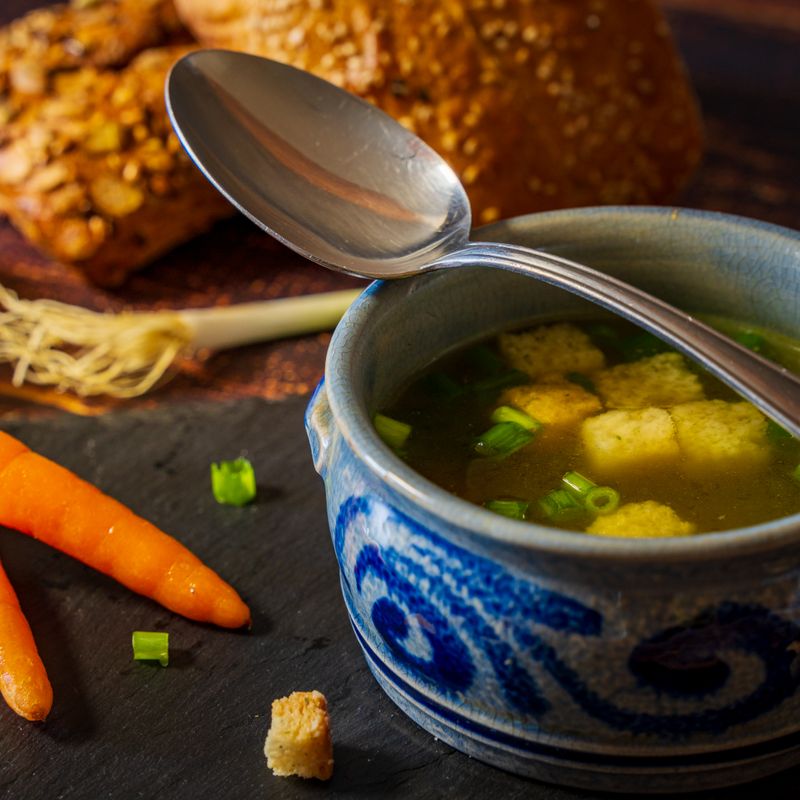
Simple Chicken and Vegetable Broth
A light, flavorful broth built on chicken thighs simmered gently with aromatic vegetables. This broth is the foundation for soups, risottos, and sauces—or drink it on its own. The long, slow simmer extracts deep chicken flavor while the vegetables add subtle sweetness and body. Homemade broth freezes beautifully and tastes far superior to store-bought.
- Prep
- 10 min
- Cook
- 1 hr 30 min
- Wait
- 25 min
- Total
- 2 hr 5 min
- Makes
- About 8 cups (2 liters) broth
Steps
Before you start
- Pat the chicken thighs dry with paper towels before starting
- Have a fine-mesh strainer or cheesecloth-lined colander ready
- Use a large pot (at least 6-quart capacity)
Combine chicken and vegetables
- Place the chicken thigh pieces in a large 6-quart pot.
- Add the onion halves, carrot chunks, celery pieces, peppercorns, bay leaves, and thyme sprigs (if using).
- Pour in the cold water until everything is just covered (it's okay if the chicken sits just above the water—it will release liquid as it cooks).
- Add the kosher salt.
+ Show details− Hide details
Tip: Cold water helps extract the maximum flavor from the chicken and vegetables. Using bone-in chicken thighs would add gelatin for extra body, but boneless thighs give a cleaner, lighter broth.
Bring to simmer
- Set the pot over medium-high heat and bring to a boil, about 8–10 minutes.
- Once the liquid reaches a rolling boil, you'll see gray foam (impurities) rise to the surface.
- Reduce the heat to low to bring the broth to a gentle simmer.
+ Show details− Hide details
Ready when: Liquid reaches a rolling boil; bubbles break rapidly at the surface
Tip: Do not stir vigorously, as this will make the broth cloudy. A clear broth is a sign of gentle, careful cooking.
Skim and adjust heat
- Using a spoon or ladle, gently skim off the gray foam that rises to the surface—do this for 1–2 minutes until you see mostly clear liquid rising.
- This step removes impurities and keeps the broth clear and light.
- Adjust the heat to low so the broth maintains a bare simmer: you should see only occasional small bubbles breaking the surface, not a rolling boil.
+ Show details− Hide details
Ready when: Clear liquid with only occasional small bubbles at the surface
Tip: Skimming is the key to a clear, refined broth. It takes only a moment but makes a visible difference.
Simmer gently
- Maintain a low, steady simmer for 1.5 hours.
- The liquid should gently bubble on the sides of the pot but not aggressively boil.
- Do not cover the pot—uncovered simmering allows flavors to concentrate and any remaining impurities to rise and be skimmed.
- Resist the urge to stir; you want minimal agitation.
- The chicken will reach a safe internal temperature of 165°F (74°C) well before the simmering time is complete.
+ Show details− Hide details
Ready when: Broth is fragrant, slightly reduced, and has a light golden color; chicken reaches 165°F (74°C) internal temperature
Tip: Longer, slower simmering at low heat yields more flavor than a quick boil. If the heat is too high, the broth will be cloudy and taste harsh.
Taste and adjust seasoning
- After 1.5 hours, the broth should taste rich and savory.
- Carefully ladle a spoonful and taste it.
- If it tastes weak, simmer for another 15–20 minutes.
- Add more salt if needed—start with ¼ tsp and taste again.
- The seasoning should be subtle; the chicken and vegetables should shine.
+ Show details− Hide details
Ready when: Broth tastes rich and savory, well-seasoned but not salty
Tip: Taste as you go. Seasoning salt now is easier than trying to desalt an oversalted broth later.
Strain the broth
- Place a fine-mesh strainer lined with cheesecloth over a large bowl or another pot.
- Slowly pour the hot broth through the strainer, letting the liquid drain while leaving the solids behind.
- Discard the solids (chicken, vegetables, herbs).
- Pour the strained broth back into the original pot or divide among storage containers.
+ Show details− Hide details
Ready when: All liquid has dripped through; only solids remain in the strainer
Tip: Let the broth drain naturally without pressing the solids—pressing forces bits of chicken and vegetables into the broth, making it cloudy. A patient pour yields the clearest result.
Cool and store
- Let the broth cool at room temperature for about 15 minutes, then cover and refrigerate until fully chilled, at least 2 hours.
- Once chilled, any fat will solidify on top; you can lift it off with a spoon if you prefer a leaner broth, or leave it for added richness.
- The broth is now ready to use or freeze.
+ Show details− Hide details
Ready when: Broth is cool and safe to handle
Tip: Chilling makes it easy to separate fat from broth. If you're in a hurry, you can use warm broth—just ladle it directly into containers and cool in the fridge.
Good to know
Tips
- Skim early and often: A clear, impurity-free broth is the result of gentle heat and good skimming in the first 10 minutes. Ignore the pot after the initial skim, and you'll have cloudy broth.
- Do not cover the pot: An uncovered simmer allows flavors to concentrate and steam to escape. A covered pot will trap moisture and dilute the broth.
- Save your vegetable scraps: Onion skins, carrot peels, and celery tops add color and body to broth. You can use them here instead of whole vegetables if you prefer a cleaner, less vegetable-forward flavor.
- Cold broth will taste less seasoned than hot broth: Always taste broth when it's warm, then adjust salt again once it's chilled. The saltiness becomes more apparent when cold.
Make ahead
Yes. Make the broth up to 5 days ahead and refrigerate, or freeze for up to 3 months. Thaw in the refrigerator overnight before using.
Storage & reheating
Room temperature: Do not leave at room temperature for more than 2 hours. Refrigerator: Store in an airtight container for up to 5 days. Freezer: Freeze in ice cube trays, freezer bags, or containers for up to 3 months. Thaw in the refrigerator or gently reheat in a pot over low-to-medium heat until steaming.
Substitutions
- boneless, skinless chicken thighs → bone-in chicken thighs (skin removed) or chicken drumsticks. Bone-in chicken yields richer, more gelatinous broth. Increase simmering time to 2 hours and be more diligent with skimming.
- fresh thyme sprigs → 1 tsp dried thyme or 2–3 sprigs fresh rosemary. Dried thyme is more potent than fresh; use less. Rosemary gives an earthier, more assertive flavor.
- yellow onion → 1 leek (white and light green parts) or 2 small shallots. Leeks add a subtle sweetness; shallots yield a slightly more delicate broth.
- black peppercorns → ⅛ tsp white pepper or ⅛ tsp ground white pepper. White pepper is milder and less assertive. Use half the amount of ground pepper to avoid overpowering the broth.
More broths
See all →
Find more like this
- Meal
- Dinner
- Main ingredient
- Chicken Thighs
- Method
- Stovetop
- Quick & Easy
- EasyFreezer Friendly