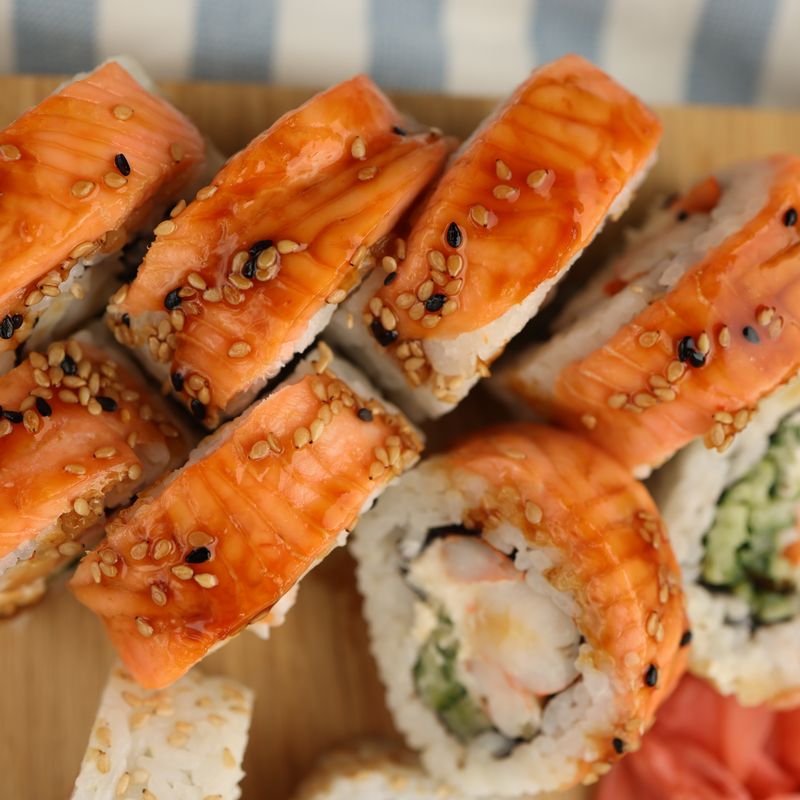
Sesame Ginger Salmon Casserole
A Japanese-inspired baked salmon casserole layered with tender bok choy and silky miso-butter sauce, topped with toasted sesame seeds and fresh ginger. The salmon stays moist and flaky while the vegetables soften in the aromatic broth, making this an elegant weeknight dinner that feels restaurant-quality.
- Prep
- 20 min
- Cook
- 25 min
- Wait
- 5 min
- Total
- 50 min
- Makes
- 4 servings (one 9×13-inch casserole)
Steps
Before you start
- Preheat the oven to 400°F (200°C)
- Pat the salmon dry with paper towels to help it cook evenly
- Have all ingredients measured and prepared—the assembly goes quickly
- Use a 9×13-inch (23×33 cm) baking dish, preferably ceramic or glass for even heat distribution
Toast the sesame seeds
- Place the sesame seeds in a small skillet over medium heat and toast, stirring frequently, for 2–3 minutes until fragrant and lightly golden.
- Transfer to a plate to cool.
+ Show details− Hide details
Ready when: seeds are fragrant and lightly golden
Tip: Watch carefully—sesame seeds burn quickly once they start to color.
Make the sauce
- In a small saucepan over medium heat, whisk together the miso paste, soy sauce, mirin, and dashi until smooth (it's okay if there are a few tiny miso lumps).
- Add the minced ginger and stir well.
- Let the mixture warm through for 1–2 minutes until fragrant, then remove from heat.
- Stir in the cold butter pieces until they dissolve into the sauce.
- Season with a pinch of salt and pepper.
+ Show details− Hide details
Ready when: sauce is warm, smooth, and the butter is fully incorporated
Tip: Don't boil the miso or the sauce will become bitter; gentle heat is key.
Arrange vegetables in the dish
- Spread the white and light green parts of the bok choy (the tougher pieces) in a single layer on the bottom of a 9×13-inch (23×33 cm) baking dish.
- Scatter the white parts of the sliced scallions over the bok choy.
- Season lightly with salt and pepper.
+ Show details− Hide details
Tip: Separating the bok choy parts ensures even cooking—white parts go on bottom, tender greens will be added later.
Position the salmon
- Arrange the four salmon fillets skin-side down on top of the bok choy, spacing them evenly.
- Season the top of each fillet lightly with salt and pepper.
+ Show details− Hide details
Tip: Place salmon skin-side down so the skin crisps slightly and the flesh stays moist.
Add the tender greens
- Scatter the dark green leafy parts of the bok choy around the salmon fillets.
- Pour the warm sauce evenly over the salmon and vegetables, making sure to distribute the ginger pieces.
+ Show details− Hide details
Tip: Adding tender greens last prevents them from becoming mushy during the bake.
Bake the casseroleOven 400°F / 205°C
- Bake uncovered in a preheated 400°F (200°C) oven for 15–20 minutes, until the salmon is cooked through and flakes easily with a fork, and the bok choy is tender.
- The internal temperature of the thickest part of the salmon should reach 145°F (63°C).
+ Show details− Hide details
Ready when: salmon flakes easily and reaches 145°F (63°C) internal temperature; bok choy is soft
Tip: Do not overcook or the salmon will dry out. Check at 15 minutes by inserting a fork—the flesh should look opaque and just beginning to flake.
Rest and finish
- Remove the casserole from the oven and let it rest for 5 minutes.
- While it rests, drizzle the sesame oil (if using) over the top.
- Scatter the toasted sesame seeds and fresh green scallion tops evenly over the casserole.
+ Show details− Hide details
Tip: The resting time helps the salmon retain moisture and allows the sauce to be absorbed into the vegetables.
Good to know
Tips
- Toasting the sesame seeds before sprinkling them on top brings out their nutty flavor and adds a pleasant crunch that contrasts with the soft salmon.
- For a spicier version, add ½ tsp (2.5 g) of red pepper flakes or a few slices of fresh red chili to the sauce at the ginger stage.
- If your salmon fillets are very thick (over 1 inch), add 2–3 minutes to the baking time and check the internal temperature carefully.
- Serve with steamed white or brown rice and a side of Japanese pickled vegetables (tsukemono) for an authentic meal.
Make ahead
The sauce can be made up to 1 day ahead, cooled, covered, and refrigerated. Reheat gently in a small saucepan over low heat or in a microwave before using. Do not assemble the casserole more than 2 hours ahead, as the bok choy will begin to release water and dilute the sauce.
Storage & reheating
Store any leftovers covered in the refrigerator for up to 3 days. To reheat, cover the casserole loosely with foil and warm in a 300°F (150°C) oven for 12–15 minutes until heated through. Do not microwave, as this can cause the salmon to dry out. The casserole is best consumed fresh; freezing is not recommended because the salmon texture will deteriorate.
Substitutions
- dashi or chicken broth → low-sodium chicken or vegetable broth. Dashi adds authentic umami depth, but any light broth works well. The casserole will be slightly less savory but still delicious.
- mirin (Japanese rice wine) → 1½ tbsp (22 ml) sugar or honey mixed with ½ tbsp (7 ml) rice vinegar. Mirin adds sweetness and body to the sauce. This substitute approximates that balance without the rice wine.
- bok choy → baby spinach or thinly sliced cabbage. Bok choy provides a mild, tender green vegetable. Spinach wilts quickly, so add it only in the final step; cabbage can go in with the white parts.
- white or red miso paste → 1½ tbsp (22 ml) soy sauce plus ½ tsp (2.5 g) sugar (omit some of the soy sauce in the recipe). Miso brings umami and depth; this substitute is a partial replacement if miso is unavailable, though the flavor will be less rich.
More casseroles
See all →



Find more like this
- Meal
- Dinner
- Cuisine
- Japanese
- Main ingredient
- Salmon
- Diet
- Sugar-Free
- Method
- Oven