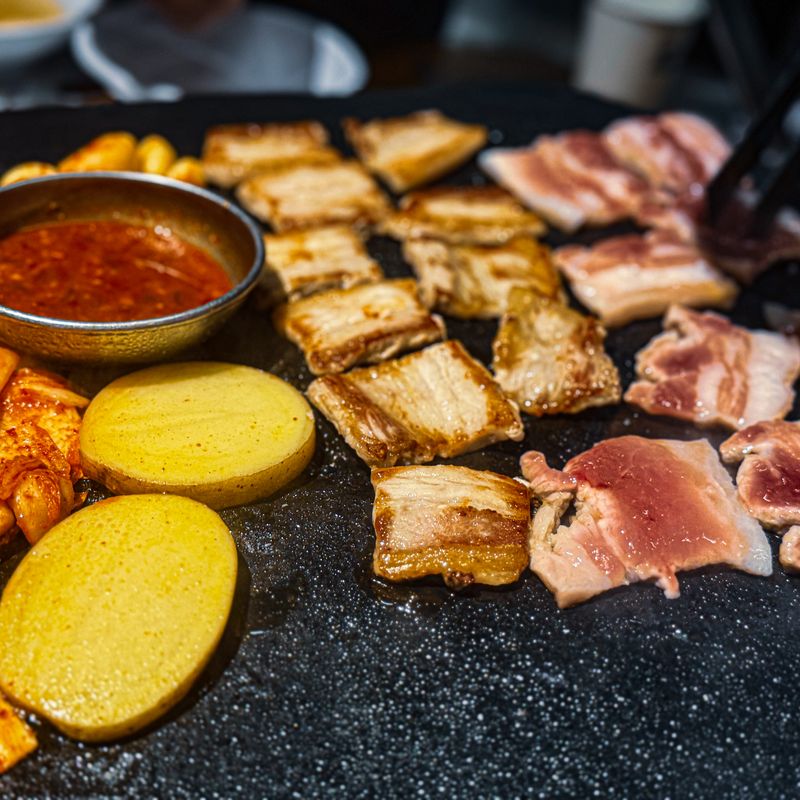
Korean Kimchi Pork Belly Casserole
A warming one-dish meal of braised pork belly, fermented kimchi, and tofu baked together with gochujang, soy, and sesame. The pork becomes meltingly tender while the kimchi softens and its funk melds with the broth. Serve over steamed white rice with scallions and sesame seeds.
- Prep
- 20 min
- Cook
- 1 hr 30 min
- Wait
- 15 min
- Total
- 2 hr 5 min
- Makes
- 4 servings (about 1½ cups each)
Steps
Before you start
- Preheat oven to 325°F (163°C)
- Cut pork belly into 1½-inch (4 cm) cubes
- Press or squeeze excess liquid from kimchi; measure ½ cup of the kimchi liquid separately
- Have white rice cooking or cooked and ready to serve
Sear pork belly
- Place the Dutch oven over medium-high heat.
- Working in batches to avoid crowding, sear the pork belly cubes until golden brown on two sides, about 4–5 minutes total per batch.
- Transfer to a plate.
- You'll render some fat—this is good; don't drain it.
+ Show details− Hide details
Ready when: Pork is golden brown on at least two sides
Tip: Don't skip searing—it develops the Maillard reaction and adds depth to the braising liquid.
Build the sauce base
- Reduce heat to medium.
- Add the sliced onion to the pot and cook for 2–3 minutes until softened.
- Stir in the minced garlic and ginger, cooking for about 30 seconds until fragrant.
- Add the gochujang and stir constantly for 1 minute to toast the paste and deepen its flavor.
- Pour in the soy sauce, broth, and reserved kimchi juice; whisk well to combine.
+ Show details− Hide details
Ready when: Mixture is smooth and aromatic, liquid is bubbling gently
Tip: Cooking the gochujang briefly mellows the raw flavor and makes it fully part of the sauce.
Combine and add sesame oil
- Return the seared pork belly to the pot along with any accumulated juices.
- Drizzle in the sesame oil and stir to coat everything evenly.
- Add the chopped kimchi and gently fold it in so it's distributed throughout.
+ Show details− Hide details
Tip: Sesame oil has a low smoke point, so add it after the searing is done.
Bring to simmer, then bakeOven 325°F / 165°C
- Bring the liquid to a bare simmer over medium heat, then cover the Dutch oven with its lid.
- Transfer to the preheated 325°F (163°C) oven.
- Bake for 60 minutes, covered, until the pork is nearly fork-tender.
+ Show details− Hide details
Ready when: Pork pieces yield easily to a fork
Tip: Keep the lid on during the first 60 minutes to trap steam and ensure even cooking.
Add tofu and finishOven 325°F / 165°C
- Remove from oven and carefully stir in the tofu cubes.
- Return to the oven, uncovered, for 20 more minutes so the tofu absorbs the braising liquid and the top of the casserole begins to reduce slightly.
+ Show details− Hide details
Ready when: Tofu is heated through; liquid has reduced by about ¼
Tip: Add tofu in the last 20 minutes so it doesn't fall apart from prolonged cooking.
Rest, check temperature, and garnish
- Remove from oven and let rest for 10–15 minutes.
- Insert an instant-read thermometer into the thickest piece of pork; it should read 145°F (63°C) or higher for food safety.
- Taste and season with black pepper as needed.
- Stir in the white and light green parts of the scallions, reserving the dark green tops.
- Divide the rice among serving bowls and ladle the casserole over top.
- Sprinkle with the reserved scallion greens and toasted sesame seeds.
+ Show details− Hide details
Ready when: Pork registers 145°F (63°C) or higher on an instant-read thermometer; casserole is warm throughout
Tip: Resting allows the braise to thicken slightly and ensures even heat distribution to every piece.
Good to know
Tips
- Kimchi juice: squeeze or press the chopped kimchi through a fine-mesh strainer to capture liquid without losing the solids—this reduces excess liquid in the final dish.
- Tofu texture: press your tofu block between paper towels weighted with a skillet for 20–30 minutes before cutting so it absorbs more braise and doesn't become mushy.
- Customize spice: if you prefer less heat, reduce gochujang to 2 tbsp; if you want more, add a pinch of gochugaru or extra-spicy gochujang.
- Serve with banchan: offer quick pickled vegetables, steamed egg (gyeran jjim), or a simple sesame spinach salad alongside to echo a full Korean meal.
Make ahead
Prepare the casserole through step 4 (before adding tofu). Cool, cover, and refrigerate up to 2 days. Reheat in a 325°F (163°C) oven for 25–30 minutes, then continue with step 5.
Storage & reheating
Room temperature: not recommended (store in fridge within 1 hour). Refrigerator: up to 3 days in an airtight container. Reheat gently in a 300°F (149°C) oven for 15–20 minutes, or on the stovetop over low heat, stirring occasionally. Freezer: up to 2 months; thaw overnight in the fridge before reheating.
Substitutions
- firm tofu → silken tofu or ½ lb (225 g) mushrooms (shiitake, oyster, or cremini), sliced. Mushrooms add earthiness and won't dissolve as easily. Use same cooking time.
- napa cabbage kimchi → radish kimchi (mu kimchi) or cabbage kimchi from a different brand. Any fermented kimchi variety works; adjust the amount of liquid to taste.
- gochujang (Korean red chili paste) → 2 tbsp gochugaru (Korean red chili flakes) mixed with 1 tbsp miso paste. Less smooth but equally spicy and umami-rich.
- pork belly, skin removed → 2 lb (900 g) beef short ribs or chicken thighs. Reduce initial searing time for chicken (3 minutes); braise short ribs for 90–120 minutes. Check beef short ribs at 165°F (74°C) and chicken at 165°F (74°C).
More casseroles
See all →


Find more like this
- Meal
- Dinner
- Cuisine
- Korean
- Main ingredient
- Pork ShoulderTofu
- Method
- Oven
- Quick & Easy
- One-PotMake AheadFreezer Friendly