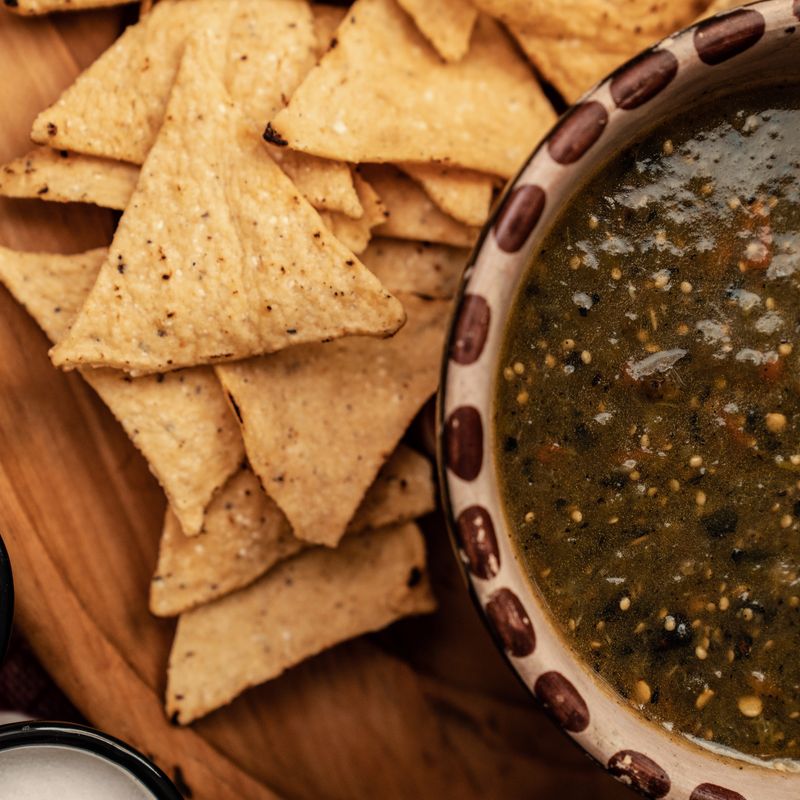
Salsa Verde
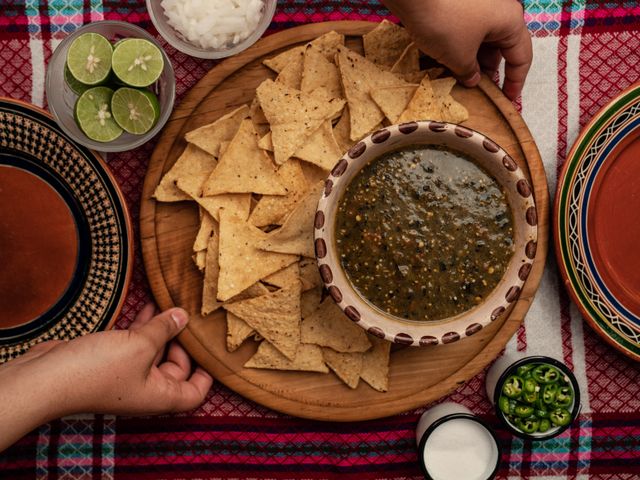
A vibrant roasted salsa verde made with charred tomatillos, jalapeños, and fresh cilantro. Roasting the vegetables mellows the heat and deepens the flavor, creating a complex and balanced sauce that's perfect with tortilla chips or as a topping for tacos, quesadillas, and enchiladas.
- Prep
- 10 min
- Cook
- 13 min
- Wait
- 2 min
- Total
- 25 min
- Makes
- 2 cups (8 servings)
Steps
Before you start
- Preheat your oven to 425°F (220°C) before you begin
- Remove tomatillo husks and rinse them well under cool water
- Have fresh lime juice ready (you'll need juice from about 2 large limes)
- A blender works best; a food processor is an acceptable alternative
Preheat and prepare vegetablesOven 425°F / 220°C
- Heat oven to 425°F (220°C).
- Remove the papery husks from tomatillos and rinse thoroughly under cool water; pat completely dry with paper towels.
- Arrange tomatillos, jalapeños (whole, with stems on), and onion quarters on a large baking sheet (18×13 inch / 46×33 cm) in a single layer, spreading them so they roast rather than steam.
+ Show details− Hide details
Ready when: Vegetables arranged on baking sheet and oven is preheated to 425°F
Tip: Pat the tomatillos completely dry with paper towels—excess moisture prevents the charring that builds flavor
Roast until charredOven 425°F / 220°C
- Place the baking sheet in the oven and roast for 12–14 minutes.
- The tomatillos should soften and develop blistered, charred patches; the jalapeños should turn dark and blacken in spots; the onion will caramelize and turn soft and translucent at the edges.
- The kitchen will smell deeply fragrant.
- Remove from oven.
+ Show details− Hide details
Ready when: Tomatillos blistered and charred, jalapeños darkened and blackened in spots, onion tender and caramelized
Tip: Do not skip roasting. Roasting mellows the jalapeños' raw heat, caramelizes the tomatillos' sugars, and creates deep, complex flavor impossible to achieve in raw salsa
Cool briefly
- Remove the baking sheet from the oven and let the vegetables rest on the hot sheet for 2 minutes.
- This stops the cooking and cools them enough to handle safely.
+ Show details− Hide details
Ready when: Vegetables have cooled enough to handle safely without burning yourself
Blend to desired consistency
- Transfer the roasted vegetables to a blender, including all charred bits and any pan juices—these add authentic depth.
- Add cilantro, lime juice, salt (starting with 1/2 teaspoon), and garlic if using.
- Cover and blend: for chunky salsa, pulse or blend for 30–45 seconds; for smoother salsa, blend for 1–2 minutes.
- Watch carefully and do not over-blend, or the salsa will become watery.
+ Show details− Hide details
Ready when: Salsa reaches your desired consistency, ranging from chunky to smooth
Tip: Use the pulse function if you want more control over texture; avoid running the blender on high speed continuously, which creates a watery, broken texture
Taste and adjust seasoning
- Pour the salsa into a serving bowl.
- Taste a small spoonful.
- Add more salt if it needs seasoning depth, more lime juice if it needs brightness or acidity, or a bit more cilantro if you want fresher flavor.
- You can pulse briefly in the blender again if adding more cilantro.
- Serve at room temperature or chilled.
+ Show details− Hide details
Ready when: Flavors are well balanced and salsa tastes delicious to your preference
Tip: Taste carefully before adding more salt; the roasted vegetables release liquid that already contains some salt, and oversalting is easy to do
Good to know
Tips
- Roasting is non-negotiable: it mellows the jalapeños' heat, caramelizes the tomatillos' natural sugars, and creates complex depth that raw salsa simply cannot achieve
- Include all the charred bits and pan juices when blending—they contain concentrated flavor and are not mistakes; they are the point
- If your salsa turns out hotter than expected, serve with sour cream or crema on the side, or blend in a few additional roasted tomatillos to dilute and cool
- Fresh lime juice makes a dramatic difference; bottled lime juice produces a flat, harsh acidic taste that will disappoint you
Make ahead
Salsa verde can be made up to 1 day ahead and stored in an airtight container in the refrigerator. The flavors will deepen slightly and meld together as it sits, making the salsa taste even better the next day.
Storage & reheating
Room temperature (covered): up to 2 hours. Refrigerator (airtight container): up to 5 days. Freezer (airtight container or freezer bag): up to 3 months. To use frozen salsa, thaw in the refrigerator overnight or stir directly into hot dishes. Note: thawed salsa will be slightly thinner but retains good flavor.
Substitutions
- fresh jalapeños → 1–2 serrano peppers or ½ habanero. For a spicier salsa; start with a smaller amount and taste as you blend, since these are significantly hotter than jalapeños
- fresh jalapeños → 2–3 poblano peppers. For a milder, earthier salsa with almost no heat; roast alongside the tomatillos
- fresh cilantro → Fresh parsley. Not traditional, but works if cilantro is unavailable; use the same amount for a less fragrant but still bright salsa
- white onion → Yellow onion or sweet white onion. Yellow onions add more sweetness; use white onion for a sharper, more traditional bite