Rye and Charred Onion Scones with Poppy Seeds
Rustic Scandinavian-style scones with nutty rye flour, deeply caramelized onions, and poppy seeds for texture. The tangy yogurt keeps them tender and moist. Perfect warm with butter and smoked fish, or simply on their own. These scones balance earthy rye flavor with sweet, charred onions.
Steps
Before you start
- Chill butter in the freezer for 30 minutes before starting
- Preheat oven to 400°F (200°C) 15 minutes before baking
- Have a baking sheet lined with parchment paper ready
Char the onions
- Heat 2 tablespoons (30 g) of butter in a large 10-inch (25 cm) skillet over medium-high heat.
- Once foaming, add the sliced onions and ½ teaspoon (3 g) of salt.
- Cook, stirring occasionally, for 20–25 minutes until the onions are deeply golden brown and caramelized, with some darker charred bits.
- The onions should be soft, sweet, and smell fragrant.
- If they're sticking too much, reduce heat to medium.
- Once done, spread them on a plate to cool slightly, then roughly chop any large pieces.
- You should have about 1 cup (240 ml) of caramelized onions.
- Set aside.
+ Show details− Hide details
Ready when: Onions are deeply golden brown with charred edges, soft, and smell sweet and caramelized
Tip: Don't rush this step. Low and slow caramelization develops the complex sweetness the scones need. Stir occasionally but not constantly.
Mix dry ingredients
- In a mixing bowl, whisk together 1.25 cups (155 g) of rye flour, 1.75 cups (220 g) of all-purpose flour, 1.5 teaspoons (7 g) of baking powder, ½ teaspoon of freshly ground black pepper, and ¾ teaspoon (4 g) of salt.
- Whisk for about 30 seconds to evenly distribute the leavening and seasonings.
+ Show details− Hide details
Ready when: Mixture is evenly combined with no visible streaks of baking powder
Cut in cold butter
- Add the 6 tablespoons (85 g) of cold butter cubes to the dry ingredients.
- Using a pastry cutter, two forks, or your fingertips, work the butter into the flour until the mixture resembles coarse breadcrumbs with pea-sized pieces of butter still visible.
- This should take 2–3 minutes.
- The mixture should look sandy but still have small butter nuggets, which create layers as they melt during baking.
+ Show details− Hide details
Ready when: Mixture resembles coarse breadcrumbs with visible pea-sized butter pieces still throughout
Tip: Keep the butter cold and work quickly. If your kitchen is warm, chill the bowl for 5 minutes before starting this step.
Add onions, yogurt, and egg
- Make a well in the center of the flour mixture.
- Add the cooled charred onions, ¾ cup (180 ml) of cold yogurt, and the 1 egg.
- Using a wooden spoon or your hand, gently mix until the dough just comes together.
- Don't overmix—stop as soon as you no longer see dry flour.
- The dough should be slightly shaggy and moist but not sticky.
- Overworking develops gluten, which makes tough scones.
+ Show details− Hide details
Ready when: Dough just comes together with no visible dry flour; texture is slightly shaggy and moist
Tip: Minimize mixing once wet ingredients are added. This keeps the scones tender. A few flour streaks are okay—they'll disappear with one or two more gentle folds.
Turn out and fold dough
- Lightly flour a work surface and turn the dough out onto it.
- Gently fold the dough in half, then press it flat to about 1-inch (2.5 cm) thickness.
- Fold it in half again, and press flat once more.
- This creates lamination—thin layers that contribute to a flaky texture.
- Do not knead or compress hard; be gentle and let the dough rest naturally.
+ Show details− Hide details
Ready when: Dough is folded twice and pressed to about 1-inch (2.5 cm) thickness
Tip: These folds create the tender, flaky layers. Handle gently and avoid overworking the dough.
Shape and cut scones
- Pat the dough into a rough rectangle about ¾-inch (2 cm) thick.
- Using a floured knife or bench scraper, cut the dough into 8 roughly equal wedges (like cutting a pie) or 8 rectangles (about 2.5 × 3 inches / 6 × 8 cm).
- Transfer the scones to a parchment-lined baking sheet, spacing them about 2 inches (5 cm) apart.
- If the dough gets warm or sticky, refrigerate it on the baking sheet for 10 minutes.
+ Show details− Hide details
Ready when: 8 scones are cut and arranged on the baking sheet with 2-inch (5 cm) spacing
Tip: Keep your knife or cutter well-floured so it doesn't drag and seal the edges, which prevents rise.
Brush and top with seeds
- Brush the top of each scone with a thin layer of milk or cream.
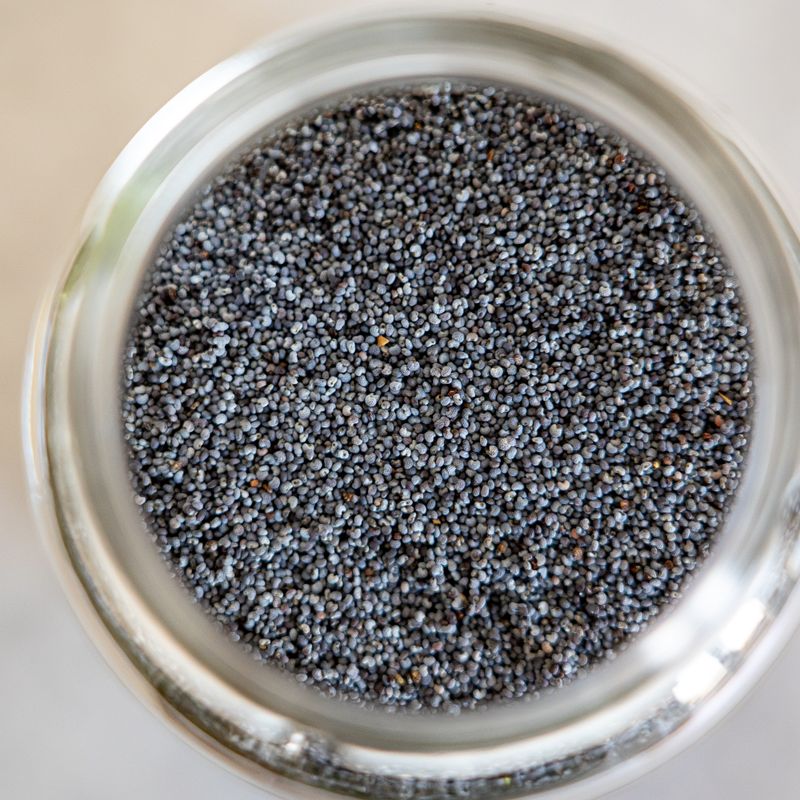
- Sprinkle 1 teaspoon (about 3–4 g) of poppy seeds on top of each scone, gently pressing them in so they stick.
+ Show details− Hide details
Ready when: All scones are brushed with milk and topped with poppy seeds
Tip: A thin milk wash gives a golden, slightly glossy finish. Don't oversaturate or the dough will become soggy before baking.
Bake sconesOven 400°F / 205°C
- Bake in a preheated 400°F (200°C) oven for 16–18 minutes, until the scones are golden brown on top and the edges are set.
- Check at 15 minutes by gently pressing the side of a scone—it should feel firm but not hard.
- A toothpick inserted into the center should come out with just a few moist crumbs.
- The poppy seeds should be dark and fragrant.
+ Show details− Hide details
Ready when: Scones are golden brown on top, edges are set, and a toothpick inserted in the center comes out with a few moist crumbs
Tip: Ovens vary, so check at 15 minutes. Baking too long dries them out; too short and they'll be doughy inside.
Cool and serve
- Remove the scones from the oven and let them cool on the baking sheet for 5 minutes.
- Transfer to a wire rack or serve warm.
- They're best eaten within a few hours of baking, while still warm or at room temperature.
- Serve with butter, smoked salmon and crème fraîche, or simply on their own.
+ Show details− Hide details
Ready when: Scones have cooled slightly and can be handled without falling apart
Tip: Scones are best served warm, but if they cool completely, gently warm them in a 300°F (150°C) oven for 5 minutes before serving.
Good to know
Tips
- The key to tender scones is cold, chunky butter and minimal mixing. Handle the dough gently and stop mixing as soon as you don't see dry flour.
- Deeply caramelized onions are crucial—they should look almost burnt at the edges with golden, sweet flavor. This takes time; don't rush by using high heat.
- If your yogurt is very thick (like Greek yogurt), thin it slightly with milk so the dough doesn't become too stiff.
- These scones pair beautifully with smoked salmon, crème fraîche, and fresh dill, or simply with good butter and a pinch of fleur de sel.
Make ahead
Caramelize the onions up to 2 days ahead and store in an airtight container in the refrigeridge. Bring them to room temperature before mixing into the dough. You can also shape the scones, brush with milk, and freeze on a baking sheet for up to 1 month. Bake directly from frozen, adding 2–3 minutes to the baking time.
Storage & reheating
Store cooled scones in an airtight container at room temperature for up to 1 day. They gradually dry out, so same-day enjoyment is best. Refrigerate for up to 3 days and reheat gently in a 300°F (150°C) oven for 5 minutes. Freeze in a freezer bag for up to 1 month; thaw at room temperature for 1–2 hours or warm directly in a 300°F (150°C) oven for 8–10 minutes.
Substitutions
- plain full-fat yogurt → Greek yogurt or sour cream. Use the same amount. Sour cream will make the scones slightly more tangy; Greek yogurt will make them slightly denser. Both work well.
- rye flour → Whole wheat flour. Substitute ¾ cup (95 g) of whole wheat flour for the rye flour. The nutty flavor will be slightly different but still delicious. Whole wheat absorbs more liquid, so add 1–2 tablespoons more yogurt if the dough feels too dry.
- poppy seeds → Sesame seeds, caraway seeds, or a combination. Caraway seeds are especially Scandinavian and pair beautifully with rye. Use the same amount by weight.
- all-purpose flour → Bread flour. Use the same amount. Bread flour has slightly more protein and will make the scones a bit tougher and chewier. Reduce slightly to 1.5 cups (190 g) if you want a softer crumb.