Rustic Berry and Almond Galette
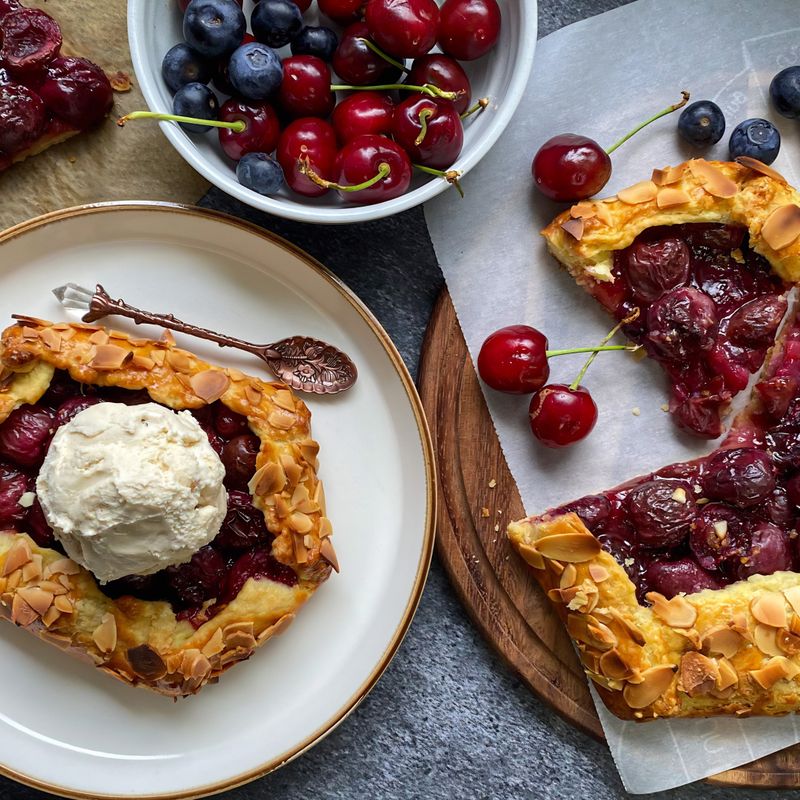
A free-form tart with a tender, buttery pastry crust filled with a nutty almond cream, fresh mixed berries, and a whisper of vanilla and lemon. The edges fold up casually around the filling and brush with egg white for a light shine. Rustic, elegant, and surprisingly simple—a French-inspired dessert that's perfect for summer entertaining or a weekend treat.
- Prep
- 25 min
- Cook
- 35 min
- Wait
- 45 min
- Total
- 1 hr 45 min
- Makes
- 1 galette (6 slices)
Steps
Before you start
- Chill the dough in the freezer for at least 30 minutes before rolling (or up to 2 days in advance)
- Preheat your oven to 400°F (200°C) with a rack in the lower third
- Have your berries at room temperature, not cold from the fridge
- Use cold butter straight from the refrigerator for the dough
Make the dough
- In a food processor, pulse together 1¼ cups (155 g) all-purpose flour and ¼ teaspoon (1.5 g) kosher salt.
- Add 6 tablespoons (85 g) cold unsalted butter cubes and pulse until the mixture resembles coarse meal with pea-sized pieces of butter still visible (8–10 pulses).
- Sprinkle 3 tablespoons (45 ml) ice water over the mixture and pulse 3–4 times, just until the dough comes together in moist clumps.
- Do not overmix.
- If using a bowl, cut the butter in with a pastry cutter or fork until the texture is coarse.
+ Show details− Hide details
Ready when: Dough clumps together and holds when squeezed
Tip: Do not overwork the dough. Pea-sized butter pieces create a flaky texture; if they disappear, the crust will be tough.
Chill the dough
- Turn the dough out onto a sheet of plastic wrap and gather it into a rough disk about 1 inch thick.
- Wrap tightly and refrigerate for at least 30 minutes.
- For best results, freeze for 45 minutes to 1 hour.
- (The dough can also be made ahead and refrigerated for up to 2 days, or frozen for up to 3 months.)
+ Show details− Hide details
Ready when: Dough is firm and holds its shape
Tip: A very cold dough is easier to work with and produces the flakiest crust.
Prepare the almond filling
- In a small bowl, combine ½ cup (60 g) sliced almonds, 3 tablespoons (38 g) granulated sugar, 2 tablespoons (28 g) softened unsalted butter, ¼ teaspoon (1.25 ml) almond extract, ½ teaspoon (2.5 ml) vanilla extract, and the zest of ½ lemon.
- Stir until you have a coarse, spreadable paste.
- Set aside.
+ Show details− Hide details
Ready when: Mixture is creamy and holds together
Tip: The almond paste acts as a barrier between the crust and juicy berries, preventing a soggy bottom.
Prepare the berries
- In another bowl, toss together 2 cups (300 g) fresh mixed berries (halve any large strawberries) with 1 tablespoon (8 g) cornstarch and a tiny pinch of salt.
- Let sit for 5 minutes so the cornstarch can begin to absorb the berry juices.
- This prevents the galette from becoming watery.
+ Show details− Hide details
Ready when: Berries are coated and beginning to release juices
Tip: Do not skip the cornstarch; it thickens the berry juices and keeps the crust crisp.
Roll out the dough
- Remove the chilled dough from the refrigerator and let it sit at room temperature for 2–3 minutes to soften very slightly.
- Place a large sheet of parchment paper on your work surface and lay the dough disk in the center.
- Cover the dough with another sheet of parchment and roll gently with a rolling pin, working from the center outward, until you have a rough circle about 12–13 inches (30–33 cm) in diameter and roughly ¼ inch (0.6 cm) thick.
- Peel away the top parchment and check that the dough is not sticking to the bottom sheet.
+ Show details− Hide details
Ready when: Dough is rolled into a 12–13-inch circle, uniform in thickness
Tip: Roll between parchment sheets to prevent sticking and tearing. If the dough cracks at the edges, pinch it back together.
Transfer and build the galette
- Keeping the rolled dough on the bottom parchment, transfer it to a large baking sheet (11×17 inches / 28×43 cm).
- Spread the almond filling over the dough, leaving a 1.5-inch (4 cm) border around the edges.
- Scatter the prepared berries and any accumulated juices over the almond filling, again leaving a 1.5-inch border clear.
+ Show details− Hide details
Ready when: Dough is spread with filling and fruit, leaving a clear border
Tip: Leave a clear border so you have room to fold the edges without compressing the filling.
Fold up the edges
- Working around the galette, fold the border of dough up and over the filling, creating loose, casual pleats and creases.
- The berries and almond cream will show through the center; this rustic look is intentional.
- It's okay if some juices escape—that's part of the charm.
- Do not try to make this neat.
+ Show details− Hide details
Ready when: Dough border is folded into loose pleats around the perimeter
Tip: Imperfect folds are what make a galette look rustic and charming. Aim for casual, not controlled.
Brush with egg white and chillOven 400°F / 205°C
- In a small bowl, lightly beat 1 egg white with a fork.
- Brush it over the folded dough edges only, avoiding the berries (which would become tough).
- Sprinkle coarse sugar (turbinado or sanding sugar) lightly over the egg-washed edges if desired.
- Slide the entire baking sheet into the freezer for 15 minutes while the oven preheats to 400°F (200°C) with the rack in the lower third.
+ Show details− Hide details
Ready when: Dough is cold and firm; oven is preheated
Tip: A final chill prevents the dough from spreading too much. Cold dough also browns better.
Bake the galetteOven 400°F / 205°C
- Transfer the cold galette directly from the freezer to the preheated 400°F (200°C) oven on the lower rack.
- Bake for 35–40 minutes, until the crust is deep golden brown at the edges and the center is also lightly golden, and you can see the fruit filling bubbling slightly around the perimeter.
- If the edges brown too quickly, loosely drape a piece of aluminum foil over them in the last 10 minutes.
+ Show details− Hide details
Ready when: Crust is deep golden brown, edges puffed and crispy, fruit filling bubbles at the perimeter
Tip: Place the galette on the lower rack so the bottom crust bakes fully. A baking sheet below catches any drips.
Cool and rest
- Remove the galette from the oven and let it rest on the baking sheet for at least 15 minutes at room temperature.
- This allows the fruit filling to set slightly and makes slicing easier without the galette falling apart.
- You can serve it warm or at room temperature.
+ Show details− Hide details
Ready when: Galette has cooled enough to be handled and sliced cleanly
Tip: Do not skip the resting time; a warm galette is hard to slice. If serving later, reheat gently in a 300°F (150°C) oven for 10 minutes.
Good to know
Tips
- Do not overwork the dough. The key to a flaky, tender crust is keeping the butter in distinct pieces. If your food processor is large, it will blend the dough too quickly; a bowl and pastry cutter are sometimes better.
- The almond filling serves two purposes: it adds flavor and texture, and it acts as a moisture barrier between the juicy berries and the pastry crust, keeping it crisp.
- Fresh berries work best, but frozen berries (thawed and drained) work too. Just drain any excess liquid so the galette is not watery.
- This galette is forgiving. Imperfect folds, cracks, and irregular shape are all part of its rustic charm. Embrace the casual look.
Make ahead
Dough can be made up to 2 days ahead and refrigerated, or frozen for up to 3 months. Assemble the galette and freeze unbaked for up to 24 hours; add 5–10 minutes to the bake time if baking from frozen.
Storage & reheating
Room temperature: up to 1 day, loosely covered. Refrigerator: up to 3 days in an airtight container. Freezer: up to 2 months (wrap well before freezing). Reheat in a 300°F (150°C) oven for 10 minutes before serving.
Substitutions
- fresh mixed berries (blueberries, raspberries, blackberries, strawberries) → Stone fruit (halved or sliced peaches, plums, apricots) or rhubarb. Adjust cornstarch slightly based on fruit juiciness; rhubarb may need an extra ½ teaspoon. Stone fruits work beautifully and are less juicy than berries.
- sliced almonds → Finely ground almonds (almond flour) or chopped pistachios or walnuts. If using almond flour, reduce the amount to ¼ cup (28 g) and add an extra ½ tablespoon softened butter to keep the cream spreadable. Pistachios add a different but equally delicious flavor.
- all-purpose flour → Whole-wheat pastry flour or a blend of all-purpose and whole-wheat (up to 50%). Whole-wheat will make the crust slightly denser and nuttier. You may need an extra ½ tablespoon of ice water.
- large egg white → 1 tablespoon whole milk or heavy cream, or a small beaten egg yolk. These create a shine and help coarse sugar adhere. Egg white is traditional and lightest.