Chocolate Mousse Tart with Glazed Berries
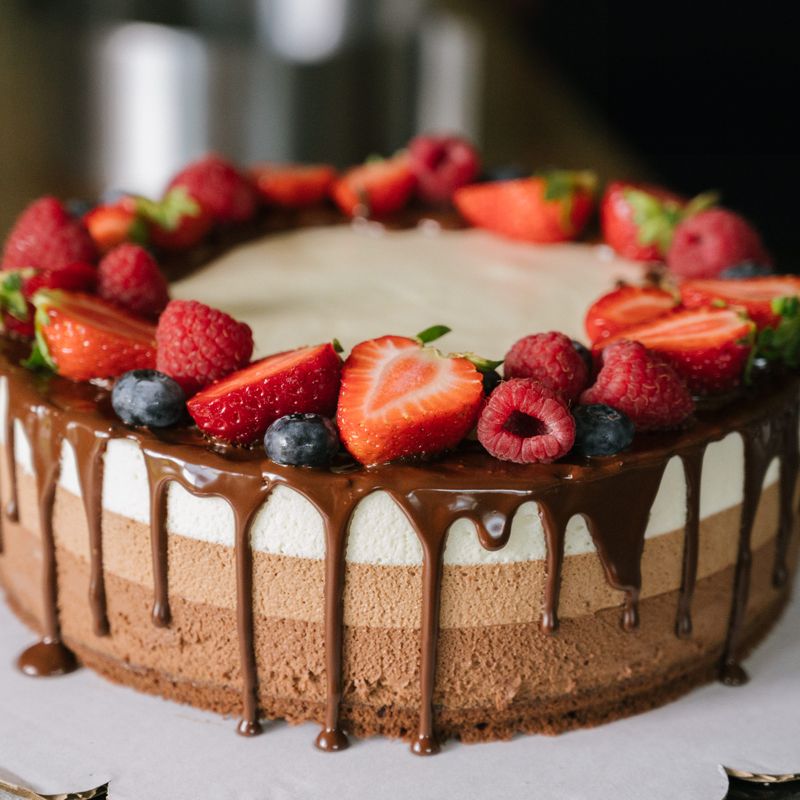
A classic French-style tart featuring a buttery pastry shell filled with silky dark chocolate mousse and topped with jewel-like glazed berries. The contrast of the crispy crust, airy chocolate filling, and glossy fruit creates an elegant dessert worthy of any table.
- Prep
- 45 min
- Cook
- 25 min
- Wait
- 2 hr 30 min
- Total
- 3 hr 40 min
- Makes
- 1 tart (8 slices)
Steps
Before you start
- Remove eggs from refrigerator 30 minutes before starting
- Chill a 9-inch (23 cm) tart pan in the freezer for 15 minutes
- Ensure your chocolate is finely chopped for even melting
- Have an ice bath (bowl of ice water) ready before beginning the mousse
Prepare and chill the crust
- Remove the pie crust from refrigeration.
- On a lightly floured surface, roll the dough into a 10-inch (25 cm) circle, about ⅛-inch (3 mm) thick.
- Carefully transfer it to your chilled 9-inch (23 cm) tart pan, pressing it gently into the bottom and sides without stretching.
- Trim excess dough with a knife, leaving a ¼-inch (6 mm) overhang, then press the overhang against the pan rim to create a neat edge.
- Prick the bottom with a fork in 8–10 places to prevent puffing.
- Refrigerate the lined pan for 20 minutes while you preheat the oven.
+ Show details− Hide details
Ready when: Dough is firm and fully adheres to the pan
Tip: Don't stretch the dough—let gravity help it settle into the corners. Prickling prevents large air bubbles that cause puffing.
Bake the crust blindOven 375°F / 190°C
- Preheat your oven to 375°F (190°C).
- Line the chilled tart shell with parchment paper and fill it with pie weights or dried beans to about halfway.
- Bake for 12–14 minutes until the edges are set and lightly golden.
- Carefully remove the parchment and weights.
- Return the shell to the oven for 3–4 minutes more to lightly bake the bottom.
- Remove from oven and let cool in the pan for 10 minutes.
+ Show details− Hide details
Ready when: Crust edges are light golden and feel firm when tapped; bottom is no longer raw to the touch
Tip: Pie weights prevent the crust from puffing and shrinking. If you don't have them, crumpled foil works, but weights give better results.
Melt chocolate over water
- Fill a medium saucepan with 1–2 inches (2.5–5 cm) of water and bring to a simmer over medium heat.
- Set a heatproof bowl over the saucepan, ensuring the bottom doesn't touch the water.
- Add the finely chopped dark chocolate and butter to the bowl.
- Stir frequently with a whisk until completely melted and smooth, about 3–4 minutes.
- Remove from heat and let cool for 2 minutes, then whisk in the vanilla extract and sea salt until evenly mixed.
- Set aside.
+ Show details− Hide details
Ready when: Chocolate is completely smooth with no lumps; mixture is warm but not hot to the touch
Tip: Never let water splash into the chocolate—moisture causes it to seize and become grainy. If this happens, add 1 teaspoon of neutral oil per ounce and stir gently.
Whisk egg yolks with sugar
- Separate the 3 eggs while they're at room temperature, placing yolks in one bowl and whites in another.
- Add half the sugar (about 2.5 tablespoons / 30 g) to the yolks and whisk vigorously for 2–3 minutes until pale, thick, and ribbon-like.
- Slowly drizzle the cooled chocolate mixture into the yolk mixture while whisking constantly.
- Continue whisking for 1 minute until fully combined and glossy.
- Set aside.
+ Show details− Hide details
Ready when: Mixture is pale, thick, and falls from the whisk in a slow ribbon when lifted
Tip: Room-temperature eggs whisk faster and incorporate air more readily. If your chocolate is too hot, it will cook the yolks; let it cool slightly first.
Whip egg whites to stiff peaks
- Using an electric mixer (or whisk by hand), begin beating the room-temperature egg whites on medium speed.
- Once they're foamy, add the remaining sugar (about 2.5 tablespoons / 32 g) and increase speed to medium-high.
- Beat for 4–5 minutes until stiff, glossy peaks form—when you lift the beater, the whites should stand straight up without drooping.
+ Show details− Hide details
Ready when: Whites hold firm, glossy peaks and no liquid pools in the bowl when beater is lifted
Tip: Any yolk or fat in the whites will prevent proper whipping. Use scrupulously clean bowls and beaters. A tiny pinch of cream of tartar helps stabilize the foam.
Fold whites into chocolate mixture
- Add one-third of the whipped egg whites to the chocolate-yolk mixture and fold gently with a rubber spatula, rotating the bowl and cutting down through the center, folding the bottom over the top, and turning the bowl.
- Work until the whites are mostly incorporated but some streaks remain.
- Add the remaining egg whites in two additions, folding gently each time until no white streaks are visible.
- Be patient—aggressive stirring deflates the mousse.
+ Show details− Hide details
Ready when: Whites are fully integrated with no visible streaks; mixture is light and mousse-like
Tip: Use a light hand when folding—you want to maintain the airy structure created by the beaten whites. Over-mixing deflates them and makes a dense mousse.
Whip and fold in heavy cream
- In a separate chilled bowl, whip the cold heavy cream with an electric mixer on medium-high speed for 2–3 minutes until soft peaks form (the cream should fall gently from the beater, not hold a stiff point).
- Add one-third of the whipped cream to the chocolate mousse and fold gently to combine.
- Then fold in the remaining cream in two additions until no white streaks remain and the mousse is uniformly light and fluffy.
+ Show details− Hide details
Ready when: Cream is fully folded in; mousse is pale, fluffy, and holds soft peaks
Tip: Don't over-whip the cream—if it becomes grainy, you've gone too far toward butter. Stop while it's just past soft peaks, still slightly thick but flowing.
Fill the tart shell
- Pour the mousse into the cooled tart shell, spreading it evenly with an offset spatula or the back of a spoon.
- Smooth the top so it's level with the rim of the pan.
- Transfer the tart to the refrigerator and chill for at least 2 hours (or up to 8 hours) until the mousse is set but not rock-hard—it should yield slightly to a gentle press.
+ Show details− Hide details
Ready when: Mousse is firm to the touch but yields gently when pressed; no liquid remains on the surface
Tip: If you chill longer than 2 hours, let the tart sit at room temperature for 5–10 minutes before serving so the mousse isn't ice-cold and brittle.
Prepare the berry glaze
- In a small saucepan, warm the apricot jam over low heat (about 1–2 minutes), stirring occasionally to loosen it.
- If using chunky jam, press it through a fine-mesh sieve into a small bowl to make a smooth glaze.
- Stir in the water until the mixture is the consistency of thin honey—it should flow easily but still coat a spoon.
- Let cool for 2 minutes until it's warm but not hot.
+ Show details− Hide details
Ready when: Jam is liquid and pourable; glaze falls from a spoon in a thin stream
Tip: Straining the jam gives a professional-looking glossy finish. If your glaze is too thick, add a few more drops of water.
Arrange berries and glaze
- Just before serving, arrange the fresh berries on top of the mousse in concentric circles, alternating colors for visual appeal.
- Start from the outer edge and work toward the center.
- Using a pastry brush, gently brush each berry with the warm apricot glaze, working quickly so the glaze sets.
- If any glaze remains, drizzle it lightly between the berries.
- Allow 1–2 minutes for the glaze to set.
+ Show details− Hide details
Ready when: Berries are evenly coated with a glossy layer; glaze no longer looks wet
Tip: Arrange berries just before serving—they'll stay fresher and the glaze will look more vibrant. Work quickly but gently to avoid bruising delicate berries like raspberries.
Remove and serve
- Let the tart sit at room temperature for 10 minutes to allow the mousse to warm slightly and become easier to slice.
- Run a warm thin knife around the inner edge of the tart pan (a bowl of hot water helps—dip the knife and wipe dry).
- Gently push the removable bottom up from below to lift the tart away from the ring.
- Slice with a sharp, warm knife, wiping it clean between cuts.
- Transfer slices to plates and serve immediately.
+ Show details− Hide details
Ready when: Slices are clean and mousse is creamy, not icy; berries stay in place
Tip: A warm, damp cloth draped over a sharp knife between cuts keeps the blade from sticking and produces cleaner slices. Room-temperature mousse slices far better than cold.
Good to know
Tips
- Separate eggs when cold (they separate more easily), then let them come to room temperature before using. Room-temperature whites whip faster and reach greater volume, making a lighter mousse.
- Use a pastry comb or offset spatula to create decorative ridges on the mousse before chilling if you'd like—they'll provide visual interest when you glaze the berries.
- For a no-bake option, substitute a pre-baked or store-bought graham cracker or chocolate cookie crust to save time on crust preparation.
- If your mousse seems grainy or curdled (rare, but possible), whisk in 1–2 tablespoons of warm cream off the heat to emulsify it; the mixture should become smooth again.
Make ahead
The tart shell can be blind-baked up to 1 day ahead and stored in an airtight container at room temperature. The chocolate mousse can be made and refrigerated in the shell for up to 8 hours before glazing the berries, which must be done within 1–2 hours of serving for best appearance.
Storage & reheating
Store the finished tart in the refrigerator, loosely covered, for up to 3 days. Do not freeze the baked crust or mousse—the texture will be compromised. If made without berries, the mousse-filled tart can be held in the fridge, loosely covered, for 2 days before topping. To serve after refrigeration, let sit at room temperature for 10 minutes before slicing.
Substitutions
- dark chocolate (60–72% cacao) → milk chocolate or 70% dark chocolate. Milk chocolate will yield a sweeter, less intense mousse; 70% cacao is ideal if you prefer slightly less bitterness than 60%. Avoid white chocolate—it lacks cocoa solids to create proper mousse texture.
- heavy whipping cream, cold → mascarpone (whipped lightly with 2 tablespoons cold cream). Mascarpone adds richness and tang. Whip it gently with a small amount of cream to achieve a spreadable consistency; don't over-beat or it will separate.
- apricot jam or fruit preserves → seedless raspberry jam or red currant jelly. These offer brighter color and tang. Red currant jelly is especially elegant and requires no straining. Adjust the water amount if needed to achieve the right glaze consistency.
- mixed fresh berries (raspberries, blackberries, blueberries, strawberries) → candied berries, freeze-dried berries, or seasonal fresh fruit (sliced peaches, figs, or kiwi). Candied berries add texture and keep longer; freeze-dried berries stay crisp. Fresh stone fruit or tropical fruit also works beautifully and glaze the same way.