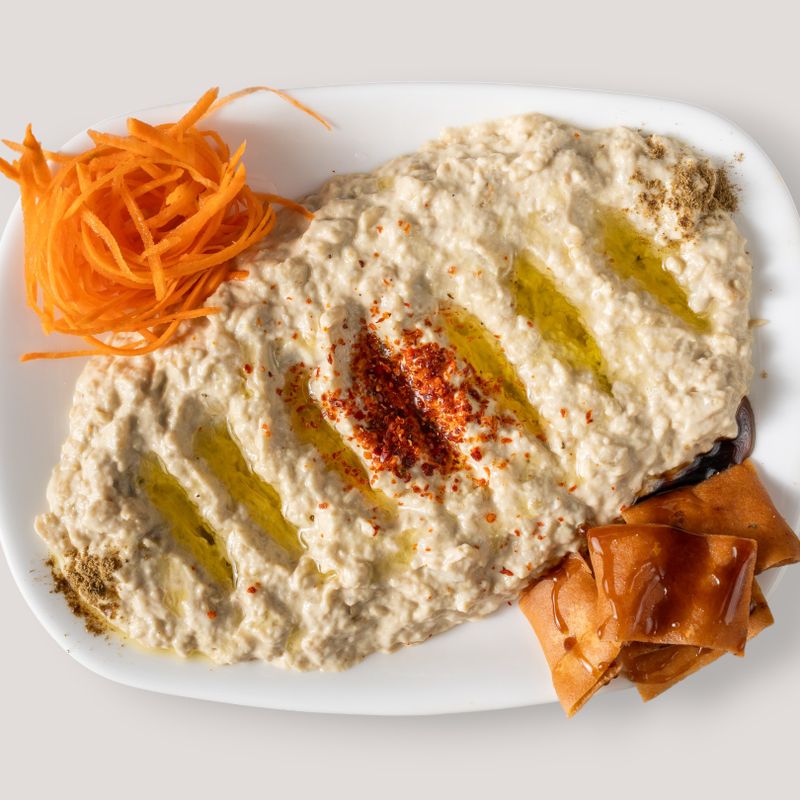
Roasted Eggplant and Yogurt Dip
A silky Mediterranean dip of charred roasted eggplant blended with creamy yogurt, sweet roasted garlic, bright lemon juice, and warm cumin. The deep, smoky flavor of the eggplant is balanced by tangy yogurt for a lighter take on traditional baba ganoush. Serve chilled with pita, crackers, or raw vegetables.
- Prep
- 10 min
- Cook
- 35 min
- Wait
- 35 min
- Total
- 1 hr 20 min
- Makes
- Makes about 2 cups (6 servings as a dip)
Steps
Before you start
- Preheat your oven to 425°F (220°C)
- Line a large baking sheet with parchment paper or foil for easy cleanup
- Gather all ingredients and equipment—this recipe moves quickly once the eggplants cool
Roast the eggplantsOven 425°F / 220°C
- Rinse the 2 large eggplants under cold water and pat dry thoroughly.
- Using a sharp fork or knife tip, prick each eggplant all over 4–5 times to prevent them from bursting in the oven.
- Place them on the prepared baking sheet.
- Brush lightly with about 1 tablespoon of the olive oil, coating all sides evenly.
- Roast at 425°F (220°C) for 30–35 minutes, until the skin is deeply charred in spots and the entire eggplant has collapsed.
- The flesh should feel very soft when pierced with a fork, and the skin will be dark brown or blackened.
- The eggplants may leak a little liquid—this is normal.
+ Show details− Hide details
Ready when: Skin is charred and wrinkled; flesh is very soft when pierced with a fork
Tip: Pricking the eggplants prevents them from exploding in the oven and making a mess.
Add garlic to roastOven 425°F / 220°C
- About 10 minutes before the eggplants are finished (at the 25-minute mark), add the 4 unpeeled garlic cloves to the baking sheet.
- Toss them lightly with a pinch of salt.
- They will roast for the final 10 minutes alongside the eggplants, becoming soft, sweet, and fragrant.
- By the time the eggplants are fully charred, the garlic will be tender throughout.
+ Show details− Hide details
Ready when: Garlic cloves are very soft and fragrant
Tip: Roasting garlic unpeeled keeps it moist and prevents burning; the flesh slips out of the skin easily once cool.
Cool to handle
- Remove the baking sheet from the oven.
- Let the eggplants and garlic rest at room temperature for about 5 minutes until cool enough to touch without burning yourself.
- The eggplants will continue to soften slightly as they cool.
+ Show details− Hide details
Ready when: Eggplants are cool enough to handle comfortably
Extract eggplant flesh
- Once cooled, cut each eggplant in half lengthwise.
- Scoop out the soft interior flesh using a spoon, being gentle to separate it from the charred skin—discard the skin entirely.
- Place all the eggplant flesh into a food processor or blender.
- The flesh should look pale and creamy.
- A small amount of char flavor is desirable, but if the outer layer is very bitter (overly burnt), discard those bits.
- While scooping, peel the roasted garlic cloves: they will slip easily out of their papery skin.
- Add the peeled garlic to the processor with the eggplant.
+ Show details− Hide details
Ready when: Eggplant flesh is separated from skin and gathered in the processor; garlic is peeled
Tip: Avoid the very darkest, most burnt parts of the eggplant skin as excessive charring can taste unpleasantly bitter.
Blend with yogurt and seasonings
- Add the 1 cup of Greek yogurt to the processor with the eggplant and garlic.
- Pour in the 3 tablespoons of fresh lemon juice.
- Sprinkle in the 1 teaspoon of ground cumin, ½ teaspoon of salt, and ¼ teaspoon of black pepper.
- Pulse the mixture 3–4 times to break everything down, then blend on medium speed for 1–2 minutes until the dip is smooth and creamy.
- A slight texture is pleasant; it should look like a thick, spoonable dip, not a thin puree.
- If it's too thick, add water 1 tablespoon at a time and pulse again.
- If it's too thin, it will firm up as it chills.
+ Show details− Hide details
Ready when: Mixture is smooth, creamy, and well combined with no large lumps
Tip: Don't overblend or the friction heat from the processor can break down the yogurt and make it thin; pulse and blend in short bursts for the best creamy texture.
Season to taste
- Transfer the dip to a serving bowl.
- Taste a spoonful.
- Adjust the seasoning by adding a little more salt, lemon juice, cumin, or black pepper as needed.
- The goal is balance: tangy (from yogurt and lemon), rich (from the eggplant), and warm-spiced (from the cumin).
- Cover the bowl.
+ Show details− Hide details
Ready when: Seasonings are balanced to your taste
Chill and serve
- Refrigerate the dip for at least 30 minutes (or up to 4 hours) before serving.
- The dip will firm up slightly as it chills, and the flavors will deepen and meld.
- Just before serving, drizzle the remaining 1 tablespoon of olive oil over the top in a thin stream.
- Sprinkle with the chopped fresh parsley and paprika if using.
- Serve chilled with warm pita chips, fresh pita bread, raw vegetables (cucumber, bell pepper, tomato, radish), or crackers.
+ Show details− Hide details
Ready when: Dip is chilled and ready to serve
Tip: The dip can be made up to 1 day ahead; store covered in the refrigerator. Drizzle with fresh olive oil and garnish just before serving for the best appearance and fresh flavor.
Good to know
Tips
- For the deepest, most complex smoky flavor, char the eggplants directly over a gas flame using kitchen tongs (or on a grill), rotating them until the skin is completely blackened. This takes 15–20 minutes but develops exceptional flavor that oven-roasting doesn't quite match. Scoop the flesh the same way.
- If your eggplants yield excess liquid when scooped, transfer the flesh to a fine-mesh strainer lined with cheesecloth and let it drain for 5 minutes before adding to the processor. This prevents the dip from becoming watery.
- For extra smokiness, add ¼ teaspoon of smoked paprika to the blend in step 5. For heat, add a pinch of cayenne or Aleppo pepper. For brightness, whisk a small drizzle of pomegranate molasses into the finished dip or drizzle it on top.
Make ahead
Yes, make up to 1 day ahead. Prepare through step 6, cover, and refrigerate. Drizzle with fresh olive oil and garnish just before serving.
Storage & reheating
Refrigerator: Store covered for up to 4 days. The dip will thicken slightly over time as moisture evaporates. Freezer: Not recommended; yogurt will separate and the texture will become grainy when thawed. To serve, remove from the refrigerator 10 minutes ahead if you prefer it slightly warmer than chilled.
Substitutions
- plain Greek yogurt, full-fat → Labneh (thick Greek-style yogurt) or sour cream mixed with 1 tablespoon water. Labneh will make the dip even creamier and tangier. Sour cream adds richness but use less salt as sour cream is already tangy.
- fresh lemon juice → Fresh lime juice or red wine vinegar. Lime gives a fresher, brighter taste. Red wine vinegar adds sharper acidity; start with 2 tablespoons as it's more intense than lemon.
- ground cumin → Smoked paprika or a pinch of Aleppo pepper. Smoked paprika adds deeper, smokier notes. Aleppo pepper (or pinch of cayenne) brings warmth and gentle heat; use sparingly.
- extra-virgin olive oil → 2 tablespoons tahini (sesame paste) blended in with the yogurt. Adding tahini creates a richer, nuttier dip closer to traditional baba ganoush. Omit the final olive oil drizzle or use just ½ tablespoon.
More dips & spreads
See all →


Find more like this
- Meal
- Snack
- Cuisine
- Mediterranean
- Method
- Oven
- Quick & Easy
- Easy