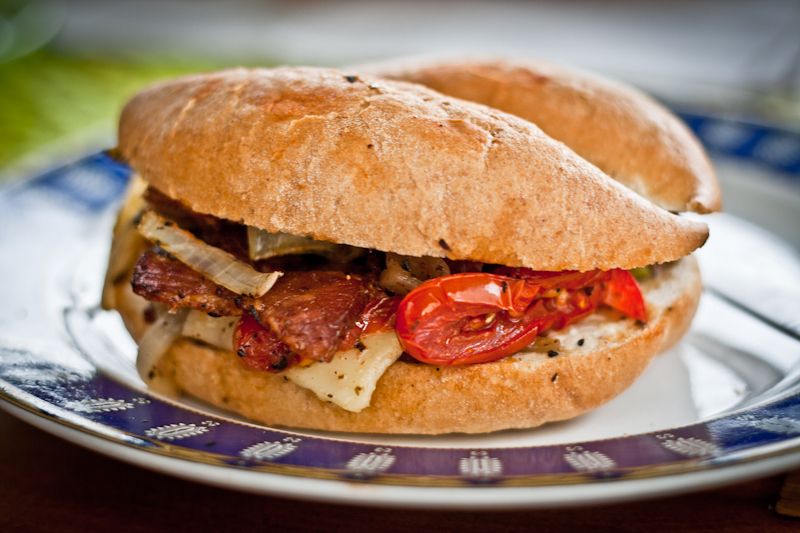
Roast Beef and Horseradish Cream Panini
A bold, upscale pressed sandwich with thinly sliced roast beef, peppery arugula, and a sharp horseradish cream that cuts through the richness of melted Swiss cheese. Pressed on a buttered griddle until the bread is golden and crispy, this panini delivers restaurant-quality comfort in every bite.
Steps
Before you start
- Have your roast beef sliced thin (not shaved into paper-thin wisps) from the deli counter or slicing machine—about ⅛ inch thick
- Make the horseradish cream while your griddle heats
- Gather all fillings and lay them out so assembly is quick
Make horseradish cream
- In a small bowl, combine the sour cream, drained prepared horseradish, and Dijon mustard.
- Stir until smooth.
- Taste and season with a pinch of salt and black pepper.
- The mixture should taste noticeably sharp and peppery.
- Set aside.
+ Show details− Hide details
Ready when: Smooth, uniform, fragrant spread
Tip: Drain the horseradish well in a fine-mesh sieve for 30 seconds before mixing so excess liquid doesn't make the cream watery.
Preheat griddle
- Set a griddle or large cast-iron skillet over medium heat.
- Let it warm for 2 minutes until a drop of water sizzles gently on the surface.
+ Show details− Hide details
Ready when: Water droplet sizzles gently and rolls
Assemble first panini
- Lay out one slice of rye bread.
- Spread 2 teaspoons (10 g) of horseradish cream evenly on one side.
- Layer half the roast beef (about 3 ounces/85 g) on top, leaving a small border.
- Arrange half the Swiss cheese slices over the beef.
- Top with 1 cup (25 g) of arugula, piled loosely.
- Place the second slice of rye bread on top, pressing gently to compress.
- Repeat with the remaining bread, horseradish cream, roast beef, cheese, and arugula for the second panini.
- You now have two uncooked sandwiches.
+ Show details− Hide details
Ready when: Both sandwiches assembled and compressed
Tip: Don't overstuff—keep fillings slightly away from the edges so they don't squirt out when the panini is pressed.
Butter bread surfaces
- Using your finger or a butter knife, spread 1 teaspoon (7 g) of softened butter thinly and evenly on the top surface of the first sandwich.
- Spread 1 teaspoon (7 g) on the griddle surface at the point where the sandwich will land.
+ Show details− Hide details
Ready when: Bread surfaces lightly coated with butter
Tip: Softened butter spreads more easily than cold butter and creates a more even golden crust.
Griddle first panini
- Carefully lay the first buttered sandwich butter-side down on the hot griddle.
- Immediately spread ½ teaspoon (3.5 g) of softened butter on the upper (now facing up) surface.
- Cook for 2 minutes without moving it, until the bottom bread is deep golden brown and crisp.
+ Show details− Hide details
Ready when: Bottom bread is deep golden brown with visible crust
Tip: Resist the urge to move or flip early—the bread needs undisturbed contact with the hot griddle to brown properly.
Press and finish first panini
- Using a panini press or a heavy skillet/plate placed on top of the sandwich, press down firmly for 2 minutes.
- The cheese should melt, and the sandwich should flatten slightly.
- Then flip the sandwich carefully and press the other side for 1 to 2 minutes, until the top bread is also deep golden brown and crispy and the cheese is fully melted.
+ Show details− Hide details
Ready when: Both sides deep golden brown, cheese fully melted and oozing slightly at edges
Tip: If your panini press is dual-sided, you can cook both sides at once; otherwise, flip and press again. Either way, watch for dark browning, not burning.
Remove and rest first panini
- Transfer the first finished panini to a cutting board.
- Repeat the buttering, griddling, pressing, and cooking process with the second sandwich, using the same method and timing.
- Once both panini are cooked, let them rest for 1 minute to allow the cheese to set slightly and make them easier to cut.
+ Show details− Hide details
Ready when: Both sandwiches cooked and resting on cutting board
Tip: While the second sandwich cooks, keep the first one on a warm plate so it doesn't cool down too much.
Slice and serve
- Using a sharp serrated knife, carefully cut each panini in half diagonally, pressing down gently to avoid squashing them.
- Serve immediately while the bread is still warm and crispy and the cheese is warm and creamy.
+ Show details− Hide details
Ready when: Panini cleanly halved and ready to serve
Tip: A serrated knife (bread knife) prevents crushing the crispy crust better than a flat blade.
Good to know
Tips
- Buy thinly sliced roast beef from the deli counter (about ⅛ inch/3 mm thick)—avoid ultra-thin shaved beef, which can tear, and thick deli slices, which don't layer smoothly.
- Don't skip draining the prepared horseradish: excess liquid will make the cream thin and cause the bread to become soggy. Press it in a fine-mesh sieve for 30 seconds.
- The panini should spend about 3–4 minutes total cooking on the griddle (1 minute on the first side before pressing, then 2 minutes pressed, then 1–2 minutes on the flipped side). This timing ensures the bread crisps without burning and the cheese melts completely.
- If you prefer less intense horseradish flavor, reduce it to 1 tablespoon (15 g). If you love sharp, peppery heat, use up to 3 tablespoons (45 g)—taste as you go.
Storage & reheating
These panini are best eaten fresh and warm. If you have leftovers, wrap them in foil and refrigerate for up to 2 days. Reheat in a 300°F (150°C) oven for 8–10 minutes, wrapped in foil, until warmed through. Toasting them briefly on a griddle will restore some crispness to the bread, though the texture will not be as good as freshly made.
Substitutions
- rye bread → sourdough bread or whole wheat bread. Sourdough adds tang and a crispy crust; whole wheat provides a hearty flavor. Both should be sliced ½ inch (1.25 cm) thick.
- prepared horseradish (not horseradish sauce) → wasabi paste (use half the amount). Wasabi delivers similar heat and pungency. Start with 1 tablespoon (15 g) and adjust to taste, as it is spicier than horseradish.
- Swiss cheese → gruyère or fontina cheese. Gruyère adds nuttiness; fontina is creamier. Both melt beautifully and complement the roast beef.
- fresh arugula → watercress or peppery mixed greens. Watercress has a similar bite; mixed greens provide color and texture variation while remaining peppery enough to balance the beef.
More paninis
See all →

Find more like this
- Meal
- Lunch
- Cuisine
- American
- Main ingredient
- Beef RoastCheese
- Diet
- HalalSugar-Free
- Method
- Sheet Pan