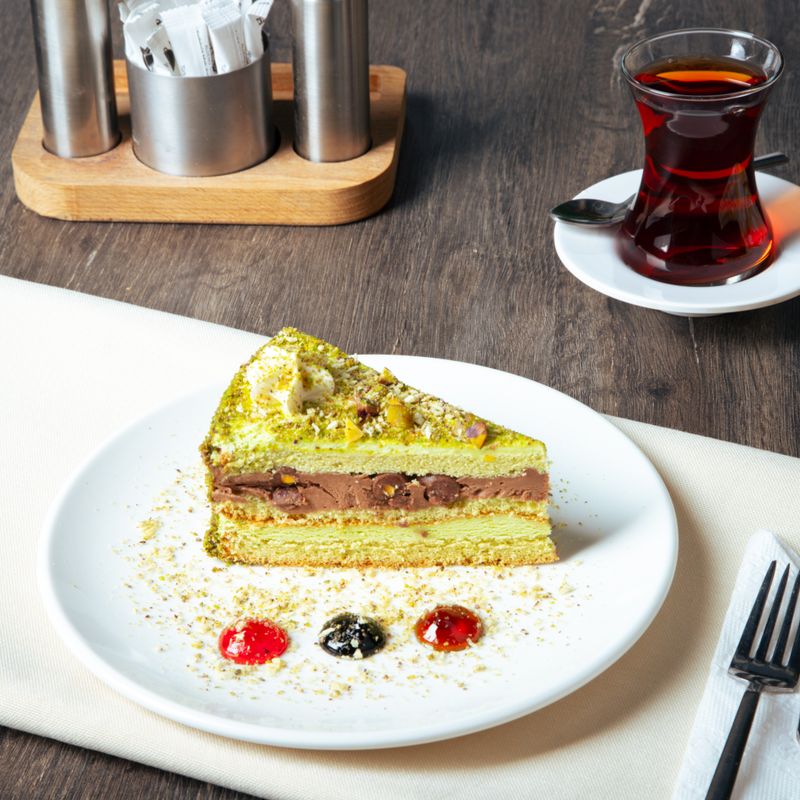
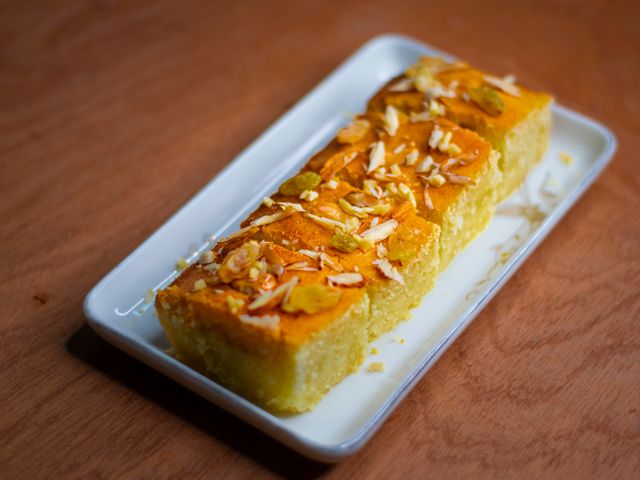
Ramadan Special Soaked Saffron Sponge Cake with Pistachio Threads
A light, airy saffron-infused sponge cake soaked in aromatic sugar syrup and crowned with threads of pistachios. This traditional Middle Eastern cake is perfect for Ramadan iftar celebrations, combining the delicate crumb of a sponge with the luxurious flavors of saffron and cardamom. The cake absorbs the syrup beautifully, creating moist, flavored layers that stay tender for days.
- Prep
- 25 min
- Cook
- 35 min
- Wait
- 2 hr
- Total
- 3 hr
- Makes
- 1 nine-inch cake (12 slices)
Steps
Before you start
- Preheat oven to 350°F (175°C) 15 minutes ahead
- Soak saffron threads in 2 tablespoons hot water while preparing other ingredients
- Separate eggs carefully; ensure mixing bowls are grease-free
- Have a 9-inch (23 cm) round cake pan buttered and lined with parchment paper
Prepare saffron infusion
- Pour 2 tablespoons of hot water over the saffron threads in a small bowl and set aside for 10 minutes to bloom.
- This extracts the color and flavor into the water.
+ Show details− Hide details
Ready when: Saffron threads are softened and water is deeply golden
Tip: Use the hottest water available, but not boiling, to protect the delicate saffron flavor.
Whip egg whites
- In a large, grease-free bowl, whip the 6 egg whites on medium-high speed using an electric mixer for 3–4 minutes until soft peaks form.
- Gradually add 3 tablespoons (37 g) of the measured sugar while beating, then whip another 1–2 minutes until stiff, glossy peaks form.
- Set aside.
+ Show details− Hide details
Ready when: Peaks stand straight up and hold firm when you lift the whisk
Tip: Any trace of egg yolk or grease will prevent the whites from reaching full stiff peaks. Use a spotless bowl and beaters.
Combine yolks and sugar
- In a second bowl, whisk the 6 egg yolks with the remaining sugar (approximately ¾ cup minus 3 tablespoons, or 113 g) for 2–3 minutes until pale, thick, and ribbony.
- Add the saffron water (with threads), rose water, and vegetable oil, whisking until smooth.
+ Show details− Hide details
Ready when: Mixture is pale yellow, thick, and falls in ribbons when you lift the whisk
Tip: Don't skip the pale ribbon stage—it incorporates air and ensures a light, tender crumb.
Sift dry ingredients
- Sift the flour, baking powder, salt, and crushed cardamom seeds into a medium bowl, whisking gently to combine.
- This removes lumps and distributes the leavening evenly.
+ Show details− Hide details
Ready when: Dry ingredients are well combined with no lumps visible
Tip: Sifting is crucial for a tender sponge cake. Do not skip this step or the cake may be dense.
Fold flour into yolk mixture
- Pour the sifted dry ingredients into the egg yolk mixture and fold gently with a rubber spatula, using a bottom-to-top motion, for 8–10 folds until just combined.
- The mixture should look streaky but no dry flour should be visible.
+ Show details− Hide details
Ready when: Flour is almost incorporated with a few streaks remaining
Tip: Fold gently—overmixing develops gluten and results in a tough, dense cake instead of a light sponge.
Fold in egg whites
- Gently fold the whipped egg whites into the batter in two additions, folding until just combined and no white streaks remain.
- This lightens the batter without deflating the air bubbles.
+ Show details− Hide details
Ready when: Batter is uniform in color and no streaks of egg white are visible
Tip: Use a large spatula and fold from the bottom of the bowl upward. Stop as soon as the whites disappear to keep the batter airy.
Pour and bakeOven 350°F / 175°C
- Pour the batter into your prepared 9-inch (23 cm) round cake pan, spreading it level.
- Bake in a preheated 350°F (175°C) oven for 32–35 minutes until the top is pale golden and a toothpick inserted in the center comes out clean or with just a few moist crumbs.
+ Show details− Hide details
Ready when: Top is light golden, springs back when gently touched, and a toothpick comes out clean or with a few moist crumbs
Tip: Do not overbake; the cake will continue to cook slightly as it cools. A slightly moist toothpick is preferable to a dry one.
Cool in pan
- Remove the cake from the oven and let it cool in the pan for 10 minutes.
- Run a thin knife around the edges to release it, then turn it out onto a wire rack to cool completely, about 30 minutes.
+ Show details− Hide details
Ready when: Cake is cool to the touch and no longer steaming
Tip: Cooling completely ensures the syrup soaks in evenly without curdling or pooling on a warm cake.
Make the sugar syrup
- While the cake cools, combine 1 cup (200 g) sugar, 1 cup (240 ml) water, lemon juice, saffron threads, and crushed cardamom pods in a small saucepan.
- Bring to a boil over medium-high heat, then reduce to medium and simmer for 10 minutes until slightly thickened and fragrant.
- Remove from heat and let cool to room temperature, about 15 minutes.
- Strain out the cardamom pods.
+ Show details− Hide details
Ready when: Syrup has a light, pourable consistency; cardamom is fragrant
Tip: The syrup must cool before applying to the cake or it will make the cake soggy and warm. Strain out the cardamom pods so they don't lodge between cake layers.
Poke and soak the cake
- Place the cooled cake on a serving plate.
- Using a skewer or toothpick, poke holes all over the top and sides of the cake, spacing them about 1 inch (2.5 cm) apart and going about halfway through the cake's depth.
- Slowly pour the cooled syrup over the entire cake, allowing it to soak in gradually.
- You should use all the syrup.
- Let the cake rest for 30 minutes at room temperature before garnishing.
+ Show details− Hide details
Ready when: All syrup has been absorbed and the cake feels moist throughout
Tip: Don't rush this step. Pouring slowly allows the syrup to penetrate evenly without pooling on top. The deeper holes help distribute syrup throughout the cake.
Garnish with pistachios
- Scatter the pistachio threads over the top of the cake in an even layer.
- If using, sprinkle the coarsely chopped pistachios over the threads for extra texture.
- Serve at room temperature.
+ Show details− Hide details
Ready when: Cake is evenly topped with pistachio threads
Tip: Add the pistachio garnish just before serving to keep it from absorbing moisture and becoming soft.
Good to know
Tips
- Saffron is expensive—source it from a reputable spice merchant and store it in an airtight container away from light and heat. Soaking the threads in hot water before adding to the batter deepens their color and flavor.
- Fold the batter gently at every stage. This is a sponge cake, and its delicate crumb depends on keeping air bubbles intact throughout mixing and folding.
- The sugar syrup is the soul of this cake. Letting it cool completely before pouring prevents the warm syrup from creating a soggy cake. Room-temperature syrup soaks in evenly and allows the sponge to absorb it like a sponge should.
- Cardamom releases its fragrance as it's heated, but it becomes bitter if cooked too long. Simmer the syrup for exactly 10 minutes and strain out the pods immediately to capture the best flavor.
Make ahead
The cake can be made 1 day ahead. After soaking with syrup, cover it with plastic wrap and store at room temperature. The flavors actually deepen overnight. Do not garnish with pistachios until just before serving.
Storage & reheating
Room temperature: up to 3 days in an airtight container. Refrigerator: up to 5 days, covered. The cake stays moist and tender. Freezer: up to 1 month, unwrapped and then wrapped tightly. Thaw at room temperature for 2 hours. Do not freeze after garnishing. To serve chilled, let the cake come to room temperature for the best flavor and texture.
Substitutions
- saffron threads → ½ teaspoon turmeric (for color) combined with a pinch of ground cinnamon. Turmeric gives color but lacks saffron's floral complexity. Use this only if saffron is unavailable; the cake will taste different.
- green cardamom pods → ¼ teaspoon ground allspice or ⅛ teaspoon ground clove. These provide warmth and spice but are more assertive than cardamom. Use sparingly or combine with cardamom if available.
- rose water → 1 tablespoon orange zest plus 1 teaspoon vanilla extract. Orange and vanilla create a different but pleasant floral note, less delicate than rose but still Middle Eastern in spirit.
- roasted unsalted pistachios → Sliced almonds or chopped blanched almonds. Almonds lack the delicate flavor of pistachios but are a traditional alternative. Toast them lightly first for extra flavor.
More cakes
See all →



Find more like this
- Meal
- Dessert
- Cuisine
- Middle Eastern
- Main ingredient
- Lemons
- Method
- Oven
- Occasion
- Ramadan