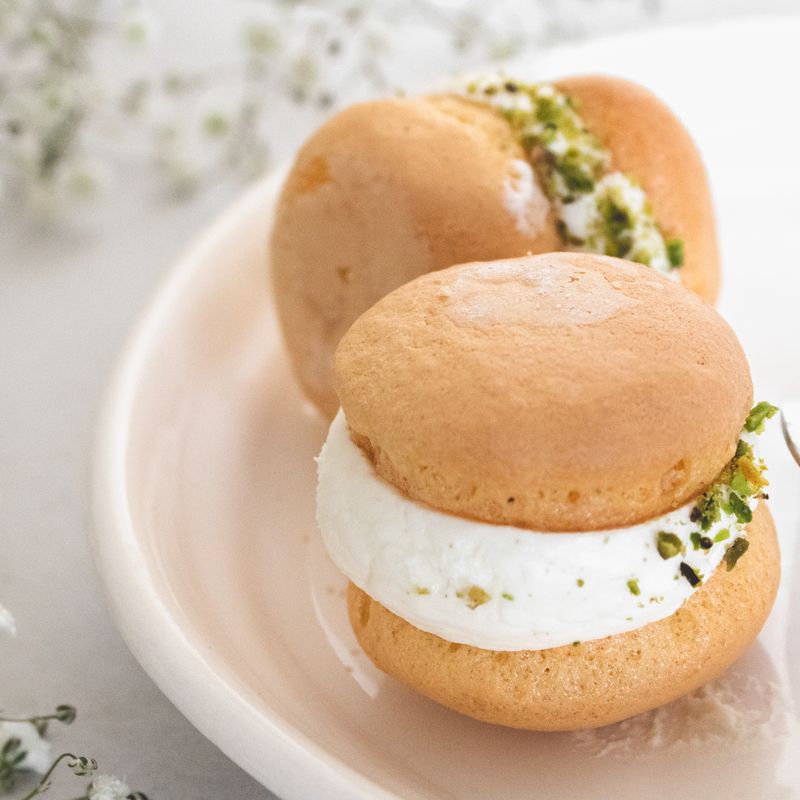
Ramadan Rose Water Choux Buns with Cream Filling
Delicate choux pastry buns infused with rose water, filled with rose water–scented whipped cream and topped with a light glaze. These elegant cream puffs blend French pastry technique with Middle Eastern flavors, making them an ideal dessert for Ramadan iftar celebrations. Light, airy, and subtly floral.
- Prep
- 25 min
- Cook
- 35 min
- Wait
- 45 min
- Total
- 1 hr 45 min
- Makes
- 12 choux buns
Steps
Before you start
- Preheat oven to 400°F (200°C) and line two baking sheets with parchment paper
- Have all ingredients at room temperature (eggs, milk, water) for smooth choux dough
- Measure rose water carefully—a little goes a long way; use a food-grade culinary variety
- Read through the choux pastry steps—timing and technique matter for proper rise
Make the choux dough baseOven 160°F / 70°C
- In a medium saucepan, combine water, milk, cold butter cubes, salt, and sugar.
- Place over medium heat and stir occasionally with a wooden spoon until the butter melts and the mixture comes to a gentle boil (about 5 minutes).
- The mixture should look emulsified and warm, around 160°F (70°C).
+ Show details− Hide details
Ready when: Butter fully melted and mixture at a gentle boil; steam visibly rising
Tip: Don't skip the cold butter cubes—they help create an even, emulsified mixture that leads to light, airy buns.
Add flour and mix
- Remove the saucepan from heat.
- Add the flour all at once and stir vigorously with the wooden spoon until the mixture is smooth, about 1 minute.
- The dough should pull away from the pan sides and form a shaggy ball.
- It will be quite thick and sticky.
+ Show details− Hide details
Ready when: Flour fully incorporated; dough forms a thick, cohesive ball
Tip: Stir immediately and thoroughly—lumpy flour pockets won't hydrate properly and will cause dense spots in the buns.
Cool and add eggs
- Let the dough cool in the pan for about 2–3 minutes (it should be warm but not steaming).
- Transfer to a mixing bowl if desired, then add the beaten eggs gradually, about ¼ of the mixture at a time, beating well after each addition with an electric mixer or vigorous whisking.
- The dough will look broken at first, then become glossy and smooth.
- After all eggs are incorporated, add the rose water and beat until fully combined.
- The final dough should be thick, smooth, and fall slowly from a spoon.
+ Show details− Hide details
Ready when: Dough is glossy, smooth, and holds a ribbon when lifted on a spoon
Tip: Add eggs in portions and beat well each time—rushing this step creates lumps that won't rise evenly. The dough should have a slight sheen and drop slowly from the spoon.
Pipe the buns
- Transfer the dough to a piping bag fitted with a ½-inch (1.25 cm) round tip.
- Pipe 12 mounds onto the two prepared baking sheets, spacing them about 2 inches (5 cm) apart.
- Each bun should be roughly the size of a walnut in its shell.
- Smooth any peaks by lightly dampening your finger and touching the top of each mound.
+ Show details− Hide details
Ready when: 12 evenly spaced, smooth mounds on baking sheets
Tip: Space them generously—they puff significantly and need room to expand without touching each other.
Bake the bunsOven 400°F / 205°C
- Bake at 400°F (200°C) for 25–30 minutes, until the buns are golden brown and feel firm when gently pressed (they should not spring back).
- Do not open the oven door during the first 20 minutes, or the buns may collapse.
- They are done when lightly tapped on the bottom, they sound hollow.
+ Show details− Hide details
Ready when: Golden brown exterior; firm to touch; hollow sound when tapped on the bottom
Tip: Resist the urge to open the oven early. The steam trapped inside is what makes them puff. They should be dry and crisp when done, not wet or dense.
Cool the buns
- Remove the baking sheets from the oven and transfer the buns to a wire rack.
- Let them cool for at least 10–15 minutes.
- Once cooled, use a small serrated knife to carefully slice each bun in half horizontally, creating a lid and a base.
- Gently scoop out any wet dough inside the center with a small spoon (this is normal and helps room for filling).
+ Show details− Hide details
Ready when: Buns cooled to room temperature; centers are hollow and free of excess moisture
Tip: Don't slice while hot—they'll collapse. If any soft, wet dough remains inside, gently remove it with a spoon to ensure a crisp texture.
Whip the cream filling
- Pour the cold heavy cream into a mixing bowl.
- Using an electric mixer or whisk, beat on medium-high speed until soft peaks form (about 2 minutes).
- Sift the powdered sugar over the cream and add the rose water.
- Continue beating until stiff peaks form, about 1–2 minutes more.
- Do not overbeat, or the cream will turn to butter.
+ Show details− Hide details
Ready when: Cream holds stiff peaks when the beater is lifted; no liquid visible
Tip: Keep the bowl and beaters cold. Stop beating as soon as stiff peaks form—overbeating will separate the cream and make it grainy.
Fill the buns
- Spoon or pipe the rose water whipped cream into the hollow base of each bun, filling it generously but not overflowing.
- Replace the lid at a slight angle for a classic cream puff look.
+ Show details− Hide details
Ready when: All 12 buns filled and topped
Tip: If the cream is too soft to hold the shape, refrigerate the buns for 10 minutes before filling to firm them up.
Make the glaze
- In a small bowl, whisk together the powdered sugar and water until smooth and pourable.
- The glaze should have a consistency like thin honey—thick enough to coat the bun lids but thin enough to drip slightly.
+ Show details− Hide details
Ready when: Smooth glaze with no lumps; consistency is pourable but not runny
Tip: Sift the powdered sugar first if it's lumpy, so your glaze stays glossy and smooth.
Glaze and garnish
- Dip the top (lid) of each filled bun lightly into the glaze, letting excess drip off.
- Place on a serving plate.
- While the glaze is still wet, sprinkle a few dried rose petals or chopped pistachios on top if desired.
- Let the glaze set for 5 minutes at room temperature before serving.
+ Show details− Hide details
Ready when: All buns glazed and garnished; glaze matte and set to the touch
Tip: If the glaze is too thick, add a few drops of water; if too thin, whisk in a bit more powdered sugar. The rose petals or pistachios stick best while the glaze is still tacky.
Good to know
Tips
- Rise and sheen matter: Choux dough that is glossy and falls slowly from a spoon will bake into light, airy buns. If the dough looks grainy or breaks apart when you add eggs, you may have added them too quickly or the dough was too hot.
- Don't skip the cooling step before slicing: Warm buns will collapse when you cut them. A 10–15 minute cool is enough; they don't need to be completely cold, just set on the outside.
- The dough inside the shells may be slightly wet or creamy after baking—this is normal and part of the choux pastry process. Remove excess with a spoon before filling.
- Rose water is powerful; use a culinary-grade variety and measure carefully. A little goes a long way. Start with the amounts given; you can always taste the cream and add a few drops more if you'd like it more floral.
Make ahead
The choux buns (unfilled) can be baked up to 1 day ahead. Store them in an airtight container at room temperature. Fill them no more than 2 hours before serving, as the cream will soften the shells. For longer storage, freeze the baked, unfilled buns (well wrapped) for up to 2 weeks; thaw at room temperature before filling.
Storage & reheating
Room temperature (filled): up to 2 hours. Refrigerator: up to 4 hours (cream will soften the shells gradually). Freezer (unfilled buns only): up to 2 weeks in an airtight container; thaw at room temperature and fill fresh. Do not freeze filled buns, as the cream will separate.
Substitutions
- rose water (culinary grade) → 1 teaspoon orange zest (finely minced) or ½ teaspoon vanilla extract. For a different floral or aromatic profile. Use the same amount, or reduce vanilla to ½ teaspoon as it is more potent than rose water.
- rose water (culinary grade) → ½ teaspoon vanilla extract or 1 tablespoon honey (or 15 ml). Vanilla adds a warm, classic flavor; honey adds subtle sweetness and depth. Omit one ingredient if using honey, as it adds moisture.
- heavy whipping cream, cold → Crème fraîche (1.5 cups / 360 ml) or mascarpone mixed with 2–3 tablespoons heavy cream to reach the same volume. Crème fraîche is tangier and more stable; mascarpone is richer and less likely to weep. Both create a slightly different but delicious texture.
- dried edible rose petals or pistachios, finely chopped → Toasted sliced pistachios, crushed freeze-dried berries, or a sprinkle of ground pistachios. Pistachios echo Middle Eastern flavors beautifully and add a subtle crunch. Berries provide tartness and color.