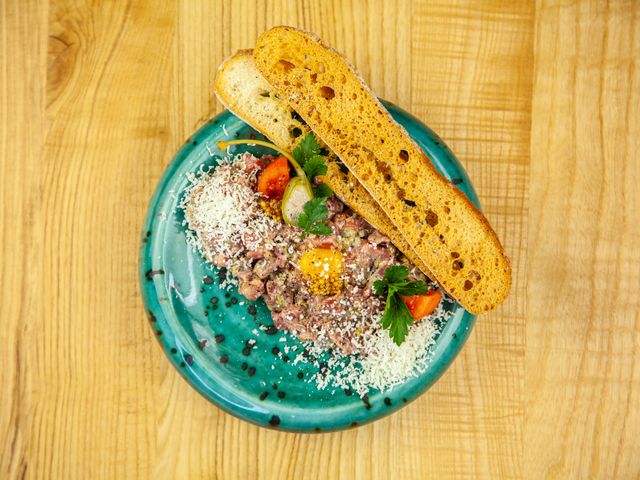
Party Smoked Trout and Horseradish Cream Crostini
Crispy sourdough crostini topped with tangy horseradish cream, silky smoked trout, and bright garnishes of fresh dill and capers. This Scandinavian-inspired appetizer uses sourdough discard, making it perfect for using up starter while impressing guests. The toasted bread provides a sturdy base for the creamy, briny, and herbaceous toppings.
Steps
Before you start
- Preheat your oven to 400°F (200°C)
- Have all toppings prepped and ready before assembling
- Allow smoked trout to come to room temperature for easier handling
Mix sourdough dough
- In a small bowl, stir together 0.5 cup (120 ml) sourdough discard, 2 tbsp (30 ml) neutral oil, 0.5 tsp (3 g) sea salt, and several generous grinds of cracked black pepper until well combined.
- The mixture should be loose and slightly sticky, almost like a thin pancake batter.
+ Show details− Hide details
Ready when: mixture is uniform and well combined
Tip: If your sourdough discard is very thick, add 1–2 tbsp water to loosen it so it spreads easily on the bread.
Spread and toast crostiniOven 400°F / 205°C
- Arrange 24 thin sourdough slices (about 0.25 inch / 6 mm thick) on two baking sheets in a single layer.
- Using a pastry brush or the back of a spoon, coat each slice with the sourdough oil mixture, spreading it to the edges.
- Bake in a preheated 400°F (200°C) oven for 12–15 minutes, rotating the sheets halfway through, until the crostini are golden brown and crispy throughout.
- The edges should be darker than the centers.
+ Show details− Hide details
Ready when: crostini are golden brown, crispy, and sound hollow when tapped
Tip: Thin, even slices ensure uniform toasting. If using a sourdough loaf not yet sliced, slice it on the bias for an elegant look.
Make horseradish cream
- While the crostini toast, prepare the topping.
- In a small bowl, whisk together 0.75 cup (180 ml) sour cream, 2 tbsp (20 g) finely grated fresh horseradish, 1 tbsp (15 ml) fresh lemon juice, and a pinch each of sea salt and cracked black pepper.
- Stir until smooth and well combined.
- Taste and adjust horseradish and lemon to your preference—the sauce should have a pleasant bite and tang.
+ Show details− Hide details
Ready when: sauce is smooth, creamy, and uniform in color
Tip: Fresh horseradish has a sharp, clean heat that fades quickly; jarred preparations are often milder and may contain additives, so adjust quantities to taste.
Cool and assemble crostini
- Remove the crostini from the oven and transfer them to a wire rack to cool for 2–3 minutes—they should still be warm but cool enough to handle comfortably.
- Once cooled, spread 1 tsp (5 ml) horseradish cream onto each crostino.
- Top with a small piece of smoked trout, then garnish with a pinch of fresh chopped dill and 2–3 capers.
- If using crème fraîche, add a small dollop on top for richness.
+ Show details− Hide details
Ready when: crostini are topped evenly and look appetizing
Tip: Assemble crostini close to serving time so the bread stays crispy; if prepared more than 30 minutes ahead, the cream will soften the toast.
Good to know
Tips
- Use sourdough discard that is at peak activity (bubbly and risen) for the most flavor, but unfed starter works fine if that's what you have on hand.
- For a party, toast the crostini in advance and store them in an airtight container, then assemble just before serving so they stay crispy.
- If fresh horseradish is unavailable, good-quality prepared horseradish from a jar is a reliable backup; taste first as brands vary in heat level.
- Capers add crucial briny notes and textural interest; if you don't have nonpareil (small) capers, chop larger capers into smaller pieces.
Storage & reheating
The untopped crostini may be stored in an airtight container at room temperature for up to 2 days. Reheat in a 350°F (175°C) oven for 3–4 minutes to restore crispness. The horseradish cream can be made up to 1 day ahead and refrigerated in an airtight container; assemble the crostini no more than 30 minutes before serving to keep the bread from becoming soft.
Substitutions
- fresh horseradish root, peeled → prepared horseradish in a jar (2 tsp / 10 g), drained of excess liquid. Jarred horseradish is milder and more shelf-stable than fresh; rinse it briefly to remove excess vinegar if the sauce tastes too sharp.
- smoked trout fillet, skin removed → smoked salmon, mackerel, or halibut (same weight). These smoked fish work equally well; choose based on availability and preference. Smoked salmon is milder; smoked mackerel is richer.
- full-fat sour cream → Greek yogurt (full-fat) or crème fraîche. Greek yogurt is tangier and slightly thinner; use 0.5 cup (120 ml) and thin with 2–3 tbsp water. Crème fraîche is richer and less sour.
- fresh dill fronds → fresh tarragon or fennel fronds, or 1 tsp (1 g) dried dill. Tarragon adds anise-like notes; fennel is more delicate. If using dried dill, use half the amount.