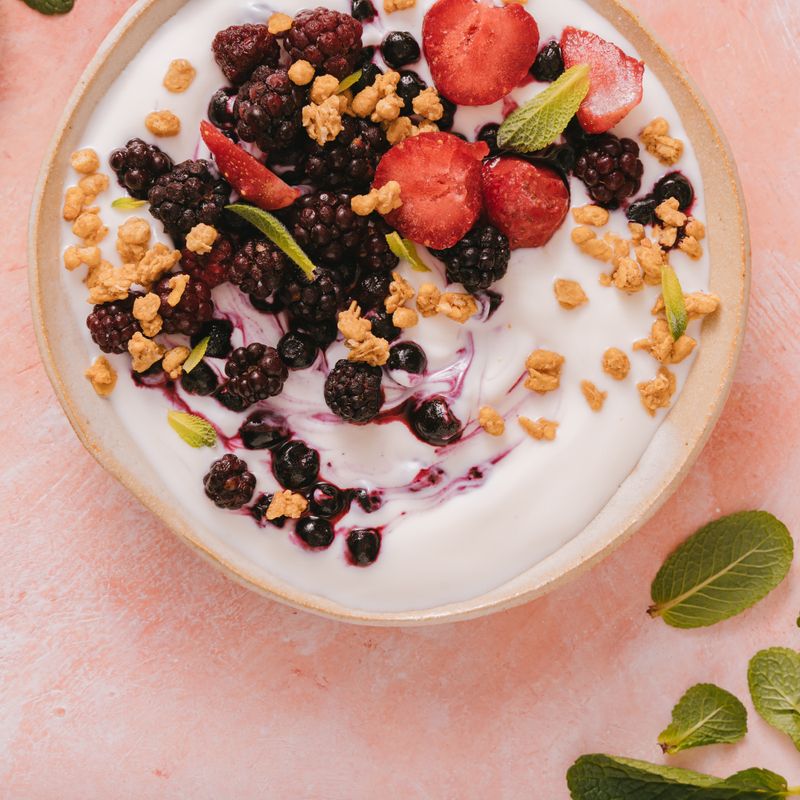
One-Pot Yogurt Muhallebi with Berry Compote
A silky, creamy Middle Eastern custard made with yogurt and milk, thickened with cornstarch and delicately flavored with rose water and cardamom. The pudding sets lightly and is finished with a tart-sweet berry compote that cuts through the richness. Served chilled, this is an elegant, not-too-sweet dessert that feels special without fussy technique. The entire recipe—custard and fruit topping—comes together in one pot, making it ideal for weeknight entertaining.
- Prep
- 15 min
- Cook
- 15 min
- Wait
- 2 hr
- Total
- 2 hr 30 min
- Makes
- 6 servings (about 4 cups total, with compote)
Steps
Before you start
- Have a fine-mesh sieve ready to strain yogurt if using full-fat plain yogurt (Greek yogurt does not need straining).
- Measure all dry ingredients and spices before you start cooking.
- Chill serving bowls in the freezer for 15 minutes before plating if time allows—this keeps the delicate custard cool.
Mix cornstarch slurry
- Pour ¼ cup (60 ml) of the whole milk into a small bowl.
- Add the 3 tablespoons (24 g) of cornstarch and whisk until completely smooth, with no lumps.
- Set aside.
- This prevents lumps from forming when the cornstarch hits hot liquid.
+ Show details− Hide details
Ready when: Mixture is smooth and pourable
Tip: Whisk thoroughly—any lumps of cornstarch will show as grainy texture in the finished custard.
Combine yogurt and remaining milk
- In a medium heavy-bottomed pot (3-quart / 2.8 L), whisk together the 2 cups (500 g) of Greek yogurt and the remaining 1¼ cups (300 ml) of whole milk until smooth.
- The mixture should be homogeneous with no streaks of yogurt visible.
+ Show details− Hide details
Ready when: Yogurt and milk are evenly combined
Tip: Use Greek yogurt—its thickness blends more smoothly into the milk. Regular yogurt will be harder to incorporate without lumps.
Heat yogurt mixtureOven 180°F / 80°C
- Set the pot over medium heat.
- Stir frequently with a wooden spoon or silicone spatula, moving to all corners and the bottom, as the mixture heats.
- You are aiming for the mixture to reach 180°F (82°C), which takes about 5–6 minutes.
- The mixture should steam gently and feel very warm to the touch but not yet bubble or simmer.
- Do not leave it unattended.
+ Show details− Hide details
Ready when: Mixture reaches 180°F (82°C) and steams gently; small wisps of steam rise from the surface
Tip: Use a thermometer if you have one; this prevents overheating, which can cause the yogurt to curdle. If you don't have a thermometer, stop just before the mixture would bubble at the edges.
Add honey and spices
- Remove the pot from heat.
- Add the 3 tablespoons (45 g) of honey, ½ teaspoon (2.5 ml) of rose water, ¼ teaspoon (0.5 g) of ground cardamom, and a small pinch of sea salt.
- Whisk until the honey is fully dissolved and spices are evenly distributed.
+ Show details− Hide details
Ready when: Honey is fully dissolved and mixture is smooth
Tip: Whisk in the rose water carefully—a little goes a long way. It should add a subtle floral note, not an overpowering perfume.
Temper and add cornstarch slurry
- Return the pot to medium heat and bring the yogurt mixture to a gentle simmer (you will see bubbles forming slowly at the edges and small bubbles rising through the middle).
- Once simmering, slowly pour in the cornstarch slurry while whisking constantly.
- Whisk for 1–2 minutes after the cornstarch is fully incorporated, until the mixture thickens slightly and coats the back of a spoon.
- The mixture should flow slowly off a spoon rather than run off immediately.
+ Show details− Hide details
Ready when: Mixture thickens and coats the back of a spoon; when you run your finger across the spoon, it leaves a faint trail
Tip: Whisk constantly while adding the slurry so it doesn't clump. If lumps form, pour through a fine-mesh sieve immediately to remove them.
Cool custard and transfer
- Pour the muhallebi into a shallow dish or divide among serving bowls.
- If using one shallow dish, cover the surface directly with plastic wrap (this prevents a skin from forming on top).
- Let the custard cool to room temperature on the counter, about 30 minutes, then refrigerate for at least 1.5 hours until well chilled.
+ Show details− Hide details
Ready when: Custard is firm enough to hold a slight mound when spooned, and is very cold
Tip: Do not skip the cooling step—the muhallebi will taste better and have a better texture when fully chilled. It continues to thicken slightly as it cools.
Make berry compote
- In the same pot (rinsed if needed), combine the 2 cups (250 g) of fresh or thawed berries, 2 tablespoons (30 g) of honey, and 1 tablespoon (15 ml) of fresh lemon juice.
- Set over medium heat.
- Stir gently with a wooden spoon, breaking apart the berries slightly as they heat, for 5–7 minutes.
- The berries should release their juice and begin to break down; the mixture should look glossy and jammy.
- If using vanilla extract, stir it in now.
- Remove from heat and let cool to room temperature, about 15 minutes.
+ Show details− Hide details
Ready when: Berries have broken down and released their juice; mixture is glossy and moves slowly in the pot
Tip: Do not over-cook the compote—you want some berry texture remaining, not a smooth jam. If the berries are very large, break them with the back of the spoon as they heat.
Serve
- Spoon the chilled muhallebi into individual bowls (or serve from the shallow dish).
- Top each serving with a generous spoonful of the cooled berry compote, allowing the bright juices to drip into the cream.
- Serve immediately while the muhallebi is cold and the compote is still at room temperature.
+ Show details− Hide details
Tip: The contrast of chilled custard and room-temperature compote is part of the appeal—don't refrigerate the compote if you can help it.
Good to know
Tips
- Rose water and cardamom are essential to authentic muhallebi flavor—do not skip them if possible. Even just ½ teaspoon of rose water makes a noticeable difference.
- The muhallebi is delicate and should just barely set. It will feel looser than a thick pudding or mousse—that silky, spoonable texture is the hallmark of this dessert.
- If the compote breaks down into almost a jam, you can add 2–3 tablespoons of water to loosen it back to a glossy, saucy consistency.
- A sprinkle of unsalted pistachios or sliced almonds toasted just before serving adds texture and an elegant finish to individual servings.
Make ahead
The muhallebi can be made up to 2 days ahead and stored covered in the refrigerator. The berry compote can also be made up to 1 day ahead. Assemble just before serving so the compote remains at room temperature against the chilled custard.
Storage & reheating
Store the muhallebi and compote separately. Muhallebi: covered, in the refrigerator for up to 3 days. Compote: covered, in the refrigerator for up to 3 days. Reheat compote gently on the stovetop over low heat for 2–3 minutes if you prefer it warm. Do not freeze either component—the texture of the custard will break down when thawed.
Substitutions
- Greek yogurt, plain, full-fat → Plain full-fat yogurt (not Greek), strained through cheesecloth for 30 minutes to remove excess whey. Regular yogurt is thinner and must be drained to avoid a watery custard. Greek yogurt is a shortcut to the same thickness without extra work.
- rose water → Orange blossom water, in the same quantity, or omit entirely for a simpler custard. Rose water and orange blossom water are traditional flavorings for muhallebi. Omitting either shifts the dessert toward plain vanilla-cream territory.
- fresh mixed berries (blackberries, raspberries, blueberries), or frozen → Poached stone fruit (peaches, apricots, plums), diced; or a compote made from pomegranate seeds simmered with honey and lemon juice. Any tart-sweet fruit compote works. Adjust honey in the compote to taste depending on the fruit's natural sweetness.
- ground cardamom → Ground cinnamon (use ⅛ teaspoon) or a pinch of ground clove (use less—clove is stronger). Cardamom is classic in Middle Eastern custards, but cinnamon or clove offer a different warm spice profile. Do not use both together.
More puddings & custards
See all →
Find more like this
- Meal
- Dessert
- Cuisine
- Middle Eastern
- Main ingredient
- Berries