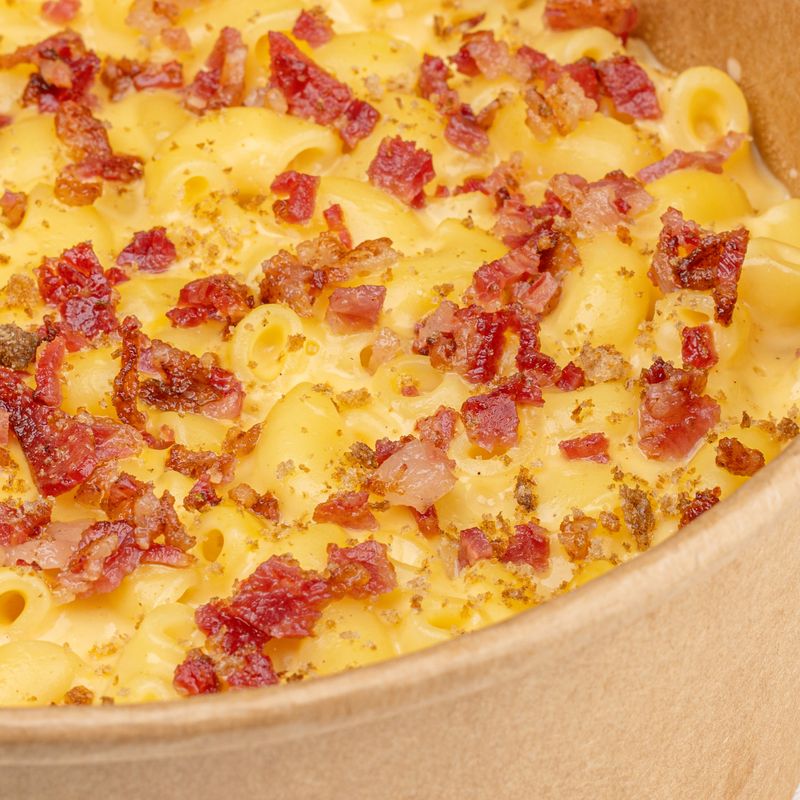
One-Pot Baked Mac and Cheese with Bacon
A creamy, stovetop-to-oven mac and cheese that comes together in one Dutch oven. Crispy bacon and a smooth cheddar sauce coat tender pasta, finished with a buttery panko topping that turns golden in the oven. Ready in about 80 minutes with mostly hands-off baking time.
- Prep
- 15 min
- Cook
- 1 hr
- Wait
- 5 min
- Total
- 1 hr 20 min
- Makes
- Serves 6, about 1.5 cups per serving (one 6-quart pot)
Steps
Before you start
- Use a 6-quart oven-safe Dutch oven or pot so you can go straight from stovetop to oven
- Shred cheese from a block instead of using pre-shredded—it melts much more smoothly into the sauce
- Have all ingredients measured and ready before you start cooking
- If using thick-cut bacon, cut it into 1/4-inch pieces so it disperses evenly
- Preheat your oven while you're making the sauce in step 4
Cook and crumble bacon
- Cut the bacon into 1/4-inch pieces and place them directly into your 6-quart Dutch oven or oven-safe pot.
- Cook over medium heat, stirring occasionally, for 8–10 minutes until the bacon is crispy and golden brown.
- Use a slotted spoon to transfer the bacon to a paper towel–lined plate.
- Leave about 2 tablespoons of bacon fat in the pot; discard or reserve the rest for another use.
+ Show details− Hide details
Ready when: bacon is crispy and golden brown with no pink
Tip: Don't pour out all the bacon fat—it adds deep, savory flavor to your cheese sauce. If there's a lot of excess (more than 3 tablespoons total), pour some out.
Boil the pasta
- Add 4 quarts (4 liters) of water to the same pot and bring it to a boil over high heat, about 10 minutes.
- Once boiling, add about 1–2 tablespoons of salt and the elbow macaroni.
- Stir well to separate the pieces.
- Cook for 1–2 minutes less than the package directions (e.g., if the box says 8 minutes, cook for 6–7 minutes).
- The pasta should be slightly firm to the bite—it will finish cooking in the oven.
- Drain the pasta in a colander and set aside.
- Wipe the pot dry with paper towels to remove excess water.
+ Show details− Hide details
Ready when: pasta is slightly firm (1–2 minutes under al dente)
Tip: Undercooking the pasta is crucial—it will soften further in the oven and won't turn mushy. Test a piece by biting it; you should feel a tiny firmness in the center.
Make the roux base
- Return the pot to medium heat.
- Add 4 tablespoons of butter and allow it to melt completely, about 1 minute.
- Whisk in the all-purpose flour until no dry bits remain—it will look like wet sand.
- Cook, stirring constantly with a whisk or wooden spoon, for 1–2 minutes.
- You'll notice the roux will change from floury to glossy and will smell nutty and toasted.
- Do not let it brown.
+ Show details− Hide details
Ready when: mixture is light golden, glossy, and smells nutty
Tip: Stir constantly to prevent the flour from burning. A roux that smells acrid or looks dark brown will taste bitter and ruin your sauce.
Build the cheese sauce
- Remove the pot from the heat.
- Pour the whole milk slowly into the roux while whisking constantly—this is key to avoiding lumps.
- Once the milk is mostly incorporated, return the pot to medium heat and whisk steadily for 2–3 minutes until the mixture thickens and coats the back of a spoon.
- Remove from heat again.
- Add the shredded sharp cheddar cheese, Dijon mustard, and a pinch each of salt and black pepper.
- Stir gently until the cheese is fully melted and the sauce is smooth and glossy.
- Taste and adjust the seasoning—the sauce should taste rich, tangy, and well-salted.
+ Show details− Hide details
Ready when: sauce coats the back of a spoon and cheese is completely melted
Tip: If lumps do form while adding the milk, push the sauce through a fine-mesh sieve or use an immersion blender. Remove the pot from heat before adding cheese to prevent it from becoming grainy.
Combine pasta and bacon with sauce
- Add the cooked pasta and crumbled bacon to the warm cheese sauce in the pot.
- Stir gently but thoroughly until every piece of pasta is coated with creamy sauce.
- The mixture should look cohesive and glossy, not dry or clumpy.
- Taste again and adjust salt and pepper if needed—remember, the bacon adds saltiness.
+ Show details− Hide details
Ready when: every piece of pasta is evenly coated with sauce
Tip: Stir gently to avoid breaking the pasta. If the mixture seems too thick, you can add a splash more milk and stir; if too thin, it will set as it bakes.
Make the breadcrumb toppingOven 375°F / 190°C
- Preheat your oven to 375°F (190°C).
- In a small bowl, toss the panko breadcrumbs with 2 tablespoons of melted butter and a small pinch of salt until the crumbs are evenly moistened and golden-looking.
- Spread the breadcrumb mixture evenly over the top of the mac and cheese in the pot, covering as much surface as you can.
- You can use your fingers or the back of a spoon to distribute it.
+ Show details− Hide details
Ready when: breadcrumbs are evenly moistened and coat the top
Tip: The butter is essential—it helps the crumbs brown and crisp in the oven. Don't skip it. If your breadcrumbs are very large, gently crush them between your fingers as you toss them.
Bake until goldenOven 375°F / 190°C
- Place the pot on the center rack of your preheated 375°F (190°C) oven.
- Bake for 25–30 minutes until the breadcrumb topping is golden brown and the cheese sauce is bubbling gently at the edges (you'll see it creeping up the sides of the pot).
- If the topping is browning too quickly before the edges bubble, loosely tent the pot with aluminum foil for the last 10 minutes.
+ Show details− Hide details
Ready when: top is deep golden brown and sauce bubbles at the pot's edge
Tip: Watch after 20 minutes to catch the browning at the right moment. A little dark brown is good; black means it's overbaked. The bubbling at the edges tells you the sauce has reached a simmer underneath.
Rest before serving
- Remove the pot from the oven and set it on a trivet or heat-safe surface.
- Let the mac and cheese rest, uncovered, for 5 minutes.
- This allows the sauce to firm up slightly so it holds together when you scoop and serve it.
- Stir gently once or twice to distribute the sauce, then spoon into bowls or onto plates and serve hot.
+ Show details− Hide details
Ready when: sauce has thickened enough that it clings to the pasta without running
Tip: If you serve immediately, the sauce will be quite loose and may look separated—this is normal but the resting time prevents it. The mac and cheese will also stay hotter longer if you let it rest.
Good to know
Tips
- Shredding cheese from a cold block takes effort but is worth it—pre-shredded cheese coats itself with anti-caking powder, which creates graininess in your sauce. If you must use pre-shredded, toss it lightly with a tiny pinch of cornstarch instead.
- Cook the pasta 1–2 minutes under al dente. It will soften further in the oven and from the residual heat of the sauce. Overcooked pasta turns mushy and breaks apart.
- Bacon fat is liquid gold for this sauce. Its saltiness and smokiness are essential to the final flavor. If you have more than 3 tablespoons in the pot after draining, pour off the excess, but don't drain it completely.
- If the top browns too quickly, tent loosely with foil—this prevents the breadcrumbs from burning while the inside heats through. Remove the foil in the last 2–3 minutes to re-crisp the top if needed.
Make ahead
You can assemble the entire dish (through step 5) up to 1 day ahead. Cover and refrigerate in the pot or transfer to a baking dish. When ready to bake, add the breadcrumb topping and bake for 30–35 minutes (add 5 minutes to account for the cold filling). The flavors deepen after a day in the fridge.
Storage & reheating
Store leftovers in an airtight container in the refrigerator for up to 4 days. Reheat in a 325°F (160°C) oven, covered with foil, for 15–20 minutes until heated through. You can freeze the baked mac and cheese (without the topping) for up to 3 months in a freezer-safe container; thaw overnight in the fridge and reheat in the oven for 20–25 minutes. Do not freeze with the breadcrumb topping, as it will become soggy—add a fresh topping before reheating if desired.
Substitutions
- sharp cheddar cheese → Mix 2 cups sharp cheddar with 1 cup gruyère, smoked gouda, or aged white cheddar. This adds complexity and depth. Avoid mild cheddars, which will taste bland in baked mac.
- elbow macaroni pasta → Use cavatappi, shells, ditalini, or penne—any short, sturdy pasta shape. Avoid long pasta or thin shells, which will overwhelm the dish. Short tubular shapes trap sauce best.
- bacon, thick-cut → Use 6 oz diced smoked ham, diced Canadian bacon, or crumbled cooked sausage. Ham and Canadian bacon are leaner; sausage adds a different spice profile. Cook each until crispy before adding.
- panko breadcrumbs → Mix 1/2 cup panko with 1/4 cup freshly grated Parmesan cheese and 1 tablespoon fresh thyme leaves. This adds richness and herbaceous notes. Toss with the butter as directed. You can also use crushed potato chips or crushed crackers, though the texture will differ.
More baked pasta
See all →


Find more like this
- Meal
- Dinner
- Cuisine
- American
- Diet
- Sugar-Free