Moroccan Mille-Feuille with Filo and Custard
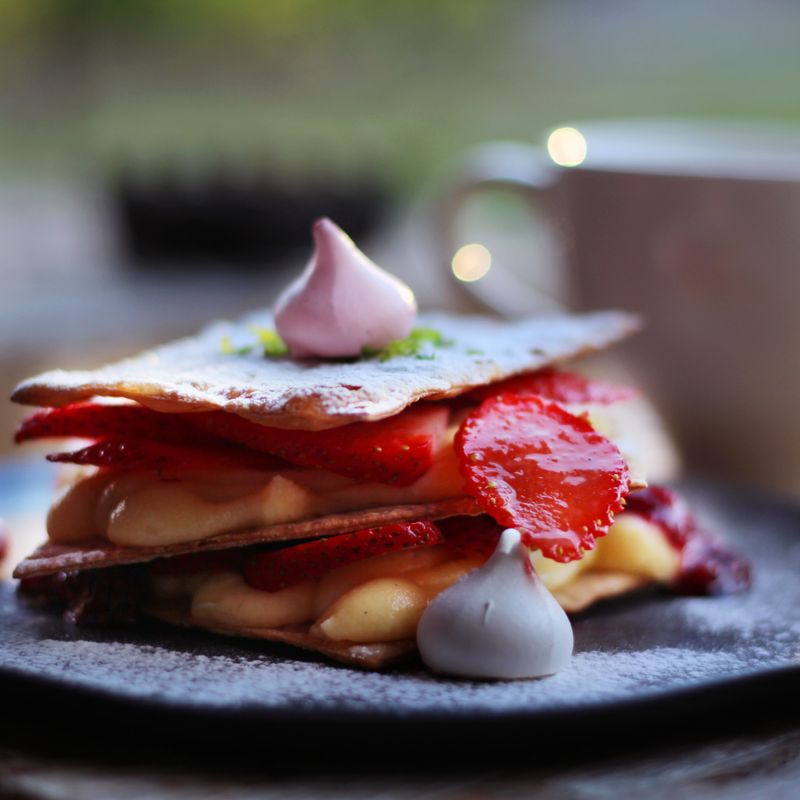
A stunning Moroccan take on the classic French mille-feuille, featuring delicate layers of crispy filo pastry brushed with warm ghee and filled with silky orange-scented custard cream. Topped with toasted almonds and a whisper of cinnamon, each layer shatters to reveal the creamy interior. Perfect for special occasions or when you want to impress—more approachable than it sounds.
- Prep
- 30 min
- Cook
- 35 min
- Wait
- 45 min
- Total
- 1 hr 50 min
- Makes
- 1 pastry cake (8 slices)
Steps
Before you start
- Remove phyllo dough from refrigerator 30 minutes before using so it comes to room temperature and doesn't crack
- Preheat oven to 375°F (190°C)
- Have a damp kitchen towel ready to cover unused phyllo sheets as you work
- Toast almond slivers in a dry skillet over medium heat for 3–4 minutes until fragrant, then set aside to cool
Make the custard base
- In a medium saucepan, combine the milk and heavy cream over medium heat.
- Warm gently until small bubbles form around the edges—do not boil.
- Meanwhile, whisk together the egg yolks, sugar, and cornstarch in a bowl until pale and thick (about 1 minute).
- Add the orange zest and a pinch of salt, whisking to combine.
+ Show details− Hide details
Ready when: Milk shows small bubbles at the edges; no large rolling boil
Tip: Warming the milk prevents the eggs from scrambling when you temper them next.
Temper the egg mixture
- Slowly pour about ½ cup (120 ml) of the warm milk into the egg mixture while whisking constantly.
- This tempers the eggs gradually.
- Then pour the egg mixture back into the saucepan with the remaining milk, whisking continuously.
+ Show details− Hide details
Ready when: Mixture is smooth and uniform with no visible egg streaks
Tip: Whisk vigorously—any hesitation risks scrambled eggs.
Cook the custard until thick
- Return the saucepan to medium heat and cook, stirring constantly with a whisk, for 4–5 minutes until the custard thickens to a pudding-like consistency and coats the back of a spoon.
- Watch for gentle steam; do not let it boil rapidly.
- Remove from heat, stir in the vanilla extract and orange blossom water (if using).
+ Show details− Hide details
Ready when: Custard coats the back of a spoon; a finger drawn across leaves a trail
Tip: Constant stirring prevents lumps and burning on the bottom. If lumps form, push the custard through a fine sieve.
Cool and chill the custard
- Press a piece of plastic wrap directly onto the surface of the custard to prevent a skin from forming.
- Refrigerate for at least 30 minutes, or until completely chilled and set.
- The custard should be firm enough to spread.
+ Show details− Hide details
Ready when: Custard is cold, firm, and holds its shape when spooned
Tip: Make the custard up to 1 day ahead so it is well chilled before assembly.
Preheat and prepare the panOven 375°F / 190°C
- Preheat the oven to 375°F (190°C).
- Lightly brush the bottom and sides of a 9×13-inch (23×33 cm) baking pan with melted ghee.
- Have a damp kitchen towel ready to cover the phyllo sheets as you work so they don't dry out and crack.
+ Show details− Hide details
Tip: A damp towel draped over unused phyllo is essential—these sheets dry out in seconds.
Layer the first phyllo sheets
- Lay one phyllo sheet in the prepared pan.
- Using a pastry brush, brush the entire sheet lightly with melted ghee.
- Repeat with 3 more phyllo sheets, brushing each layer.
- You now have 4 stacked, ghee-brushed layers.
- This first group will be the bottom crust.
+ Show details− Hide details
Ready when: Bottom phyllo base is evenly coated and layered
Tip: If a phyllo sheet tears, press it together—ghee and the layers above will hide small tears.
Spread the custard filling
- Spoon the chilled custard onto the phyllo base and spread it in an even layer using an offset spatula or the back of a spoon, leaving about ½ inch (1 cm) of space from the edges.
- Work gently so you don't crack the delicate phyllo below.
+ Show details− Hide details
Ready when: Custard is spread in an even layer with clean, visible phyllo border
Tip: A light hand prevents pressing down and breaking the crispy base layers.
Layer the top phyllo sheets
- Lay the remaining 4 phyllo sheets over the custard filling, brushing each one with ghee as you stack.
- Make sure each sheet is fully covered with ghee so the layers will be golden and crispy, not pale and tough.
+ Show details− Hide details
Ready when: Top phyllo base is evenly coated and layered
Tip: Generous ghee = crunchy, golden pastry. Stingy ghee = chewy, disappointing results.
Score and top the pastry
- Using a sharp knife, lightly score the top phyllo into 8 rectangular portions (cut lengthwise twice and crosswise once to divide the 9×13-inch pan into 8 pieces).
- Do not cut all the way through—just score the top 2–3 sheets so filling doesn't leak.
- Sprinkle the toasted almond slivers evenly over the surface, then dust lightly with ground cinnamon.
+ Show details− Hide details
Ready when: Pastry is scored into 8 portions with almonds and cinnamon on top
Tip: Scoring before baking makes it much easier to cut clean slices after baking.
Bake until goldenOven 375°F / 190°C
- Place the pan in the preheated 375°F (190°C) oven and bake for 25–30 minutes, until the top is deep golden brown and the pastry is crispy.
- The edges may brown faster; if they darken too quickly, loosely tent with foil for the last 5–10 minutes.
+ Show details− Hide details
Ready when: Top is deep golden brown; pastry is crisp and makes a crackling sound when pressed gently
Tip: If the phyllo is browning too fast, tent with foil—the residual heat will continue crisping the layers.
Cool before serving
- Remove from the oven and let the pastry rest on a cooling rack for 10–15 minutes.
- This allows the custard to set slightly and makes slicing cleaner.
- While still warm, use the scored lines to cut through all the way to the bottom, creating 8 slices.
- If desired, dust each slice lightly with powdered sugar.
+ Show details− Hide details
Ready when: Pastry is warm to the touch, slightly firm; slices cut cleanly along scored lines
Tip: Cutting while warm ensures sharp, clean slices. A thin, sharp knife dipped in hot water between cuts helps.
Serve
- Transfer slices to serving plates while still warm or at room temperature.
- The pastry will stay crisp for a few hours.
- Serve with fresh mint tea or strong coffee for an authentic Moroccan experience.
+ Show details− Hide details
Tip: Leftover slices can be reheated gently in a 300°F (150°C) oven for 5 minutes to restore crispness.
Good to know
Tips
- If your phyllo sheets are 9×14 inches instead of 14×18 inches, you may need 1–2 extra sheets to cover the pan adequately. Have backup sheets on hand.
- For extra visual drama, reserve a few extra almond slivers and press them into the warm custard along the cut lines before baking.
- Orange-scented pastries pair beautifully with Moroccan mint tea (about 1 teaspoon dried spearmint per cup of hot water) or strong black coffee.
- The key to a crispy phyllo exterior is generous brushing with ghee—do not skimp. Pastry brushes with natural bristles work best and won't shed plastic bristles into your pastry.
Make ahead
Custard can be made up to 1 day ahead and refrigerated. Assemble and bake the pastry on the day of serving for the crispest result. Unbaked assembled pastry can be covered loosely and refrigerated for up to 4 hours, then baked directly from the cold (add 5–10 minutes to baking time).
Storage & reheating
Store covered at room temperature for up to 4 hours (pastry will soften slightly). Refrigerate leftovers in an airtight container for up to 2 days; reheat in a 300°F (150°C) oven for 5–7 minutes to crisp. Do not freeze—the phyllo becomes tough upon thawing.
Substitutions
- heavy cream → whole milk. Use 2 cups (475 ml) whole milk total instead of milk and cream. The custard will be slightly thinner but still delicious.
- orange blossom water (optional but recommended) → 1 teaspoon finely grated lemon zest or 2 teaspoons rose water. Lemon gives brightness; rose water adds a floral, distinctly Moroccan note if you prefer that over orange blossom.
- ghee or clarified butter, melted → unsalted butter, melted. Use the same amount. Ghee has a higher smoke point and nuttier flavor, but butter works if ghee is unavailable.
- blanched almond slivers, toasted → chopped pistachios or a mix of sliced almonds and pine nuts. Any nuts work; toast them first. Pistachios add a subtle green color and earthier flavor.