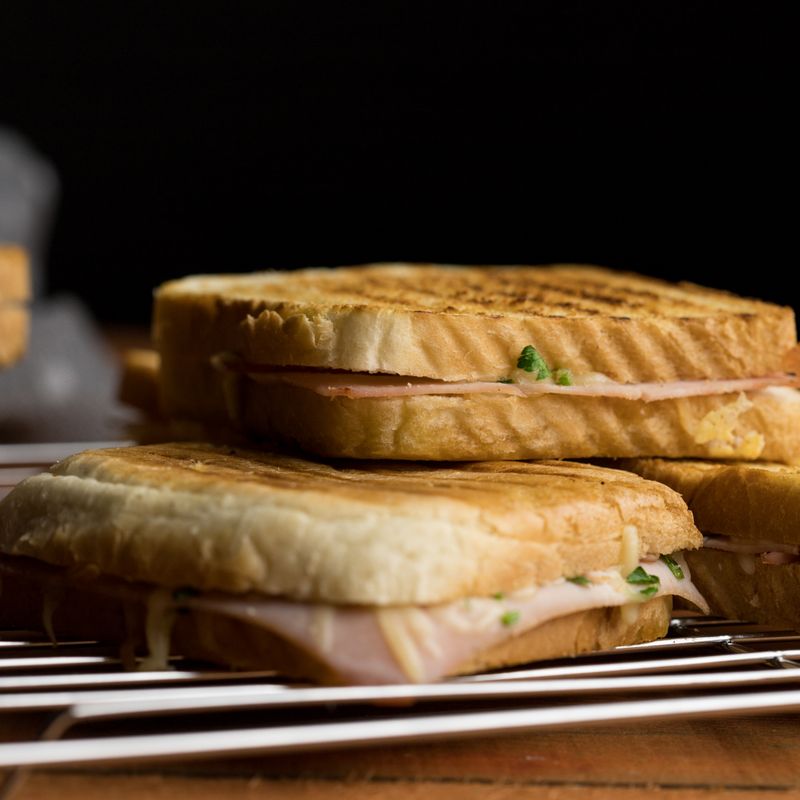
Medianoche Sandwich
A Cuban late-night sandwich made with soft, slightly sweet egg bread layered with sliced ham, tender roasted pork, Swiss cheese, and briny dill pickles, then pressed on a griddle until golden and crispy. The sweet pan de huevo bread sets this apart from the denser Cuban sandwich—it yields easily to reveal a warm, melted interior.
Steps
Before you start
- Prepare or source roasted pork ahead (can be made 2–3 days in advance or purchased from a Latin market or restaurant). If preparing your own, ensure the pork reaches an internal temperature of 145°F (63°C) for food safety. Bring to room temperature or warm gently before assembling sandwiches.
- Have a panini press or cast-iron skillet ready. If using a press, know that cooking time on the press is 8–10 minutes per batch.
- Soften the butter at room temperature for 15–20 minutes so it spreads easily without tearing the delicate bread.
Assemble sandwich layers
- Lay out 4 slices of sweet egg bread on a cutting board.
- On each slice, layer in order: 1 oz (28 g) ham, 2 oz (57 g) roasted pork, 1 oz (28 g) cheese, and 4–5 dill pickle slices (approximately 1 pickle per sandwich, thinly sliced).
- Top each stack with the remaining 4 bread slices, one per sandwich.
- Press gently with your hand so the layers adhere and the sandwich feels slightly compact.
+ Show details− Hide details
Ready when: All 4 sandwiches assembled with ingredients evenly distributed and layers adhering
Tip: Arrange pickles in a single, thin layer rather than piling them in one spot—this prevents the sandwich from being soggy or pressing unevenly.
Butter the exterior
- Spread 1/2 tablespoon (7 g) of softened butter on the outside top surface of each sandwich.
- Flip and spread another 1/2 tablespoon (7 g) on the outside bottom.
- Work quickly and gently, ensuring even, light coverage.
- The butter should create a thin, consistent coat on all exposed bread surfaces, not thick clumps.
+ Show details− Hide details
Ready when: All external surfaces of all 4 sandwiches lightly and evenly coated with softened butter
Tip: Use softened butter, not cold—cold butter will tear the delicate pan de huevo bread. If butter is still too firm, let it sit another 5 minutes.
Preheat the cooking surfaceOven 400°F / 205°C
- If using a panini press: preheat to medium-high heat (about 400°F / 200°C) for 2–3 minutes.
- If using a cast-iron skillet: place it over medium-high heat and preheat for 2–3 minutes until a small flick of water sizzles immediately on contact.
+ Show details− Hide details
Ready when: Press is evenly hot; skillet surface is hot and dry with no water droplets
Tip: A properly heated surface is critical—if too cool, the bread will be soft and soggy; if too hot, it will char before the cheese melts.
Cook first batch
- Place 2 buttered sandwiches on the hot surface.
- If using a panini press: close the top plate gently and press for 8–10 minutes.
- The sandwich should feel firm when pressed, and you may hear a light sizzle.
- If using a skillet: place the 2 sandwiches in the pan, then use another skillet placed on top, a cast-iron weight, or press gently and repeatedly with a spatula.
- Cook for 4–5 minutes until the bottom is golden brown and slightly crispy with light char marks.
- Carefully flip using a spatula and cook the other side for another 4–5 minutes until also golden and the cheese is fully melted (you will see it oozing slightly from the edges).
+ Show details− Hide details
Ready when: Bread is golden brown with light char marks; cheese is visibly melted and slightly oozing at edges; interior is warm and soft when gently pressed
Tip: On a skillet, resist the urge to flip too early—wait until the bottom is well-browned and releases easily. Flipping too soon will create a pale, soft crust.
Cook second batch
- Transfer the first batch of 2 cooked sandwiches to a cutting board or serving plate and let rest for 1–2 minutes while the bread sets and firms slightly.
- Return the press or skillet to medium-high heat.
- Place the second batch of 2 buttered sandwiches on the hot surface and repeat: panini press for 8–10 minutes, or skillet with flip method for 4–5 minutes per side, until the bottom is golden, the cheese is visibly melted, and the interior is warm.
+ Show details− Hide details
Ready when: Second batch golden brown with light char; cheese fully melted; interior warm
Tip: Letting the first batch rest for 1–2 minutes on a warm plate allows the bread to firm up, so it won't fall apart when you cut or bite into it.
Slice and serve
- Using a sharp serrated knife, carefully cut each sandwich diagonally into two triangles.
- Arrange on serving plates and serve immediately while the cheese is still warm and the bread is crispy on the outside.
+ Show details− Hide details
Ready when: Sandwiches cleanly sliced into triangles; ready to serve
Tip: The diagonal cut is traditional and makes the sandwich easier to hold and eat. Serve immediately—the contrast between crispy exterior and warm, melted interior is essential to a great medianoche.
Good to know
Tips
- Quality ingredients matter immensely: use real ham (not processed deli meat), authentic roasted pork from a Latin market or restaurant, and good-quality Swiss cheese. The flavor of a medianoche depends entirely on these three elements.
- The dill pickle is essential—it provides the sharp, acidic contrast that cuts through the richness of the ham, pork, and cheese. Omitting it will make the sandwich taste flat and overly rich.
- Press sandwiches firmly but gently. You want the layers compact and the cheese fully melted, but not squeezed so hard that the filling spills out the sides or the bread becomes dense.
- For authentic roasted pork (lechón), seek it out at a Cuban or Latin American market, restaurant, or bakery. Many offer pre-roasted pork by the pound. If making your own, a pork shoulder roasted with mojo (citrus, garlic, cumin) until shreddable is ideal, though simple seasoning with salt, pepper, and garlic works well too.
Make ahead
Roasted pork can be prepared 2–3 days ahead and stored in an airtight container in the refrigerator. Reheat gently in a 325°F (163°C) oven or microwave for 2–3 minutes until warm. Assembled sandwiches can be prepared up to 1 hour ahead (before buttering and pressing) and kept covered at room temperature; butter and press when ready to cook.
Storage & reheating
Best served immediately while warm and crispy. Leftover sandwiches can be stored in an airtight container in the refrigerator for up to 2 days. To reheat, wrap in foil and warm in a 325°F (163°C) oven for 10–12 minutes until the cheese is melted and the bread is warmed through. Toasting in a skillet for 2–3 minutes per side also restores crispness. Not recommended for freezing, as the bread will become soggy when thawed.
Substitutions
- Swiss cheese → Provolone or fresh mozzarella. Provolone adds a sharper, slightly spicy tang; fresh mozzarella melts more quickly but adds a milder flavor. Both are traditional in Cuban sandwiches.
- sliced ham → Turkey breast or bacon. Replace some or all ham with sliced roasted turkey for a lighter sandwich, or add crispy bacon for smokiness. Tradition calls for quality ham as the primary meat.
- sweet egg bread (pan de huevo loaf) → Cuban bread, brioche, or challah. Cuban bread (pan cubano) creates a more authentic Cuban sandwich with a crispier crust; brioche provides sweetness with a different crumb; challah is sweeter and slightly richer.
- medium dill pickles → Sour cream mixed with lime juice or adobo sauce. If dill pickles are unavailable, a dollop of sour cream mixed with fresh lime juice adds tanginess and acid. Adobo sauce (from canned peppers) adds smokiness and spice.
More sandwiches
See all →


Find more like this
- Meal
- Snack
- Cuisine
- Caribbean
- Diet
- Sugar-Free
- Method
- Stovetop