
Cuban Mojo Pork Sandwich
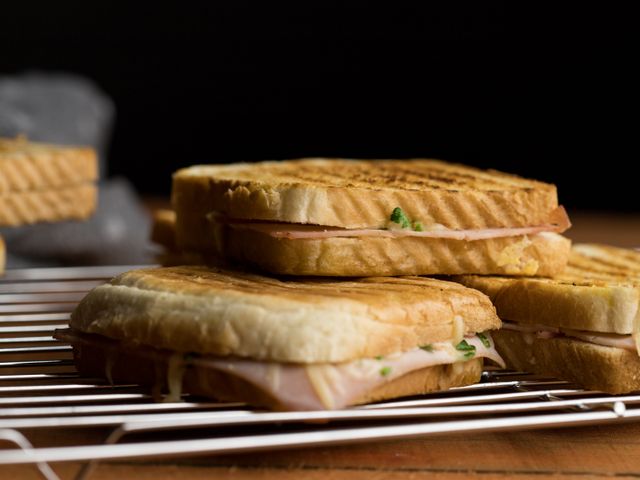
Tender, citrus-marinated pork shoulder slow-roasted until it shreds easily, piled onto toasted Cuban bread with caramelized onions, traditional ham, and optional pickles and melted Swiss cheese. The bright, savory mojo marinade—built on lime, orange, garlic, and cumin—infuses the meat with distinctly Cuban flavor that deepens beautifully after overnight marinating. Whether served simply or pressed on a griddle until crispy, this restaurant-quality sandwich brings the flavors of Havana to your table.
- Prep
- 25 min
- Cook
- 3 hr 35 min
- Wait
- 4 hr 5 min
- Total
- 8 hr 5 min
- Makes
- 4 sandwiches
Steps
Before you start
- Plan ahead: marinate pork for at least 4 hours, preferably overnight (up to 24 hours)
- Preheat oven to 325°F (163°C) when ready to begin roasting
- Prepare mise en place: mince garlic, slice onions, juice citrus, and measure all spices before starting
- Remove pork from refrigerator 30 minutes before roasting to bring closer to room temperature
Make the mojo marinade
- In a medium bowl, combine the lime juice, orange juice, minced garlic, cumin, oregano, ¼ cup (60 ml) olive oil, 1½ teaspoons kosher salt, and black pepper.
- Whisk together until the salt dissolves completely and all ingredients are well combined.
- The marinade should smell bright, aromatic, and distinctly Cuban.
- Taste and adjust seasoning if needed—it should be quite flavorful and slightly salty.
+ Show details− Hide details
Ready when: Salt is fully dissolved and flavors are well combined
Tip: Taste the marinade before using. It should be boldly seasoned, almost salty—this develops deep flavor in the meat during marinating.
Marinate the pork shoulder
- Pat the pork shoulder dry with paper towels, removing excess moisture.
- Place it in a large (1-gallon / 3.8 L) resealable plastic bag or a glass baking dish.
- Pour the mojo marinade over the pork, coating all surfaces thoroughly.
- If using a plastic bag, remove as much air as possible and seal tightly.
- If using a glass dish, cover with plastic wrap.
- Refrigerate for at least 4 hours, but preferably overnight (12–24 hours).
- If time permits, turn the pork over halfway through marinating to ensure even flavor distribution.
+ Show details− Hide details
Ready when: Pork takes on the color and aroma of the marinade; longer marinating increases flavor depth
Tip: Overnight marinating (12–24 hours) is ideal and significantly improves flavor and tenderness. Four hours is the minimum; never skip this step.
Roast pork at low temperatureOven 325°F / 165°C
- Preheat oven to 325°F (163°C).
- Remove the pork from the refrigerator about 30 minutes before roasting.
- Transfer the pork and all its marinade to a large roasting pan (at least 9×13 inches / 23×33 cm with 2–3 inch / 5–7 cm sides).
- Cover tightly with aluminum foil.
- Roast in the preheated oven for 3½ to 4 hours (approximately 50–60 minutes per pound), until the pork is extremely tender and shreds easily with a fork.
- An instant-read meat thermometer inserted into the thickest part should read 190–205°F (88–96°C).
- The meat should be falling apart, not firm.
+ Show details− Hide details
Ready when: Pork shreds easily with a fork; internal temperature reaches 190–205°F (88–96°C); meat is very soft and pulling apart naturally
Tip: Do not skip the foil cover. It's essential for keeping the pork moist and preventing the exterior from drying out. If liquid evaporates below halfway up the pan, add ½ cup water or broth at the 2-hour mark.
Caramelize the sliced onions
- While the pork roasts (start after 30 minutes to 1 hour of roasting), heat 2 tablespoons (30 ml) olive oil in a large skillet (10–12 inches / 25–30 cm) over medium heat.
- Add the sliced onions and a small pinch of salt.
- Cook, stirring every 5–10 minutes, for 35–45 minutes until the onions are very soft, deeply golden brown, and intensely sweet.
- They will shrink significantly.
- Toward the end, if they begin to stick, add 1–2 tablespoons water and stir to deglaze.
- The onions should smell sweet and caramelized, with dark golden-brown edges.
+ Show details− Hide details
Ready when: Onions are deep golden brown, very soft, and smell sweet and caramelized; color should be rich amber to dark brown
Tip: Resist the urge to increase heat to speed up caramelization. Low, steady heat creates the best flavor and prevents burning. Stir every 5–10 minutes for even browning.
Shred the cooked pork
- When the pork is extremely tender (test by pulling with a fork—it should break apart easily), carefully remove it from the roasting pan and place on a clean cutting board.
- Let it rest for 5 minutes before shredding.
- Using two meat forks or meat claws, pull the pork apart into bite-sized shreds, discarding any large chunks of hard fat.
- Strain the cooking liquid (pan drippings) through a fine-mesh strainer into a small bowl.
- Skim off and discard the excess fat from the surface using a spoon.
- Return ½ cup (120 ml) of the defatted cooking liquid to the shredded pork and toss gently to moisten; this keeps the pork flavorful and juicy for assembly.
+ Show details− Hide details
Ready when: Pork shreds easily into tender, uniform strands; no tough or chewy pieces remain
Tip: Do not discard the cooking liquid—it is pure, concentrated pork and mojo flavor. If there's a thick layer of fat on top, chill the liquid briefly in the refrigerator so the fat solidifies and is easier to remove completely.
Toast the Cuban breadOven 400°F / 205°C
- Slice each Cuban roll in half lengthwise, or if using a whole loaf, cut it into 4 sandwich-sized pieces and then halve them.
- Place the cut side up on a baking sheet.
- If desired, brush the cut sides lightly with a teaspoon of the reserved pork cooking liquid or a bit of olive oil.
- Place under the broiler or in a preheated 400°F (200°C) oven for 2–3 minutes until the cut sides are golden and lightly crispy but still pliable.
- Watch carefully to prevent burning.
- The inside should be warm and toasted but not dry or hard.
+ Show details− Hide details
Ready when: Cut sides are golden brown and lightly crispy; bread is still soft and pliable, not hard or brittle
Tip: Watch the bread carefully—it can go from toasted to burned in seconds under the broiler. Aim for a light golden color with slight crispness, not dark brown hardness.
Assemble and optional press the sandwiches
- On the toasted bottom half of each Cuban roll, layer in order: a thin slice of ham (if using, about ¼ oz / 7 g per sandwich), approximately 3–4 oz (85–115 g) of warm shredded pork from step 5, a generous handful of caramelized onions from step 4 (about 3 tablespoons / 45 g per sandwich), 3–4 dill pickle slices (if using), and 1 slice of Swiss cheese (if using).
- Top with the other toasted bread half.
- For an authentic pressed sandwich, immediately place the assembled sandwich on a hot griddle or in a large skillet over medium heat, with a weight on top (another skillet, a panini press, or even a brick wrapped in foil).
- Cook for 1–2 minutes per side until the bread is golden brown and crispy, the sandwich is hot throughout, and the cheese is melted.
- If not pressing, simply serve warm with reserved pan liquid on the side for dipping.
+ Show details− Hide details
Ready when: If pressing: bread is golden brown and crispy on both sides; sandwich is hot throughout; cheese is melted
Tip: Assemble while the pork and onions are still warm so everything is hot and the cheese melts gently from residual heat. The optional pressing is highly traditional and transforms the texture—it makes the sandwich crispy and helps everything adhere together beautifully.
Good to know
Tips
- Overnight marinating (12–24 hours) is transformative. The citric acid and aromatics penetrate deeply into the pork, creating far more complex and satisfying flavor than a 4-hour marinade alone.
- The caramelized onions are not negotiable—they add sweetness and depth that balances the bright acidity of the mojo. Do not rush this step.
- Reserve at least ½ cup of the pork cooking liquid for serving alongside the sandwiches. Many Cubans dip their sandwiches into this liquid (called 'mojo' or 'consomé') for extra flavor and moisture.
- The optional pressing step is worth the effort. It transforms the sandwich from simple to restaurant-quality, crisping the bread and melding the flavors together beautifully.
Make ahead
Marinate pork up to 24 hours ahead. Roast pork and caramelize onions up to 2 days in advance, storing separately in airtight containers in the refrigerator. Shred pork and store in its cooking liquid (covered) for up to 3 days refrigerated or 3 months frozen. Assemble sandwiches just before serving for the best texture.
Storage & reheating
Shredded pork (in cooking liquid): up to 3 days refrigerated in an airtight container; up to 3 months frozen. Reheat gently in a 350°F (175°C) oven for 10–15 minutes or on a stovetop over medium-low heat with a splash of broth. Caramelized onions: up to 5 days refrigerated; up to 2 months frozen. Assembled sandwiches: best served fresh; can be wrapped individually and refrigerated up to 1 day (rewarm on a griddle or in a 350°F oven before serving). Do not freeze assembled sandwiches.
Substitutions
- Fresh orange juice, strained → Equal amount of chicken broth or additional fresh lime juice. Broth reduces brightness; lime increases acidity. Flavor will be less balanced but still delicious.
- Ground cumin → Ground coriander in equal amount. Less authentic but provides similar earthy warmth. Use 1½ tablespoons coriander.
- Cuban bread rolls → Portuguese rolls, ciabatta, or fresh focaccia cut into sandwich-sized pieces. Texture and crumb structure differ, but these breads provide similar structural support and will crisp when toasted.
- Deli ham, sliced thin → Omit entirely or substitute roasted turkey breast sliced thin. Omitting reduces richness but allows mojo pork to be the star. Turkey is leaner but still traditional in some variations.
More sandwiches
See all →



Find more like this
- Meal
- Lunch
- Cuisine
- Caribbean
- Main ingredient
- Pork Shoulder
- Diet
- Sugar-Free