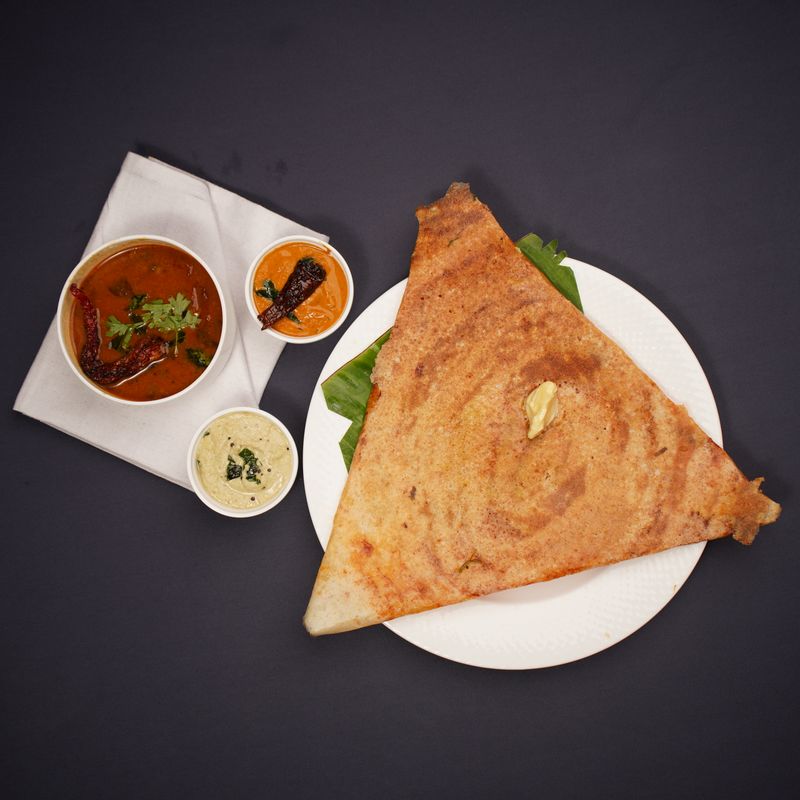
Masala Dosa with Potato Filling
Crisp, golden, paper-thin fermented rice and lentil crepes wrapped around a turmeric-yellow potato masala fragrant with mustard seeds and curry leaves. It takes time because of the soaking and fermenting, but most of that is hands-off.
- Prep
- 40 min
- Cook
- 37 min
- Wait
- 16 hr 25 min
- Total
- 17 hr 42 min
- Makes
- 8 dosas (about 8–9 inches / 20–23 cm each)
Steps
Before you start
- Plan ahead: the rice and dal soak for 6 hours, then the batter ferments 8–12 hours. Start the evening before or in the morning for dinner the next day.
- Ferment the batter in a warm spot (75–85°F / 24–29°C), such as an oven with only the light on. In a cold kitchen it can take the full 12 hours or more.
- Use a bowl or pot at least 3 times the batter's volume, because the batter will roughly double.
- Use a well-seasoned cast-iron skillet or flat griddle (tawa), or a good nonstick pan. An old, scratched nonstick pan makes the dosa stick.
- Don't use iodized-salt-heavy shortcuts: use non-iodized salt in the batter, since iodine can slow fermentation.
Soak rice and dal
- Put the rice in one large bowl and cover with 2 cups (480 ml) of the soaking water.
- In a second bowl, combine the urad dal and fenugreek seeds and cover with the other 2 cups (480 ml) of soaking water.
- Let both sit at room temperature for 6 hours (up to 8).
+ Show details− Hide details
Ready when: Grains are swollen and can be crushed easily between two fingers
Tip: Keep the rice and dal separate; they grind to different textures.
Grind the batter
- Drain the dal and fenugreek, reserving the soaking water.
- Blend with ½ cup (120 ml) of the grinding water, adding more by the tablespoon if the blades stall, for 4–5 minutes, until very smooth, pale and fluffy like thick whipped cream.
- Scrape into the large fermenting pot.
- Drain the rice and blend with about ½ cup (120 ml) more water for 2–3 minutes, until it looks like fine cream of wheat (slightly gritty, not silky).
- Add to the dal.
- Add the batter salt and mix with clean hands for 2 minutes.
- The warmth of your hands and the mixing help start fermentation.
- The batter should be thick, like pancake batter.
- Keep any remaining water for thinning later.
+ Show details− Hide details
Ready when: Dal batter is fluffy and pale; rice batter is fine but slightly grainy; combined batter is thick and pourable
Tip: Pulse the blender in short bursts and chill the jar if it gets warm. Overheated batter ferments poorly.
Ferment the batter
- Cover the pot loosely with a lid (leave a gap, since gas needs to escape) and leave in a warm place for 8–12 hours, until the batter has nearly doubled and is full of tiny bubbles.
+ Show details− Hide details
Ready when: Batter is doubled, bubbly on top and smells pleasantly sour, like yogurt
Tip: Set the pot on a rimmed plate in case it overflows. Stir once gently before using; do not beat out all the air.
Boil the potatoes
- Put the potato chunks in a medium pot, cover with cold water by 1 inch (2.5 cm) and add a generous pinch of salt.
- Bring to a boil over medium-high heat, then reduce to medium and simmer 15–17 minutes.
- Drain and let cool 8 minutes.
- Peel off the skins if you like (they slip off easily when warm), then roughly crush with your hands or a fork into small, uneven pieces about ½ inch (1 cm).
- Don't mash to a paste.
+ Show details− Hide details
Ready when: A knife slides into the center of a chunk with no resistance, and the pieces are not falling apart
Tip: Waxy potatoes hold their shape and give a better texture than floury ones.
Temper the spices
- Heat the filling oil in a large skillet over medium heat for 1 minute.
- Add the mustard seeds and chana dal.
- Cook 30–60 seconds until the mustard seeds pop and the dal turns light golden.
- Add the curry leaves (stand back, they spatter) and the asafoetida, if using, and stir for 10 seconds.
+ Show details− Hide details
Ready when: Mustard seeds are popping and the dal is light golden; the curry leaves are crisp and fragrant
Tip: If the mustard seeds don't pop, the oil isn't hot enough. If the dal darkens to brown, it will taste bitter.
Cook the onion masala
- Add the sliced onion, green chilies and ginger to the skillet.
- Cook 5–6 minutes, stirring often, until the onion is soft and translucent with a few golden edges.
- Stir in the turmeric and cook 20 seconds.
+ Show details− Hide details
Ready when: Onions are soft, translucent and lightly golden at the edges; the raw ginger smell is gone
Finish the filling
- Add the crushed potatoes, filling salt and water.
- Stir gently for 2–3 minutes, so every piece is coated in yellow and the mixture looks moist but not wet.
- Turn off the heat, then stir in the lemon juice and cilantro.
- Taste and add a pinch more salt if needed.
- Cover to keep warm.
+ Show details− Hide details
Ready when: The filling is evenly yellow, soft and moist, and holds together loosely when pressed with a spoon
Tip: Keep the filling soft. Dry filling tears the dosa when you fold it.
Thin batter, heat pan
- Stir the fermented batter gently.
- Add 2–4 tablespoons (30–60 ml) cold water as needed until it falls from a ladle in a ribbon, like heavy cream.
- Heat the 10–12-inch (25–30 cm) pan over medium-high heat for 3–4 minutes.
- Sprinkle a few drops of water on the surface: they should sizzle and vanish within 1–2 seconds.
- Wipe the pan with a little oil on a paper towel.
+ Show details− Hide details
Ready when: Water droplets sizzle and evaporate within 1–2 seconds
Tip: If the pan is too hot the batter sets before you can spread it; if too cool it sticks. Lower the heat to medium after the first dosa if needed.
Pour and spread
- Lower the heat to medium.
- Pour about ½ cup (120 ml) of batter into the center of the pan.
- Immediately use the back of the ladle to spread it in quick, light circles from the center outward, to make a thin round about 8–9 inches (20–23 cm) wide.
- Drizzle 1 teaspoon of oil or ghee around the edge and over the surface.
+ Show details− Hide details
Ready when: The surface turns from glossy to matte, with tiny holes appearing
Tip: Don't press hard while spreading, or the batter will tear and stick. The first dosa is often a test, which is normal.
Cook, fill and fold
- Cook 2–3 minutes without flipping, until the underside is deep golden brown and the edges lift away from the pan.
- Spoon about ⅓ cup (75 g) of potato filling in a line down the center, and fold the dosa in half or roll it up.
- Slide onto a plate.
- Repeat with the remaining batter, re-greasing lightly, for 8 dosas total.
- Serve right away with chutney and sambar if you like.
+ Show details− Hide details
Ready when: The underside is deep golden brown, the top looks dry, and the edges curl up; it crackles when tapped
Tip: Stir the batter between dosas, since it settles and thickens. Add a spoonful of water if it gets too thick.
Good to know
Tips
- For crisp dosas, make the batter fairly thin and cook on medium heat without flipping. A thick batter gives soft, uttapam-like results.
- If the batter does not ferment, the room is probably too cold. Put it in an oven with only the light on and check every few hours.
- Wipe the pan with a half onion dipped in oil between dosas to keep it seasoned and non-stick.
- Season the filling well, since the dosa itself is mild. The lemon juice at the end brightens the whole dish.
Make ahead
Fermented batter keeps in the fridge for up to 5 days (it will get more sour). The potato filling can be made up to 3 days ahead. Bring the batter to room temperature for 30 minutes and thin it with a little water before cooking.
Storage & reheating
Dosas are best eaten right away. Room temperature: unfilled cooked dosas keep up to 2 hours. Fridge: store batter up to 5 days and filling up to 3 days in airtight containers. Freezer: filling freezes up to 2 months (thaw overnight in the fridge); batter freezes up to 1 month, but fermentation weakens after thawing. Reheat filling in a skillet over medium-low heat with a splash of water for 4–5 minutes until hot throughout, and re-crisp leftover dosas in a hot dry pan for 30–60 seconds per side.
Substitutions
- parboiled rice (idli rice) or short-grain white rice → Regular long-grain white rice (not basmati). Gives a slightly softer, less crisp dosa. Adding 2 tablespoons (about 25 g) of soaked poha (flattened rice) helps crispness.
- fresh curry leaves → Omit, or use a few fresh basil leaves. The flavor will differ, since curry leaves have a distinct aroma. Dried curry leaves are much weaker, so use about 20.
- neutral oil or ghee → Ghee. Gives a richer flavor and a golden, crisper color.
- chana dal (split chickpeas) or extra urad dal → Urad dal. Same nutty crunch in the tempering; use the same amount.
More breakfast dishes
See all →

Find more like this
- Meal
- Breakfast
- Cuisine
- South Indian
- Method
- Stovetop