Mambo Crunch Pastry with Roasted Peanuts and Caramel
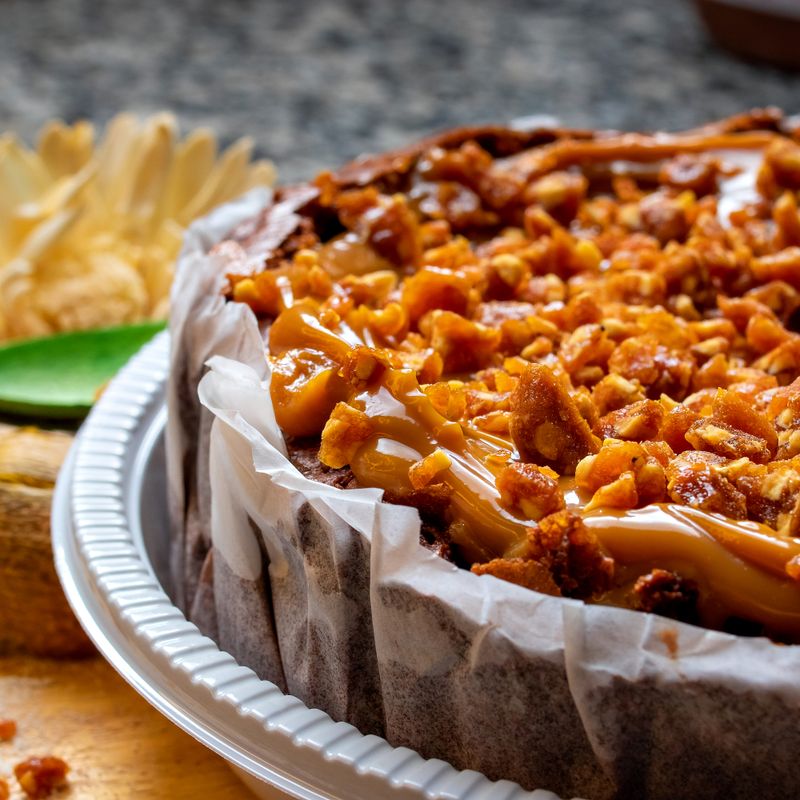
A Caribbean-inspired praline pastry featuring buttery puff pastry layers topped with roasted peanuts bound in dark caramel and finished with flakes of sea salt. The contrast between crispy pastry, crunchy nuts, and glossy caramel creates an irresistible texture and flavor. Perfect for entertaining or as an indulgent afternoon treat.
- Prep
- 25 min
- Cook
- 35 min
- Wait
- 15 min
- Total
- 1 hr 15 min
- Makes
- 12 pastry squares (about 2.5 × 2.5 inches each)
Steps
Before you start
- Preheat oven to 400°F (200°C)
- Line two baking sheets with parchment paper
- Have all caramel ingredients measured and ready—caramel can set quickly once cooled
- Keep a small bowl of ice water nearby in case caramel bubbles over
Prepare the pastry baseOven 400°F / 205°C
- Gently unfold both thawed puff pastry sheets onto your prepared baking sheets, one sheet per sheet.
- Use a sharp knife to trim each sheet to fit evenly, then lightly score the surface with crosshatch marks (do not cut all the way through).
- Brush each sheet with melted butter, coating lightly and evenly.
- Bake at 400°F (200°C) for 12–14 minutes, until golden and puffy.
- Remove and let cool for 2 minutes on the baking sheet.
+ Show details− Hide details
Ready when: Pastry is golden brown and puffed, not pale
Tip: Do not skip the butter brush—it adds flavor and helps the caramel adhere
Make the dark caramelOven 350°F / 175°C
- In a heavy-bottomed 3-quart saucepan, combine granulated sugar and dark brown sugar.
- Place over medium heat and stir constantly with a wooden spoon for 3–4 minutes until the sugars begin to melt and darken.
- Stop stirring once sugar is mostly liquid (around 3–4 minutes total), then let it bubble undisturbed for 2–3 minutes more, swirling the pan occasionally, until it reaches a deep amber color (350°F/176°C on a candy thermometer).
- Watch carefully—it will darken quickly at the end.
+ Show details− Hide details
Ready when: Deep amber color, 350°F (176°C) on thermometer; smell is rich and slightly nutty, not burnt
Tip: Have cream ready—adding it too early will cool the caramel; too late and it may seize. Do not stir after color starts changing, or the caramel will crystallize
Add cream and butterOven 300°F / 150°C
- Remove the pan from heat.
- Slowly pour in the room-temperature heavy cream, stirring gently and constantly—the caramel will bubble and steam.
- Continue stirring for about 1 minute until smooth.
- Stir in vanilla extract.
- Pour the caramel into a heatproof bowl and let it cool for about 3 minutes, stirring occasionally, until it reaches 300°F (150°C) and is still pourable but thickening slightly.
+ Show details− Hide details
Ready when: Caramel is smooth, dark amber, and slightly thicker but still pourable
Tip: Cool caramel too much and it will be too thick to coat the nuts evenly; too hot and it will run off. The 300°F mark is ideal
Toast and coat the peanutsOven 350°F / 175°C
- Spread the chopped roasted peanuts onto a separate baking sheet and toast at 350°F (175°C) for 3–4 minutes to warm through and intensify flavor.
- Pour the warm caramel over the peanuts and stir quickly and constantly with a wooden spoon for about 1 minute, coating every nut evenly.
- The mixture will begin to thicken slightly as it cools.
+ Show details− Hide details
Ready when: All peanuts are coated in glossy caramel, no white peanut pieces visible
Tip: Work fast—caramel sets as it cools. If it gets too thick, return it to the warm stovetop for 30 seconds and try again
Assemble the pastries
- Remove the cooled puff pastry sheets from the baking sheets.
- Divide each sheet into six equal squares (roughly 2.5 × 2.5 inches each) using a sharp knife.
- Place the squares back on the parchment-lined baking sheets, spacing them 1 inch apart.
- Working quickly while the caramel–peanut mixture is still warm and sticky, spoon about 2 tablespoons of the mixture onto the center of each pastry square, pressing gently so it adheres to the buttered surface.
- Do not worry if some caramel drips over the edges—this adds to the rustic charm.
+ Show details− Hide details
Ready when: All squares are topped and the caramel-peanut mixture is anchored to the pastry
Tip: If caramel sets too much before you finish topping all squares, warm it gently over low heat for 30 seconds
Finish and cool
- Once all squares are topped, sprinkle the sea salt flakes evenly over each pastry—about 2–3 flakes per square.
- Let the pastries cool on the baking sheet at room temperature for 10–15 minutes until the caramel sets to a chewy-crisp texture.
- For a crisper exterior, transfer the cooled pastries to a wire rack to continue cooling for 5 minutes more.
+ Show details− Hide details
Ready when: Caramel is no longer wet or sticky; pastry is crisp and golden
Tip: Do not refrigerate while cooling—cold will make the caramel hard and the pastry lose its crispness
Good to know
Tips
- Puff pastry quality matters—use all-butter pastry (not margarine-based) for the best flavor and crispness. Thaw it in the refrigerator for 4–6 hours or at room temperature for 1–2 hours.
- Caramel temperature is crucial. If you don't have a candy thermometer, look for a deep amber color similar to black tea or cognac—not light brown and definitely not black. Test by dropping a tiny bit into cold water; it should form a pliable ball.
- The contrast of textures—crispy pastry, crunchy nuts, chewy caramel, and briny salt—is the heart of this dish. Do not skip the cooling step; it allows the caramel to set properly.
- For a spiced variation, add 0.25 teaspoon each of cinnamon, allspice, and nutmeg to the caramel after removing from heat. This enhances the Caribbean vibe.
Make ahead
You can prepare the puff pastry base (step 1) up to 4 hours ahead and store it in an airtight container at room temperature. Make the caramel and complete assembly (steps 2–5) no more than 2 hours before serving, as the pastry gradually softens and the caramel becomes stickier as it sits.
Storage & reheating
Store in an airtight container at room temperature for up to 3 days. The pastries will gradually soften; to restore crispness, warm them in a 300°F (150°C) oven for 3–4 minutes just before serving. Do not refrigerate, as cold hardens the caramel. Freezing is not recommended due to the texture changes in both pastry and caramel.
Substitutions
- unsalted roasted peanuts, halved or coarsely chopped → roasted almonds, cashews, or a mix of roasted nuts. Use the same weight for a similar texture; note that cashews will be slightly sweeter and softer
- dark brown sugar, packed → light brown sugar or additional granulated sugar (use 0.5 cup/100 g granulated sugar instead). The caramel will be slightly less deep in flavor but still delicious; reduce vanilla slightly if using all granulated sugar
- heavy cream, at room temperature → coconut cream or whole milk. Coconut cream will add Caribbean character; whole milk makes a thinner caramel, so reduce the amount to 6 tablespoons (90 ml)
- sea salt flakes → fleur de sel or finishing sea salt, or use Maldon salt. Any large-flake sea salt works; avoid fine table salt, which will clump and taste too salty