
Lebanese Qatayef Filled Pancake Pockets
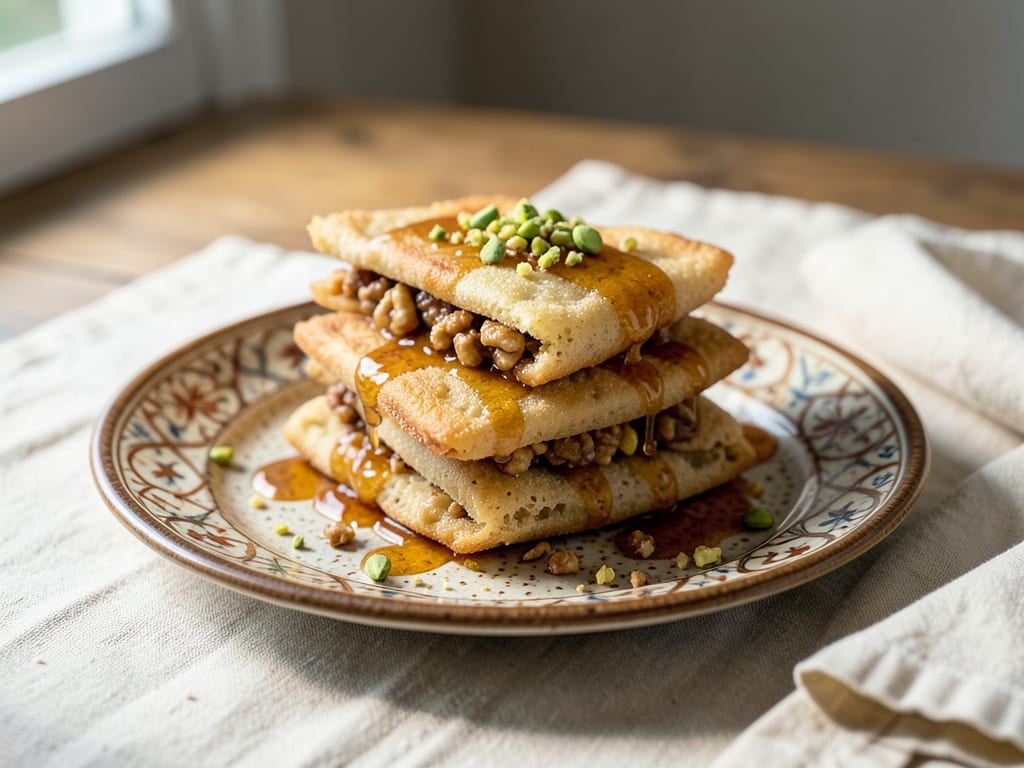
Qatayef are delicate Lebanese fried pancakes filled with a fragrant mixture of walnuts and pistachios, then drizzled with amber sugar syrup infused with rose water and orange blossom. These crispy-outside, tender-inside pastries are a beloved Ramadan and celebration treat. The pancake batter creates thin, slightly chewy crepes that fry to golden perfection, and the filling's toasted nuttiness contrasts beautifully with the floral, sticky syrup.
- Prep
- 35 min
- Cook
- 30 min
- Wait
- 20 min
- Total
- 1 hr 25 min
- Makes
- 20 filled pancakes
Steps
Before you start
- Have all ingredients measured and at room temperature before you start
- Toast the walnuts and pistachios lightly in a dry pan to enhance their flavor (5 minutes), then let cool completely before grinding
- Make the sugar syrup first so it cools while you prepare the batter
- Have a non-stick griddle or crepe pan ready; a 7-8 inch (18-20 cm) round-bottomed or flat pan works best
Make the sugar syrup
- In a small saucepan over medium heat, combine 1.5 cups (300 g) sugar and 1 cup (240 ml) water.
- Stir until sugar dissolves, then add 2 tablespoons (30 ml) fresh lemon juice.
- Bring to a gentle boil and simmer for 6–8 minutes until the syrup thickens slightly (it should coat the back of a spoon).
- Remove from heat and stir in 1 tablespoon (15 ml) rose water and 1 teaspoon (5 ml) orange blossom water.
- Pour into a shallow bowl and let cool completely.
+ Show details− Hide details
Ready when: Syrup coats the back of a spoon and is amber-colored
Tip: Don't skip the lemon juice—it balances the sweetness and prevents crystallization. The syrup will thicken more as it cools.
Prepare the nut filling
- In a medium bowl, combine 1.5 cups (180 g) ground toasted walnuts, 0.75 cup (90 g) ground toasted pistachios, 0.33 cup (65 g) sugar, 0.5 teaspoon (2.5 g) cinnamon, and 0.5 teaspoon (2.5 ml) rose water.
- Mix thoroughly with a spoon or fork until the filling is uniform and holds together slightly when pressed.
- The texture should be coarse and crumbly, not wet.
+ Show details− Hide details
Ready when: Filling is well combined and holds together when pressed
Tip: If your nuts are freshly ground, let the filling sit 5 minutes—the oils will help it hold together. It should feel like dry sand, not paste.
Make the pancake batter
- In a large bowl, whisk together 2 cups (240 g) all-purpose flour, 2 tablespoons (16 g) cornstarch, 1 teaspoon (5 g) baking powder, and 0.25 teaspoon (1.5 g) salt.
- In a separate bowl, whisk 2 large eggs with 1.5 cups (360 ml) whole milk and 1 tablespoon (12 g) sugar until smooth.
- Pour the wet ingredients into the dry ingredients and whisk until just combined—the batter should be thin and smooth with no lumps.
- Whisk in 1 tablespoon (15 ml) vegetable oil.
- Let the batter rest for 5 minutes.
+ Show details− Hide details
Ready when: Batter is smooth, thin, pourable, and slightly frothy
Tip: This batter should be much thinner than regular pancake batter—it should pour like thin cream. If it seems too thick, thin it with a tablespoon or two of milk.
Heat the crepe pan
- Place a 7–8 inch (18–20 cm) non-stick crepe pan or griddle over medium heat and let it heat for 2 minutes.
- Test the temperature by sprinkling a few drops of water on it; they should sizzle gently and evaporate within a second.
- The pan should be hot enough to cook the pancake quickly but not so hot that it burns.
+ Show details− Hide details
Ready when: Water droplets sizzle and evaporate quickly
Tip: If the pan is too hot, qatayef will be crispy outside but doughy inside. If too cool, they'll stick. Test with one pancake first.
Cook the pancakes
- Lightly wipe the hot pan with a barely-oiled paper towel.
- Pour about 3 tablespoons (45 ml) of batter into the center of the pan and immediately tilt and rotate the pan so the batter spreads into a thin, even circle about 6–7 inches (15–18 cm) across.
- Cook for 90 seconds to 2 minutes—the bottom should be set and lightly golden, and the top should be mostly dry with a few small wet patches.
- Do not flip; slide the pancake onto a clean, flat plate to cool.
- The pancake cooks on one side only.
- Repeat with remaining batter, re-oiling the pan between pancakes.
+ Show details− Hide details
Ready when: Bottom is light golden, top is mostly set with only small wet patches
Tip: The cooked side (the bottom) will be slightly bumpy and golden—this is the outside when fried. The top side is smoother and paler—this faces inward. Use this to identify which side to fill.
Fill and fold the pancakes
- Once each pancake cools to room temperature, place it cooked-side down on a flat surface.
- Place about 1 tablespoon (12 g) of the nut filling on the upper half of the pancake, leaving a 0.5-inch (1 cm) border.
- Fold the bottom half of the pancake up and over the filling to form a half-moon, pressing the edges gently so they seal.
- The edges should stick together slightly from the moisture of the batter; you can wet your finger and trace the edge if needed to seal it.
+ Show details− Hide details
Ready when: All pancakes are folded and edges are sealed
Tip: If the edges won't seal, the batter was too dry. Lightly dampen your finger with water and run it along the edge before pressing. Work in a cool spot; if the batter is too warm, it tears.
Heat the frying oilOven 350°F / 175°C
- Pour 2 quarts (2 L) of vegetable oil into a heavy-bottomed pot or Dutch oven.
- Heat to 350°F (175°C) over medium heat, using a deep-fry thermometer to monitor the temperature.
- The oil should shimmer and move in waves but not smoke.
- This takes about 8–10 minutes.
+ Show details− Hide details
Ready when: Oil reaches 350°F (175°C) on a deep-fry thermometer
Tip: Too-cool oil makes qatayef greasy and soggy. Too-hot oil burns the outside before the inside cooks through. Use a thermometer—it's worth it.
Fry the qatayef
- Working in batches of 4–5 qatayef at a time so the oil stays hot, carefully slide the filled pancakes into the hot oil with the fold facing down first.
- Fry for 1.5–2 minutes until the bottom is deep golden brown.
- Using a slotted spoon, carefully flip each one and fry the other side for another 1.5–2 minutes until both sides are evenly deep golden brown.
- The edges should be crispy and slightly darker than the flat surfaces.
- Remove with a slotted spoon and drain briefly on paper towels.
+ Show details− Hide details
Ready when: Both sides are deep golden brown, edges are crispy and slightly darkened
Tip: Don't skip the paper towel draining—it removes excess oil. If the qatayef are pale or soft, your oil wasn't hot enough. If they brown too fast and feel hard, it was too hot.
Drizzle with syrup and serve
- Arrange the warm fried qatayef on a serving plate.
- Slowly drizzle the cooled sugar syrup over them, allowing it to soak into the crispy exterior and accumulate in a pool around them.
- Serve immediately, while the qatayef are still warm and the syrup is at room temperature.
- They taste best eaten fresh, still slightly warm.
+ Show details− Hide details
Ready when: Qatayef are glistening with syrup
Tip: Serve immediately for the best texture contrast between the crispy exterior and tender, warm interior. Cold qatayef are less enjoyable.
Optional garnish
- If desired, scatter a few chopped pistachios on top of the finished qatayef for extra elegance and a reminder of the filling inside.
+ Show details− Hide details
Ready when: Garnish is evenly scattered
Tip: Save a small handful of chopped (not ground) pistachios from your filling batch to use as garnish.
Make ahead: prepare components early
- You can make both the sugar syrup and nut filling up to 2 days ahead.
- Store each in an airtight container at room temperature.
- On serving day, make the batter, cook the pancakes, fill them, and fry them.
- The entire assembly and frying process takes about 45 minutes.
Good to know
Tips
- Toast the walnuts and pistachios lightly in a dry skillet for 4–5 minutes before grinding—this deepens their flavor and makes the filled qatayef taste more complex and authentic.
- The pancake batter must be thin, like thin cream, to spread into delicate, tender crepes. If it's too thick, the qatayef will be doughy rather than crispy-tender.
- The oil temperature is critical: 350°F (175°C) is the target. An oil thermometer eliminates guesswork. Too cool, and the qatayef absorb oil and become greasy; too hot, and the outside burns before the inside warms.
- The sugar syrup must be completely cool before serving. Warm syrup will soften the crispy exterior. Make it first so it has time to cool while you prepare everything else.
Make ahead
The sugar syrup and nut filling can be made up to 2 days ahead and stored in airtight containers at room temperature. The pancake batter is best made fresh on the day of serving. Cooked (unfilled) pancakes can be stacked between parchment paper and refrigerated for up to 1 day, then brought to room temperature before filling and frying.
Storage & reheating
Qatayef are best served fresh and warm the day they are made. Leftovers can be stored in an airtight container at room temperature for up to 1 day, though the crispy exterior will soften over time. To reheat, place on a baking sheet in a 300°F (150°C) oven for 5–8 minutes to restore some crispness. Do not refrigerate, as this accelerates sogginess. They do not freeze well due to the syrup."
Substitutions
- ground walnuts (toasted) → ground almonds or a mix of ground hazelnuts and almonds. Walnuts are traditional, but almonds offer a milder, slightly sweeter flavor. Use the same amount. Avoid peanuts, as they are not traditional and overpower the delicate filling.
- rose water → 1 tablespoon (15 ml) of another floral extract such as violet water, or omit entirely. Rose water is classic, but some prefer the subtle floral note of violet or prefer no floral element. Omit in the syrup and filling together for balance.
- orange blossom water → an additional 0.5 teaspoon (2.5 ml) of rose water, or omit entirely. Orange blossom water is optional and can be replaced with additional rose water or left out. Do not substitute with orange extract, which is too strong.
- cornstarch → an additional 2 tablespoons (16 g) of all-purpose flour. Cornstarch helps create a tender crêpe, but all-purpose flour alone will work, making a slightly denser pancake.
More middle eastern sweets
See all →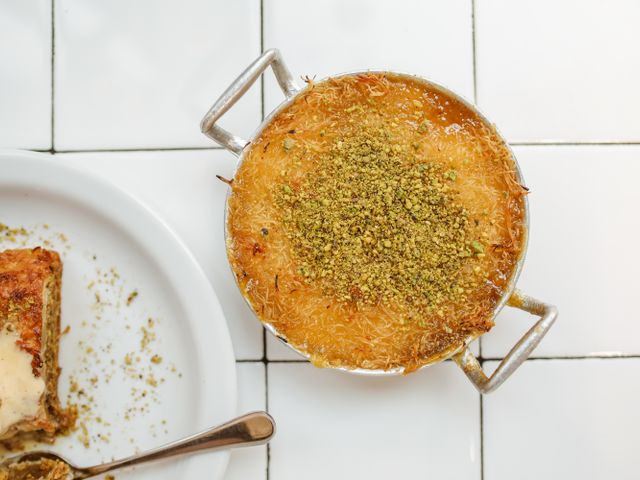


Find more like this
- Meal
- Dessert
- Cuisine
- Lebanese
- Diet
- VegetarianHalal
- Method
- Grill & BBQ
- Quick & Easy
- Make Ahead
- Occasion
- RamadanFamily Gatherings