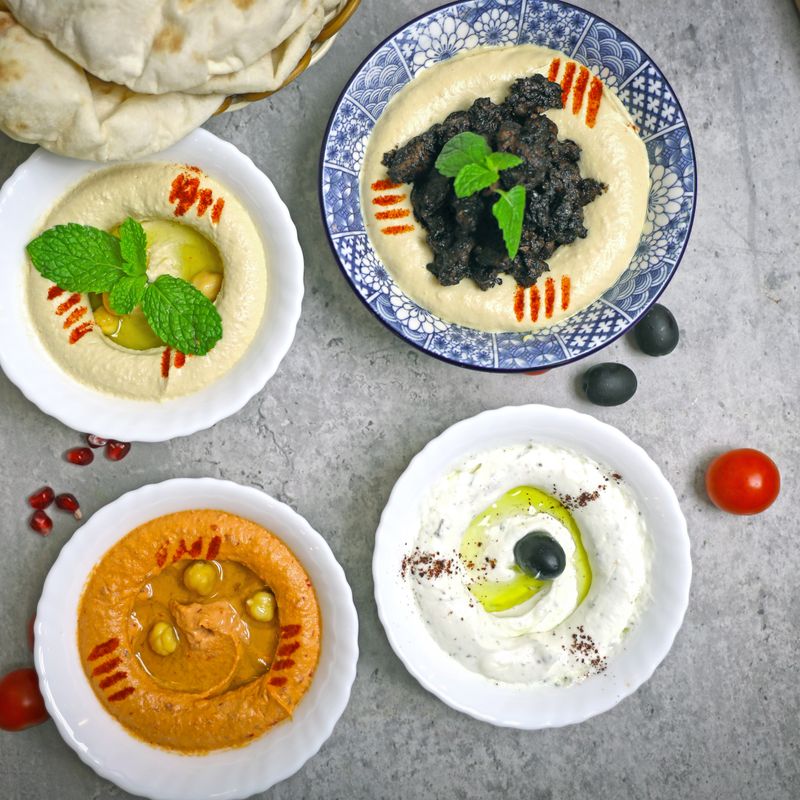
Labneh and Black Olives Manakish
A Levantine flatbread topped with creamy labneh, briny black olives, and a drizzle of fruity olive oil. This savory manakish is soft and pillowy inside with slightly crispy edges, perfect for breakfast, lunch, or as a mezze appetizer.
- Prep
- 20 min
- Cook
- 18 min
- Wait
- 2 hr
- Total
- 2 hr 38 min
- Makes
- 4 manakish (serves 4 as a main or 8 as an appetizer)
Steps
Before you start
- Preheat oven to 475°F (245°C) about 15 minutes before baking
- Bring labneh to room temperature so it spreads easily
- Have all toppings prepped and ready before shaping dough
Mix dough ingredients
- In a large mixing bowl, combine the bread flour (390 g), instant yeast (5 g), fine sea salt (6 g), and sugar (2 g).
- In a separate small bowl or measuring cup, combine the warm water (300 ml, 110°F / 43°C) with the olive oil (30 ml).
- Pour the wet ingredients into the dry ingredients and stir with a wooden spoon until a shaggy dough forms.
- There should be no dry flour visible in the bowl.
+ Show details− Hide details
Ready when: No dry flour visible, dough is shaggy and cohesive
Tip: Don't knead yet; just mix until the ingredients are combined. Overworking at this stage can develop too much gluten.
Knead dough
- Turn the dough out onto a clean, lightly oiled work surface.
- Knead for 8–10 minutes, stretching the dough toward you and folding it over itself repeatedly, rotating a quarter turn between each fold.
- The dough should become smooth, elastic, and slightly tacky but not sticky.
- If it's too sticky, dust your hands with a tiny bit of flour as needed.
+ Show details− Hide details
Ready when: Dough is smooth, elastic, springs back when poked, and holds together
Tip: If you have a stand mixer with a dough hook, knead on medium speed for 5–6 minutes instead. The dough should feel slightly tacky; if it's dry, wet your fingers and continue kneading.
First rise
- Shape the dough into a ball and place it in a lightly oiled bowl, turning it to coat all sides.
- Cover the bowl with a damp kitchen towel or plastic wrap.
- Let it rise in a warm, draft-free place for 90 minutes to 2 hours, until the dough has roughly doubled in size and springs back slowly when gently poked.
+ Show details− Hide details
Ready when: Dough has increased roughly 50–100% in size, springs back slowly when poked
Tip: A warm location (70–75°F / 21–24°C) speeds rising; avoid drafty spots. If your kitchen is cold, place the bowl in a turned-off oven with the light on.
Prepare toppings
- While the dough rises, place the labneh in a small bowl and gently stir it with a spoon until smooth and spreadable.
- Add 1–2 tbsp of the olive oil (15–30 ml from the topping amount) and stir to loosen it slightly.
- Taste and season with a pinch of black pepper if desired.
- Halve the pitted black olives and set them aside.
- If using lemon zest, grate it finely and set aside separately.
+ Show details− Hide details
Ready when: Labneh is smooth and spreadable, olives are halved
Tip: Loosening the labneh with a bit of olive oil makes it easier to spread and creates a more cohesive topping.
Shape manakish
- Once the dough has risen, gently turn it out onto a lightly floured work surface.
- Divide it into 4 equal pieces using a dough scraper (each piece will be roughly 110 g).
- Shape each piece into a ball, then gently press and stretch each ball into a 6–7 inch (15–18 cm) circle about ½ inch (1 cm) thick, being careful not to tear it.
- Poke the surface all over with your fingertips to create dimples (this prevents the bread from puffing too much).
- Place each circle on a piece of parchment paper.
+ Show details− Hide details
Ready when: Four evenly shaped circles with dimpled surfaces, ready for toppings
Tip: Don't overstretch; if the dough springs back, let it rest 2–3 minutes and try again. The dimples prevent large air pockets from forming during baking.
Top manakish
- Divide the loosened labneh evenly among the four dough circles, spreading it to within ½ inch (1 cm) of the edge using the back of a spoon or a small offset spatula.
- Divide the halved black olives evenly and scatter them over the labneh on each manakish.
- Drizzle the remaining olive oil (about 1 tbsp / 15 ml per manakish) over the toppings.
- Sprinkle lightly with freshly cracked black pepper and lemon zest if using.
+ Show details− Hide details
Ready when: Toppings are evenly distributed, olives and seasonings are visible
Tip: Don't spread the labneh all the way to the edge; leaving a border allows the bread edges to puff and crisp properly.
Bake manakishOven 475°F / 245°C
- Preheat the oven to 475°F (245°C) if you haven't already.
- Place the topped manakish (still on parchment paper) on baking sheets.
- If both fit on one large baking sheet, bake them all at once; otherwise, bake in two batches on separate racks, rotating the sheet halfway through.
- Bake for 12–15 minutes, until the bread is light golden-brown on the bottom and edges, and the labneh is warm with light golden speckles.
- The edges should be slightly crispy and the center should yield gently when pressed.
+ Show details− Hide details
Ready when: Bread is light golden on bottom and edges, labneh is warm with golden speckles, edges are slightly crispy
Tip: If baking in batches and your oven has hot spots, rotate the sheet 180 degrees halfway through for even browning. Watch the edges—they can brown quickly if the oven runs hot.
Cool and garnish
- Remove the manakish from the oven and let them cool on the baking sheet for 2–3 minutes so they firm up slightly and are safe to handle.
- Transfer to a warm serving plate.
- If using fresh mint or parsley, scatter it over the top just before serving.
- Serve warm or at room temperature.
+ Show details− Hide details
Ready when: Manakish are firm enough to transfer without tearing, herbs are scattered
Tip: Manakish are best eaten warm, but they remain delicious at room temperature. Don't refrigerate immediately after baking, as this can make the bread dry faster.
Good to know
Tips
- Labneh should be creamy and spreadable; if yours is too thick, stir in a little warm water or extra olive oil to reach the right consistency.
- For a crispier base, preheat a baking sheet in the oven and transfer the manakish to it just before baking. This gives the bottoms extra color and texture.
- Serve manakish warm with a squeeze of fresh lemon juice, a drizzle of olive oil, and extra fresh herbs on the side for guests to customize their portion.
- If you don't have instant yeast, use 1 tbsp (7 g) of active dry yeast, but let it bloom in the warm water for 5 minutes before adding it to the flour.
Make ahead
You can prepare the dough through the first rise the day before. After the rise, punch down the dough, cover it tightly, and refrigerate overnight. The next morning, bring it to room temperature (about 1 hour), then shape, top, and bake as directed. Alternatively, shape and top the manakish, then refrigerate for up to 4 hours before baking—add 2–3 minutes to the baking time if baking from cold.
Storage & reheating
Store leftover manakish in an airtight container at room temperature for up to 2 days, or wrap individually and freeze for up to 1 month. Reheat in a 350°F (175°C) oven for 5–7 minutes until warm. Do not microwave, as it will make the bread tough.
Substitutions
- labneh (strained yogurt) → Greek yogurt mixed with a pinch of salt. Use the same amount; Greek yogurt is slightly tangier than labneh but provides similar creaminess. Drain it in a fine-mesh sieve for 30 minutes if it's very wet.
- pitted black olives → green olives, kalamata olives, or a mix. Use the same amount; the flavor will shift but remain delicious. Avoid very briny olives, as excess liquid can make the topping soggy.
- bread flour → all-purpose flour. Use the same amount; the texture will be slightly less chewy but still good. All-purpose flour has less protein, so the dough may be slightly softer.
- fresh mint or parsley → dried oregano or zaatar. Use 1 tsp (2–3 g) dried herbs instead of fresh; sprinkle over the manakish after topping but before baking for best flavor.
More manakish
See all →
Find more like this
- Meal
- Breakfast
- Cuisine
- Lebanese
- Diet
- VegetarianHalal
- Method
- Oven