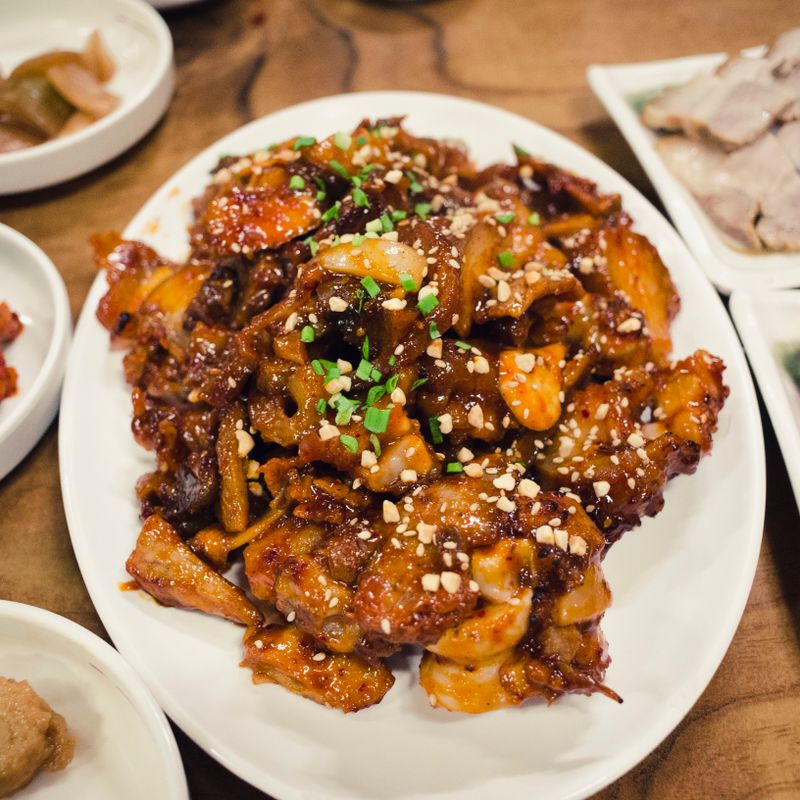
Korean Spicy Pork Shawarma with Gochugaru and Rice Cakes
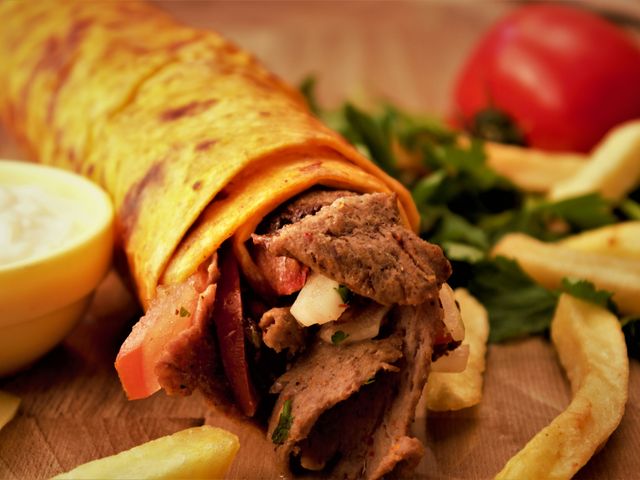
A bold fusion dish combining the warm spices and layered flavors of Middle Eastern shawarma with Korean heat and umami. Thinly sliced pork belly is marinated in gochugaru, soy sauce, garlic, and spices, then pan-fried until crispy at the edges. Served alongside chewy rice cakes simmered in a spicy sauce, fresh lettuce wraps, and pickled vegetables for a complete, interactive meal.
- Prep
- 25 min
- Cook
- 35 min
- Wait
- 2 hr
- Total
- 3 hr
- Makes
- 4 servings (1 wrap and rice cakes per person)
Steps
Before you start
- Place pork belly in the freezer 30 minutes before slicing for cleaner cuts
- Have all marinade ingredients measured and ready
- If using fresh rice cakes, they can be used directly; frozen ones should thaw at room temperature
- Slice lettuce and prepare vegetables while pork marinates
Prepare the marinade
- In a large mixing bowl, whisk together soy sauce (0.33 cup / 80 ml), rice vinegar (2 tbsp / 30 ml), sesame oil (1.5 tbsp / 22 ml), and brown sugar (1 tbsp / 12 g) until the sugar dissolves.
- Stir in minced garlic (6 cloves), minced ginger (1 tbsp / 12 g), ground cumin (1 tsp / 2 g), ground coriander (0.5 tsp / 1 g), black pepper (0.5 tsp / 1 g), and gochugaru (3 tbsp / 27 g).
- Mix until smooth and well combined.
+ Show details− Hide details
Ready when: Marinade is smooth and spices are fully incorporated
Tip: Make sure the brown sugar fully dissolves so the flavors distribute evenly throughout the marinade
Marinate the pork
- Add the thinly sliced pork belly to the marinade and stir gently to coat every piece evenly.
- Cover the bowl with plastic wrap and refrigerate for at least 2 hours (or up to overnight).
- The longer it marinates, the deeper the flavor develops.
+ Show details− Hide details
Ready when: Pork is fully submerged and glistening with marinade
Tip: Don't skip the marinade time—it's essential for building the signature shawarma depth of flavor
Prepare rice cake sauce
- In a medium saucepan (2-quart / 2 L), whisk together gochujang (2 tbsp / 30 g), water (1 cup / 240 ml), soy sauce (1.5 tbsp / 22 ml), minced garlic (3 cloves), gochugaru (1 tsp / 3 g), and sesame oil (0.5 tbsp / 7 ml).
- Bring to a simmer over medium heat, stirring occasionally, until the sauce is smooth and no lumps of gochujang remain.
+ Show details− Hide details
Ready when: Sauce is smooth, fragrant, and barely simmering
Tip: Whisk the gochujang into the water slowly to avoid lumps; use a slurry if needed
Add rice cakes to sauce
- Add the rice cakes (1 lb / 454 g) to the simmering sauce and stir gently to separate and coat them.
- Reduce heat to medium-low and simmer for 8–10 minutes, stirring occasionally, until the rice cakes are tender and have absorbed the sauce flavor.
- They should be slightly chewy but not mushy.
+ Show details− Hide details
Ready when: Rice cakes are tender, chewy, and coated in the spicy red sauce
Tip: Stir gently to prevent the rice cakes from breaking apart; they're fragile when cooked
Pan-fry the pork belly
- Remove the pork from the marinade, allowing excess marinade to drip back into the bowl.
- Reserve the remaining marinade.
- Heat a large skillet or wok (12-inch / 30 cm) over medium-high heat and add vegetable oil (2 tbsp / 30 ml) and butter (1 tbsp / 14 g).
- Once the butter foams, working in batches to avoid crowding, add the marinated pork slices in a single layer.
- Cook for 2–3 minutes per side until the edges are crispy and caramelized and the centers are cooked through.
- Transfer to a shallow serving platter and repeat with remaining pork.
+ Show details− Hide details
Ready when: Pork slices are caramelized at the edges with crispy, golden-brown surfaces; centers are cooked through
Tip: Don't overcrowd the pan—work in batches so the pork sears properly instead of steaming
Deglaze and finish pork
- Pour the reserved marinade into the hot skillet (careful of splashing).
- Scrape up any browned bits from the bottom with a wooden spoon.
- Simmer for 1–2 minutes until the sauce reduces slightly and coats the pork.
- Taste and adjust seasoning if needed.
- Transfer the pork and sauce to the serving platter.
+ Show details− Hide details
Ready when: Sauce is glossy and slightly thickened, coating the pork
Tip: This deglazing step captures all the flavorful browned bits and creates a rich glaze
Assemble and serve
- Arrange the lettuce leaves on a large platter.
- Place the pan-fried pork in the center and the spiced rice cakes in another serving bowl.
- Arrange sliced cucumber, julienned daikon radish, and the whites of the sliced green onions around the pork.
- Sprinkle the reserved green onion tops and toasted sesame seeds over everything.
- Serve warm or at room temperature, allowing diners to build their own wraps: lay a lettuce leaf, add some pork, rice cakes, and vegetables, roll, and eat with their hands.
+ Show details− Hide details
Ready when: All components are arranged, warm, and ready to serve
Tip: Keep the pork and rice cakes warm by serving immediately; the interactive, build-your-own-wrap format is part of the fun
Good to know
Tips
- This is a fusion dish meant to be interactive and customizable—encourage diners to build their own wraps with their preferred ratio of pork, rice cakes, and vegetables.
- Freezing the pork belly for 30 minutes before slicing makes it much easier to cut into thin, even pieces by hand; a meat slicer is ideal if you have one.
- Toasted sesame seeds and green onion greens add visual appeal and a final nutty, fresh brightness—don't skip them.
- Serve the rice cakes in their spicy sauce separately so diners can control how much sauce they add to their lettuce wraps and avoid sogginess.
Make ahead
The pork can be marinated up to 24 hours in advance. The rice cake sauce can be prepared 1 day ahead and reheated gently. However, the pork should be pan-fried and rice cakes warmed just before serving for best texture.
Storage & reheating
Leftovers keep, refrigerated in separate airtight containers, for up to 3 days. Reheat the pork gently in a skillet over medium heat with a splash of water. Warm the rice cakes in a saucepan over low heat, stirring occasionally. The fresh vegetables should be prepared fresh for each serving. Freezing is not recommended as the pork belly texture will suffer.
Substitutions
- gochugaru (Korean red chili flakes) → Cayenne pepper or Korean chili powder mixed with paprika. Use half the amount of cayenne as it is hotter; combine with paprika for depth. The flavor profile will be slightly less complex but still spicy.
- gochujang (Korean red chili paste) → Sambal oelek (Indonesian chili paste) mixed with 1 tsp soy sauce per tbsp. Sambal oelek is spicier and lacks the fermented umami, so boost with soy sauce. The final sauce will be thinner and simpler in flavor.
- Korean rice cakes (tteok) → Thick rice noodles or mochi. Rice noodles will need only 3–4 minutes in the sauce and will soften more quickly. Mochi will hold its shape better but absorbs sauce differently.
- pork belly, partially frozen → Thinly sliced beef brisket or chicken thigh. Beef will require slightly longer cooking; chicken thigh is leaner but still flavorful. Adjust cooking time to ensure internal doneness without drying out.
More shawarma & gyros
See all →


Find more like this
- Meal
- Dinner
- Cuisine
- Korean
- Main ingredient
- Pork Shoulder
- Method
- Stovetop
- Quick & Easy
- One-Pot