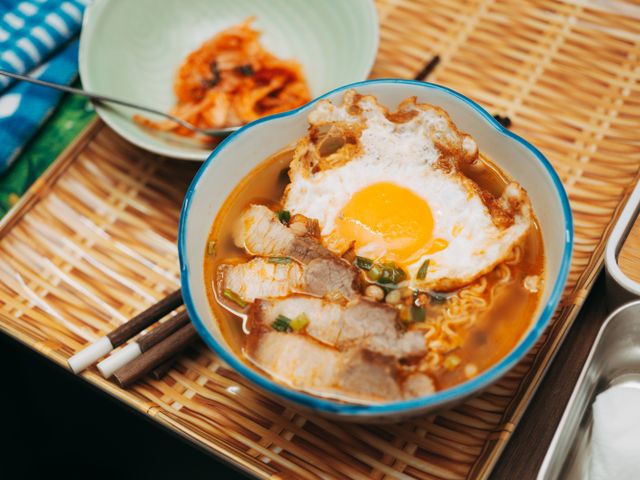
Korean Seafood Kalguksu with Clams
Kalguksu is a comforting Korean noodle soup where tender hand-torn wheat noodles swim in a savory seafood broth enriched with clams, mussels, and squid. Fresh perilla leaves, gochugaru chili flakes, and soy accents build layers of umami and heat. This one-bowl meal is both elegant enough for guests and quick enough for a weeknight dinner.
- Prep
- 25 min
- Cook
- 20 min
- Total
- 45 min
- Makes
- 4 bowls (about 2.5 cups per serving)
Steps
Before you start
- Clean clams and mussels by rinsing under cold water and scrubbing shells; discard any that won't close when tapped
- Have a large bowl of cold water nearby to prevent the dough from drying out while you tear noodles
- Ensure your seafood is fresh and your water is at a rolling boil before adding noodles
Make the noodle dough
- In a medium mixing bowl, whisk together 1.5 cups (180 g) flour and 0.25 tsp (1.5 g) salt.
- Add 0.5 cup (120 ml) cold water a little at a time, stirring with a wooden spoon until a shaggy dough forms.
- Knead by hand for 2–3 minutes until the dough comes together into a smooth ball.
- Cover the bowl with a damp cloth and let rest at room temperature while you prepare the broth.
+ Show details− Hide details
Ready when: Dough is smooth and holds together when pressed
Tip: Do not overwork the dough; it should be tender, not tough. A slightly sticky dough is fine.
Bring broth to a boil
- In a large stockpot, combine 6 cups (1440 ml) vegetable or seafood stock and 2 cups (480 ml) water.
- Add the minced garlic and bring to a rolling boil over high heat, about 4–5 minutes.
- Once boiling, stir in the soy sauce and gochugaru until evenly distributed.
+ Show details− Hide details
Ready when: Broth is at a rolling boil with steam rising steadily
Tip: Use seafood stock for deeper flavor, but vegetable stock works well too. Don't skip the gochugaru at this stage—it flavors the broth evenly.
Add clams and mussels
- Carefully add the cleaned clams and mussels to the boiling broth.
- Stir once, then maintain a boil over high heat.
- The shellfish should begin to open within 3–5 minutes.
- Continue cooking until most clams and mussels have opened.
- Discard any that remain closed.
+ Show details− Hide details
Ready when: Most shells have opened; liquid is still brisk and steaming
Tip: Boil hard enough to open the shells quickly but gently enough not to overcook tender mussel meat. Discarding unopened shells is essential for food safety.
Add squid and cook
- Add the sliced squid rings and halved tentacles to the broth.
- Bring back to a gentle boil and cook for 2–3 minutes until squid turns opaque and curls slightly.
- Stir occasionally to ensure even cooking.
+ Show details− Hide details
Ready when: Squid is opaque and slightly curled; no translucent center remains
Tip: Squid cooks very quickly. Overcooked squid becomes rubbery, so watch closely and pull it off the heat as soon as it's opaque.
Tear and cook the noodles
- Increase the heat to high and bring the broth back to a vigorous boil.
- Working quickly, tear off golf-ball-sized pieces of dough and gently stretch and drop them into the boiling broth.
- Tear the dough so you get irregular noodle shapes about 2–3 inches long.
- Stir gently with a wooden spoon to prevent clumping.
- Add all dough pieces over 1–2 minutes, then continue cooking for 4–6 minutes, stirring occasionally, until the noodles are tender but still slightly chewy.
+ Show details− Hide details
Ready when: Noodles are tender and float in the broth; they taste cooked through, not doughy
Tip: Dough pieces naturally tear into varied shapes—that is the charm of kalguksu. Stir gently so pieces don't stick together. If your broth was hot before, noodles will cook faster.
Season and finish
- Remove the pot from heat.
- Stir in 1 tbsp (15 ml) toasted sesame oil until well combined.
- Taste the broth and adjust salt or soy sauce to your preference—the soup should taste rich and well-seasoned, with just enough chili warmth from the gochugaru.
+ Show details− Hide details
Ready when: Sesame oil is evenly distributed; aroma is fragrant and inviting
Tip: Add sesame oil off heat so its aroma and flavor remain bright. Taste before serving—seasoning is personal, so adjust to your liking.
Serve and garnish
- Ladle the noodles, broth, and seafood into 4 large serving bowls, dividing the clams, mussels, and squid evenly.
- Top each bowl with 3 perilla leaves, a handful of sliced green onions, and a sprinkle of toasted sesame seeds if desired.
- Serve immediately while steaming hot.
+ Show details− Hide details
Ready when: Bowls are filled and steaming; garnish is visibly fresh and aromatic
Tip: Perilla leaves add a subtle anise-like fragrance—tear them gently as you eat for maximum flavor. Green onions should be fresh and bright.
Good to know
Tips
- Fresh seafood is key: check that clams and mussels close when tapped, and squid should smell clean and briny, not fishy. Frozen squid can be used if thawed completely before slicing.
- The dough is intentionally simple so the broth and seafood shine. Do not overwork it; a tender dough yields soft, delicate noodles.
- Korean grocery stores carry fresh perilla (called ssuk or kkaennip) year-round. It is worth seeking out for its unique flavor, but fresh basil is a fine backup.
- This soup is all about layers of umami: the seafood releases brine, the dough soaks it up, and the sesame oil brings it all together. Taste as you go and don't be shy with seasoning.
Make ahead
Noodle dough can be made up to 2 hours ahead; keep it covered in the bowl at room temperature. Seafood and garlic can be prepped and refrigerated in separate containers for up to 4 hours. Do not make ahead the full soup; kalguksu is best served immediately after cooking.
Storage & reheating
Best served immediately. Leftover soup (without noodles) can be refrigerated in an airtight container for up to 2 days; reheat gently on the stovetop over medium heat. The noodles will absorb liquid and soften upon storage, so eat fresh for the best texture. Do not freeze the finished soup, as the seafood will become tough. Noodle dough can be frozen for up to 1 month; thaw in the refrigerator overnight and bring to room temperature before tearing and cooking.
Substitutions
- littleneck clams, fresh → Manila clams or littleneck clams with the same total weight. Manila clams are slightly smaller and cook a bit faster; littlenecks are meatier. Both are traditional in Korean kalguksu.
- mussels, fresh → Additional clams or shrimp (8 oz / 225 g, peeled and deveined). If mussels are hard to find, use all clams or swap in shrimp, which cooks in 2–3 minutes at boiling temperature.
- perilla leaves (shiso), fresh → Fresh basil or cilantro leaves. Perilla's subtle anise-like flavor is traditional, but basil or cilantro offer a different but complementary freshness.
- gochugaru (Korean red chili flakes) → 0.5 tsp (1 g) crushed red pepper flakes, or a pinch of cayenne pepper. Gochugaru has a deeper, slightly sweet chili character; Western chili flakes are spicier. Start with less and adjust to taste.