
Korean Gochujang Pork Belly Skewers
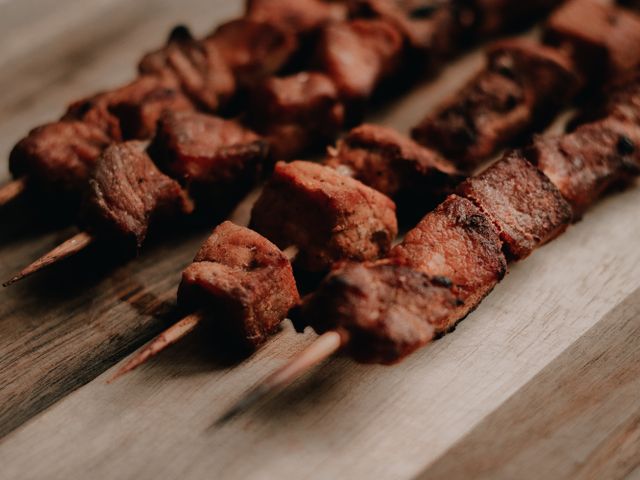
Charred and juicy pork belly strips threaded on skewers and grilled to perfection. The marinade combines spicy gochujang, umami-rich soy sauce, and toasted sesame oil with fresh garlic and ginger, creating an addictively flavorful coating. The meat marinates for at least 2 hours to absorb deep flavor, then grills quickly over high heat to develop a caramelized, blistered crust while staying tender inside. Finished with toasted sesame seeds and fresh green onions, these skewers work as an elegant appetizer or alongside rice and vegetables for a complete Korean meal.
- Prep
- 20 min
- Cook
- 10 min
- Wait
- 2 hr
- Total
- 2 hr 30 min
- Makes
- 8 skewers (serves 4 as appetizer, 2 as main)
Steps
Before you start
- Soak wooden skewers in water for at least 20 minutes if using (soak while prepping)
- Keep pork belly cold and firm in the refrigerator until ready to slice—cold meat is easier to cut cleanly
- Preheat your grill 5–10 minutes before grilling to ensure even heat
- Have all marinade ingredients measured and ready before you begin
Prepare the pork belly
- Remove pork belly from the refrigerator and pat dry thoroughly with paper towels.
- Using a sharp knife on a cutting board, slice the pork belly into ¼-inch (6 mm) thick pieces.
- Then cut each slice into 3–4 inch (8–10 cm) long strips, discarding any pieces that are mostly skin or thick fat.
- You should end up with approximately 16–20 pliable strips ready for marinating.
+ Show details− Hide details
Ready when: Pork strips are uniform in thickness and pliable
Tip: Cold pork belly is easier to slice; if the meat gets warm, freeze for 15 minutes to firm up
Make the marinade
- In a small bowl, combine the gochujang, soy sauce, sesame oil, brown sugar, minced garlic, minced fresh ginger (or ground ginger), and rice vinegar.
- Stir vigorously until the mixture is smooth, the brown sugar is fully dissolved, and there are no visible lumps of gochujang remaining.
+ Show details− Hide details
Ready when: Marinade is smooth and well combined with no lumps
Tip: If gochujang clumps, whisk it together with the soy sauce first before adding other ingredients
Marinate the pork
- Place the prepared pork belly strips in a large zip-top bag or shallow container.
- Pour the marinade over the pork and toss with your hands or a spoon until every piece is thoroughly coated.
- Seal the bag and refrigerate for at least 2 hours, preferably 3–4 hours, or up to 8 hours.
- The longer the pork marinates, the more deeply flavored and tender it will become.
+ Show details− Hide details
Tip: For best flavor, use a zip-top bag so every strip stays in contact with the marinade
Thread onto skewers
- If using wooden skewers, soak them in water for 20 minutes if not done already, then drain and pat dry.
- Remove the pork from the refrigerator and transfer to a clean cutting board, shaking off excess marinade.
- Pour the leftover marinade into a small bowl and set aside for basting.
- Thread the pork strips onto skewers, leaving about ¼ inch (6 mm) of space between pieces so they cook evenly.
- Aim for 4–6 pieces per skewer depending on size.
+ Show details− Hide details
Ready when: Pork is evenly spaced on skewers with small gaps between pieces
Tip: Don't crowd the pork on the skewers or they'll steam instead of grill; the gaps allow heat to circulate
Preheat the grillOven 425°F / 220°C
- Preheat your grill (or grill pan if using an indoor option) to medium-high heat, about 400–425°F (200–220°C).
- Once preheated, use a grill brush to clean the grates thoroughly.
- Wipe a paper towel dampened with high-smoke-point vegetable oil across the grates to prevent the pork from sticking.
+ Show details− Hide details
Tip: Hot grill grates must be well-oiled or the pork will stick and tear
Grill the skewersOven 160°F / 70°C
- Carefully place the skewers on the hot grill, spacing them 2–3 inches (5–8 cm) apart.
- Do not move them for 4–5 minutes while the first side develops a charred crust and releases easily from the grates.
- Using tongs, flip each skewer and grill for another 4–5 minutes.
- In the final minute of cooking, use a pastry brush to lightly brush the reserved marinade onto the skewers, creating a glossy glaze.
- The pork is done when an instant-read thermometer inserted into the thickest piece reads 160°F (71°C).
+ Show details− Hide details
Ready when: Internal temperature reaches 160°F (71°C), edges are caramelized and charred, and marinade has reduced to a glossy glaze
Tip: Resist the urge to flip early; the longer the pork sits undisturbed, the better the char
Rest and garnish
- Transfer the skewers to a serving platter and let rest for 3 minutes, which allows the juices to redistribute and the meat to remain juicy.
- Generously sprinkle the toasted sesame seeds across all the skewers and scatter the chopped green onions on top.
- Arrange the lime wedges on the platter for squeezing over the skewers just before eating.
- Serve immediately while still warm.
+ Show details− Hide details
Tip: Don't skip the resting period; it makes a significant difference in juiciness
Good to know
Tips
- Don't skip soaking wooden skewers, or they'll char and potentially catch fire on the grill; metal skewers eliminate this step
- Pat the pork completely dry after marinating to maximize browning; excess moisture prevents proper caramelization
- Resist moving the skewers around while grilling—they need sustained contact with the grates to develop proper char and flavor
- Use an instant-read thermometer to check doneness; pork belly cooks quickly and can dry out if overdone, but must reach 160°F for food safety
Make ahead
Marinate the pork for up to 8 hours or overnight for maximum flavor development. Thread the skewers up to 1 hour before grilling, cover, and refrigerate. Prepare the marinade up to 2 days ahead and store in the refrigerator.
Storage & reheating
Cooked skewers keep for 3–4 days in an airtight container in the refrigerator. To reheat, place on a baking sheet and warm gently in a 325°F (163°C) oven for 8–10 minutes until heated through. Frozen skewers (well wrapped) keep up to 3 months; thaw in the refrigerator overnight before reheating.
Substitutions
- Gochujang (Korean red chili paste) → Sriracha mixed with miso paste (1:1 ratio), or Korean chili flakes (gochugaru) mixed with soy sauce and garlic. Sriracha–miso will be less spicy and more vinegary; chili flakes will be chunkier but pack more heat
- Sesame oil → Peanut oil or neutral vegetable oil. Sesame oil provides unique nuttiness and is worth seeking out, but peanut oil works; use 1 tbsp to avoid overwhelming the dish
- Brown sugar → Honey, maple syrup, or granulated sugar. Honey and maple add different subtle flavors; granulated sugar works but use the same weight
- Fresh ginger (or 1 tsp / 3 g ground ginger) → Ground ginger (use 1 tsp / 3 g instead of 1 tbsp fresh). Ground ginger is more concentrated; use the smaller amount to prevent it from overpowering the marinade
More kebabs & skewers
See all →


Find more like this
- Meal
- Dinner
- Cuisine
- Korean
- Main ingredient
- Pork
- Diet
- Dairy-Free
- Method
- Grill & BBQ