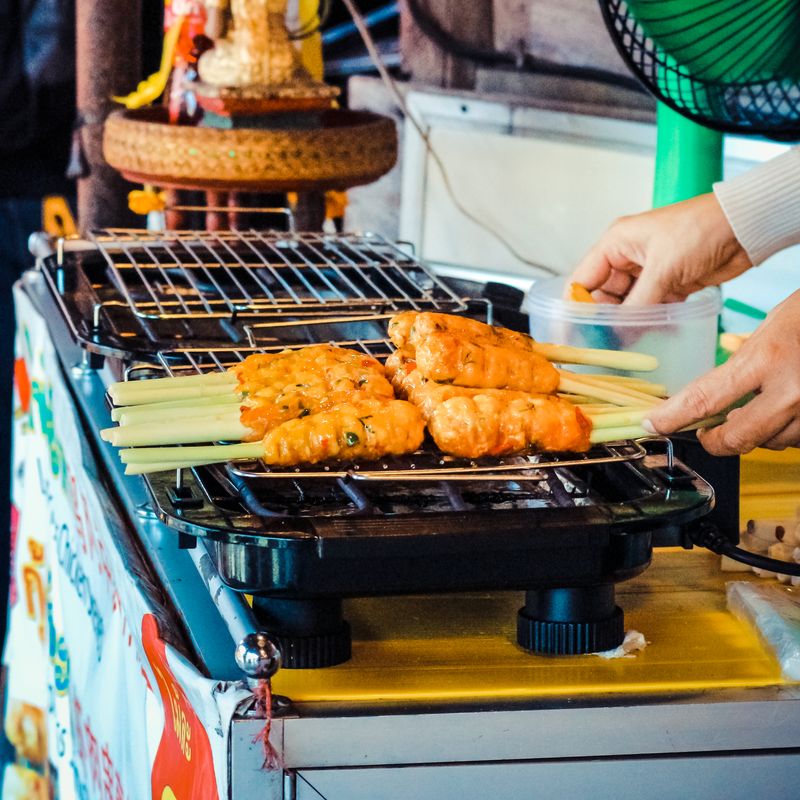
Vietnamese Lemongrass Pork Skewers
Tender pork shoulder marinated in a fragrant paste of lemongrass, garlic, and shallots, then grilled until caramelized and charred. The aromatic marinade infuses the meat with bright, complex flavors that are slightly sweet, deeply savory, and distinctly Vietnamese. Serve with steamed rice, fresh herbs, and a tangy fish sauce dipping sauce for a complete meal.
- Prep
- 25 min
- Cook
- 12 min
- Wait
- 2 hr
- Total
- 2 hr 37 min
- Makes
- 8 skewers (4 servings)
Steps
Before you start
- If using wooden skewers, soak them in water for at least 30 minutes before grilling
- Cut pork shoulder into 1-inch (2.5 cm) cubes and pat completely dry to help with marinade absorption
- Prep all aromatics: trim lemongrass to white and pale green parts only, peel garlic and shallots
- Plan for at least 2 hours of marinating time before grilling; overnight is ideal for deeper flavor
Blend the marinade paste
- In a food processor or using a mortar and pestle, combine the lemongrass pieces, garlic cloves, shallots, ginger, brown sugar, fish sauce, vegetable oil, lime juice, and white pepper.
- Blend or pound until you have a coarse paste with visible small pieces of lemongrass and other aromatics throughout.
- Do not over-blend into a completely smooth paste—texture creates deeper flavor when grilled.
- If the mixture seems too thick, add 1 tablespoon of water and pulse once or twice.
+ Show details− Hide details
Ready when: Coarse paste with small visible pieces of lemongrass and aromatics throughout
Tip: Don't over-blend; texture in the paste yields better caramelization and richer flavor when grilled.
Coat pork with marinade
- Pat the pork shoulder cubes dry with paper towels to remove excess moisture, which helps them absorb the marinade and develop a good crust on the grill.
- Place the pork cubes in a medium bowl and add all of the prepared lemongrass paste.
- Toss and fold gently but thoroughly so every piece is evenly coated.
- Cover the bowl with plastic wrap and refrigerate for at least 2 hours, or preferably overnight.
- The longer it sits, the more deeply the flavors penetrate the meat.
+ Show details− Hide details
Ready when: All pork cubes are evenly coated with the fragrant paste
Tip: Remove the pork from the fridge 15 minutes before grilling; room temperature meat cooks more evenly and absorbs residual heat better.
Heat grill and thread skewersOven 400°F / 205°C
- Preheat your grill to medium-high heat (about 400°F / 200°C).
- If using wooden skewers, remove them from water and pat dry.
- Thread the marinated pork cubes onto the skewers, fitting about 5–6 pieces per skewer and spacing them ½-inch apart so steam escapes and they cook evenly.
- Reserve any leftover marinade—you'll use it to brush the skewers near the end of grilling.
+ Show details− Hide details
Ready when: Grill grates are hot; a drop of water sizzles and evaporates immediately on the surface
Tip: Space the pork pieces apart so steam releases quickly, allowing a caramelized crust to form instead of steaming the meat.
Grill until caramelizedOven 160°F / 70°C
- Carefully place the skewers on the hot grill grates perpendicular to the bars so they won't roll.
- Grill without moving for 3–4 minutes on the first side, allowing a charred, caramelized crust to develop.
- Flip the skewers and grill for another 3–4 minutes on the second side.
- Then rotate each skewer 90 degrees and grill for 2–3 minutes more to create attractive crosshatch marks and ensure all sides are evenly cooked.
- During the final 30 seconds, brush all the pork pieces with the reserved marinade.
- The pork is done when cooked through and an instant-read thermometer inserted into the thickest piece reads 160°F (71°C).
+ Show details− Hide details
Ready when: Pork is cooked through with a caramelized, charred exterior; internal temperature reaches 160°F (71°C)
Tip: Don't move the skewers until a crust forms; resist the urge to flip early so flavors develop and the meat doesn't stick.
Rest the skewers
- Transfer the cooked skewers to a clean serving plate and let them rest at room temperature for 2–3 minutes.
- This brief rest allows the juices to redistribute throughout the meat, keeping it moist and tender when served.
+ Show details− Hide details
Ready when: Skewers have cooled slightly and juices have settled
Good to know
Tips
- For a deeper lemongrass flavor, place a split lemongrass stalk lengthwise on the grill alongside the skewers; the heat releases its aromatic oils and perfumes the entire dish.
- Serve with steamed jasmine rice, cool cucumber slices, pickled daikon, fresh mint, cilantro, and a Vietnamese dipping sauce made from fish sauce, lime juice, palm sugar, and sliced red chiles.
- If flare-ups occur from rendered fat dripping onto the coals, move the skewers to a cooler zone of the grill. The goal is caramelization, not heavy charring.
- Marinating overnight develops richer, more complex flavors; it's worth the extra time if you can plan ahead. The pork will taste noticeably better than with just a 2-hour marinade.
Make ahead
The pork can be marinated up to 24 hours in advance, covered and refrigerated. After grilling, cooled skewers can be refrigerated for up to 3 days before serving. Reheat on a medium-high grill or under the broiler for 2–3 minutes, turning once, until warmed through.
Storage & reheating
Room temperature: up to 2 hours. Refrigerator: store in an airtight container for up to 3 days; reheat on the grill over medium heat or under the broiler for 2–3 minutes, turning once. Freezer: up to 2 months (freeze before or after grilling); thaw overnight in the fridge and reheat on the grill until warmed through, about 3–4 minutes.
Substitutions
- lemongrass stalks, white and pale green parts only → 1 tablespoon dried lemongrass or 2 tablespoons lemongrass paste. Dried lemongrass is more concentrated; rehydrate with 1 tablespoon water first. Lemongrass paste works well straight from the jar.
- fish sauce → soy sauce. Use the same amount. Soy sauce is milder; add an extra squeeze of lime juice for depth and complexity.
- pork shoulder → chicken thighs or beef sirloin. Cut into 1-inch cubes. Chicken thighs cook in 8–10 minutes total; beef sirloin in 10–12 minutes depending on thickness.
- packed brown sugar → honey or palm sugar. Use the same amount. Honey and palm sugar caramelize slightly differently; watch for charring and adjust grill heat if needed.
More kebabs & skewers
See all →

Find more like this
- Meal
- Dinner
- Cuisine
- Vietnamese
- Main ingredient
- Pork Shoulder
- Method
- Grill & BBQ
- Quick & Easy
- EasyBeginnerMake Ahead