Japanese Chicken Curry with Potatoes and Carrots
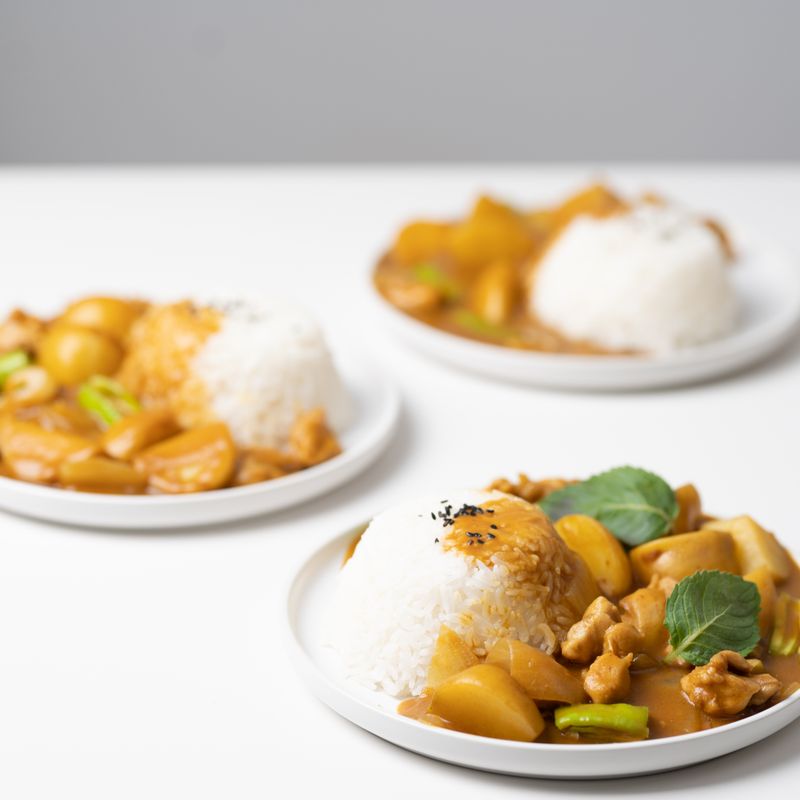
A comforting Japanese-style home curry: juicy chicken thighs, sweet browned onions, tender potatoes and carrots in a glossy, mild curry sauce thickened with store-bought roux blocks and served over fluffy rice.
- Prep
- 15 min
- Cook
- 50 min
- Wait
- 5 min
- Total
- 1 hr 10 min
- Makes
- About 6 cups curry (4 generous servings with rice)
Steps
Before you start
- Start the rice in a rice cooker or pot about 30 minutes before you want to eat so it is hot and steamed when the curry is ready.
- Check your roux package: this recipe assumes about 100 g (3.5 oz) of Japanese curry roux blocks (such as S&B Golden Curry or Vermont Curry) for 3 cups of water. If your box says otherwise, follow the ratio on the box for 4 servings.
- Cut the potatoes and carrots into large, even chunks so they cook at the same rate and don't turn to mush.
- Break the roux into small pieces before you start so it dissolves quickly later.
Season the chicken
- Pat the chicken pieces dry with paper towels.
- Place them in a bowl and toss with ½ teaspoon kosher salt.
- Let them sit while you prep the vegetables.
+ Show details− Hide details
Ready when: Chicken surface looks dry and evenly seasoned.
Tip: Dry chicken browns instead of steaming.
Prep the vegetables
- Cut the onions into ½-inch wedges.
- Peel and cut the carrots into 1-inch chunks and the potatoes into 1½-inch chunks.
- Grate the garlic, ginger, and apple (if using).
- Break the roux blocks into small pieces.
- Keep potatoes in a bowl of cold water if not using right away.
+ Show details− Hide details
Ready when: Vegetables are in even, similar-sized chunks.
Tip: Drain the potatoes well before they go in the pot.
Brown the chicken
- Heat the oil in a 4-quart heavy pot over medium-high heat until shimmering.
- Add the chicken in a single layer and cook without moving for 2 minutes, then stir and cook another 2–3 minutes until browned in spots.
- It does not need to be cooked through.
- Transfer to a plate.
+ Show details− Hide details
Ready when: Chicken is golden-brown on the outside, pink inside.
Tip: If the pot is crowded, brown in two batches.
Soften the onions
- Reduce heat to medium.
- Add the onions to the same pot, scraping up the browned bits.
- Cook, stirring often, for 8–10 minutes until soft, translucent, and golden at the edges.
- Add the garlic and ginger and stir for 30 seconds until fragrant.
+ Show details− Hide details
Ready when: Onions are soft, translucent, and lightly golden; garlic smells fragrant.
Tip: Add a splash of water if the browned bits start to scorch.
Add vegetables and water
- Return the chicken and its juices to the pot.
- Add the carrots, potatoes, and 3 cups (710 ml) water.
- Stir, then bring to a boil over high heat, about 5 minutes.
- Skim off any foam from the surface with a spoon.
+ Show details− Hide details
Ready when: Liquid is at a steady rolling boil.
Tip: Skimming keeps the finished sauce clean-tasting.
Simmer until tender
- Reduce heat to low, partially cover, and simmer gently for 15–20 minutes, until the carrots and potatoes are just tender when pierced with a knife and the chicken reaches 175°F (80°C) in the thickest piece.
- Stir once or twice.
+ Show details− Hide details
Ready when: A knife slides into a potato with slight resistance; chicken reads 175°F (80°C).
Tip: Don't over-simmer; the potatoes will keep softening in the sauce.
Dissolve the roux
- Turn the heat off completely.
- Add the roux pieces, grated apple (if using), and soy sauce.
- Stir gently for 1–2 minutes until every piece has fully dissolved with no lumps.
+ Show details− Hide details
Ready when: No visible roux pieces remain; sauce is uniformly brown.
Tip: Adding roux off the heat prevents lumps and scorching.
Simmer to thicken
- Return the pot to low heat and simmer uncovered for 8–10 minutes, stirring frequently and scraping the bottom, until the sauce is thick, glossy, and coats the back of a spoon.
- Add a splash of water if too thick.
- Taste and adjust with a pinch of salt or a little more soy sauce.
+ Show details− Hide details
Ready when: Sauce is thick and glossy and leaves a trail when a spoon is dragged across the bottom.
Tip: Stir often; roux sauces catch on the bottom of the pot easily.
Rest the curry
- Turn off the heat and let the curry rest, covered, for 5 minutes.
- The sauce will thicken a little more and flavors will meld.
+ Show details− Hide details
Ready when: Sauce has a thick, pourable consistency.
Serve over rice
- Divide the hot rice among 4 shallow bowls.
- Ladle the curry alongside or over the rice, making sure each serving has chicken, potatoes, and carrots.
- Serve with fukujinzuke pickles if you like.
+ Show details− Hide details
Tip: Serve immediately while the rice is hot and the sauce is glossy.
Good to know
Tips
- Use chicken thighs rather than breast; they stay juicy during simmering and add richer flavor.
- Always turn the heat off before adding the roux so it dissolves smoothly without lumps.
- Stir often during the final thickening and scrape the pot bottom, since the roux can scorch easily.
- For deeper flavor, cook the onions a few extra minutes until golden brown before adding water.
Make ahead
Curry tastes even better the next day. Cook through the thickening step (step 8), cool, and refrigerate in an airtight container for up to 3 days. Cook rice fresh when reheating.
Storage & reheating
Room temperature: no more than 2 hours. Refrigerator: up to 3 days in an airtight container. Freezer: up to 1 month, though potatoes may soften and become grainy (best to omit potatoes if freezing). Reheat gently in a pot over low heat, stirring and adding a splash of water, until steaming hot (165°F / 74°C).
Substitutions
- boneless, skinless chicken thighs → boneless skinless chicken breast. Cut into 1½-inch pieces and reduce the simmer time so it doesn't dry out; add it after the vegetables have simmered 10 minutes.
- Japanese curry roux blocks (mild or medium) → other Japanese curry roux brand or heat level. Choose mild, medium, or hot to taste; follow the water ratio on the package if different.
- sweet apple (such as Fuji) → 1 tablespoon ketchup or 1 teaspoon honey. Adds the classic hint of sweetness and acidity.
- Yukon Gold potatoes → Russet or white potatoes. Russets break down more and thicken the sauce further; handle gently.