Italian Salsa di Noci (Walnut Sauce)
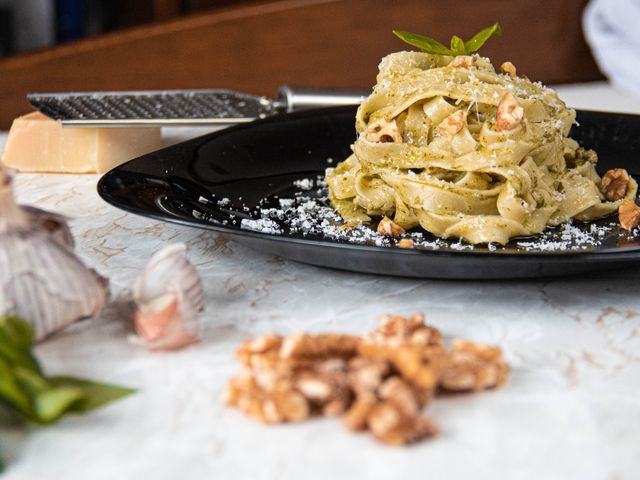
A silky, rustic Ligurian walnut sauce made with toasted walnuts, soft breadcrumbs, and garlic bound with cream and olive oil. This versatile sauce clings beautifully to pasta, makes an excellent dip for vegetables, and pairs wonderfully with roasted meats or spread on grilled bread. Traditional and simple, yet deeply flavored.
Steps
Before you start
- Toast walnuts fresh just before making the sauce for best flavor; don't use rancid nuts from the pantry.
- Have all ingredients measured and ready—the food processor works quickly.
- If using as a pasta sauce, reserve 1 cup (240 ml) pasta water before draining.
Toast the walnuts
- Heat the skillet over medium heat.
- Add the walnuts and toast for 3 to 4 minutes, stirring frequently with a wooden spoon, until they smell fragrant and begin to darken slightly.
- Pour onto a plate to cool for 1 minute.
+ Show details− Hide details
Ready when: Walnuts smell nutty and fragrant, begin to darken at the edges
Tip: Do not skip toasting—raw walnuts taste bitter and make the sauce dull. Watch carefully so they don't burn.
Process walnuts and breadcrumbs
- Transfer the cooled walnuts to the food processor.
- Add the breadcrumbs and peeled garlic cloves.
- Pulse for 8 to 10 seconds until the mixture resembles coarse meal—texture should be grainy, not a fine paste.
+ Show details− Hide details
Ready when: Mixture resembles coarse breadcrumbs; no large walnut pieces remain
Tip: Pulse in short bursts rather than continuous processing—over-processing makes the sauce gluey and bitter.
Add cream and emulsify
- With the food processor running, slowly drizzle in the heavy cream and olive oil through the feed tube over 20 to 30 seconds.
- The sauce will become creamy and smooth, lightening in color slightly.
+ Show details− Hide details
Ready when: Sauce is creamy, pale, and smooth; no oil pools on top
Tip: Add cream and oil slowly so the sauce emulsifies properly. If it breaks and looks grainy, stop and let it rest for 1 minute, then resume.
Finish with cheese and seasoning
- Pour the sauce into a bowl.
- Fold in the grated Parmigiano-Reggiano until just combined.
- Taste and season generously with kosher salt and freshly ground black pepper.
- The sauce should taste bold and savory.
+ Show details− Hide details
Ready when: Cheese is evenly incorporated and no streaks remain
Tip: Season to taste just before serving—salt can get stronger as the sauce sits, so be conservative at first.
Good to know
Tips
- Salsa di noci is best served at room temperature or warm, never chilled. Cold sauce loses its silky texture.
- For pasta: toss 1 cup (240 ml) sauce with 1 pound (450 g) freshly cooked pasta and ½ cup (120 ml) reserved pasta water for a light, clinging sauce.
- Toast walnuts fresh each time if possible, or store already-toasted walnuts in the freezer to preserve their flavor and prevent rancidity.
- This sauce works beautifully as a vegetable dip, spread on grilled bread (bruschetta or crostini), or served alongside roasted chicken or fish.
Make ahead
Prepare up to 24 hours ahead. Store in an airtight container in the refrigerator. Bring to room temperature for 30 minutes before serving, or gently warm in a small saucepan over low heat with a splash of pasta water or milk to restore creamy texture.
Storage & reheating
Room temperature: not recommended (contains cream). Refrigerator: up to 5 days in an airtight container. Freezer: up to 3 months in a freezer-safe container (freeze in smaller portions). To reheat, thaw in the refrigerator overnight, then warm gently over low heat with a splash of milk or pasta water to restore consistency.
Substitutions
- heavy cream or whole milk → whole milk or half-and-half. Results will be slightly thinner but still delicious. Use the same amount. For a richer sauce, use 1/3 cup (80 ml) milk plus 2 tablespoons (30 ml) mascarpone.
- fresh breadcrumbs (from day-old country bread) → pine nuts (lightly toasted). Use ¼ cup (40 g) pine nuts instead of breadcrumbs for a more traditional Ligurian version, though this changes the texture from creamy-grainy to smoother.
- Parmigiano-Reggiano cheese → Pecorino Romano. Use the same amount, or reduce to ⅓ cup (35 g) since Pecorino is sharper. This gives a more assertive, Southern Italian accent.
- garlic → 1 small garlic clove (halved) for milder flavor, or omit entirely. If garlic is too strong for your taste, reduce to 1 clove or remove the germ from 2 cloves before processing.