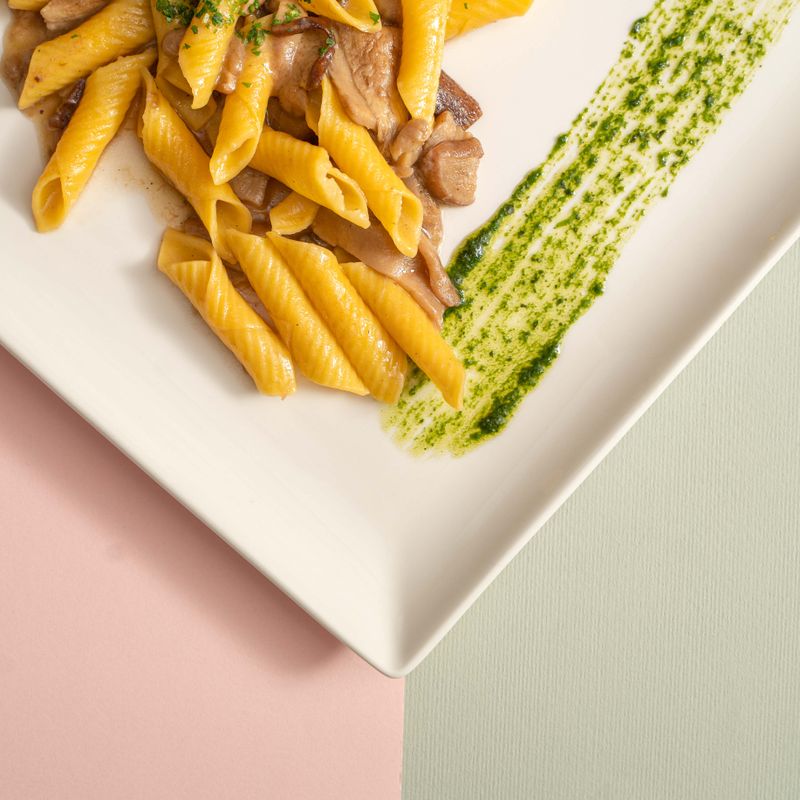
Italian Minestrone Verde with Pesto Drizzle
A bright, herbaceous vegetable soup anchored by fresh basil pesto. This minestrone verde celebrates green vegetables—zucchini, green beans, and spinach—simmered in a light broth with small pasta and finished with a drizzle of homemade pesto and aged Parmigiano-Reggiano for authentic Italian flavor.
- Prep
- 20 min
- Cook
- 25 min
- Total
- 45 min
- Makes
- 4 servings (about 10 cups)
Steps
Before you start
- Gather all vegetables and prep them before you begin so cooking moves smoothly
- Use good-quality vegetable or light chicken broth—it's the foundation of flavor
- Prepare the pesto while the soup simmers so everything finishes together
Build the base
- Heat 3 tbsp (45 ml) olive oil in a large pot over medium heat.
- Add the diced yellow onion and cook, stirring occasionally, for 3–4 minutes until softened and fragrant.
- Add the sliced celery and diced carrot, and cook for another 3 minutes, stirring often, until the carrots just begin to soften.
- Stir in the minced garlic and cook for 30 seconds until aromatic.
- This aromatic base—the soffritto—builds flavor for the whole soup.
+ Show details− Hide details
Ready when: Vegetables are softened and fragrant, garlic is no longer raw
Tip: Don't let the garlic brown—it will turn bitter. Keep the heat at medium and stir constantly once you add it.
Add broth and green vegetables
- Pour in 6 cups (1440 ml) vegetable broth and bring to a simmer.
- Add the sliced zucchini and green bean pieces.
- Stir well and simmer uncovered for 8–10 minutes until the zucchini is tender and the beans are just cooked through but still bright green.
+ Show details− Hide details
Ready when: Zucchini is fork-tender, green beans have lost their raw bite but retain some color
Tip: Don't cover the pot—you want the soup to stay bright green. Covering it will trap steam and discolor the vegetables.
Add pasta and spinach
- Stir in the uncooked pasta and spinach.
- Bring the soup back to a simmer and cook, stirring often, for 8–10 minutes until the pasta is just tender (al dente) and the spinach has wilted completely.
- The soup should be bubbling gently.
+ Show details− Hide details
Ready when: Pasta is tender but not mushy, spinach has collapsed into the broth
Tip: Taste a piece of pasta—it should have no chalky center. If using fresh pasta, reduce the cooking time to 3–4 minutes.
Season to taste
- Taste the soup and season generously with kosher salt and freshly ground black pepper.
- Add salt gradually—you can always add more, but you cannot take it out.
- The broth should taste flavorful and well-seasoned, not bland.
+ Show details− Hide details
Ready when: Soup tastes well-seasoned and balanced
Tip: Taste as you go. The seasoning is the final chance to make the soup shine.
Prepare the pesto
- While the soup finishes cooking, make the pesto.
- In a small food processor, combine 1.5 cups (45 g) fresh basil leaves, 1 minced garlic clove, 0.25 cup (35 g) lightly toasted pine nuts, and 0.5 cup (50 g) finely grated Parmigiano-Reggiano.
- Pulse until the mixture resembles coarse breadcrumbs.
- With the processor running, slowly drizzle in 0.5 cup (120 ml) extra-virgin olive oil until the pesto comes together.
- Add 1.5 tbsp (22 ml) fresh lemon juice and 0.25 tsp (1 g) salt, and pulse once more to combine.
- If you don't have a food processor, use a mortar and pestle: pound the basil and garlic to a paste, add the pine nuts and pound gently, then fold in the cheese and oil by hand.
+ Show details− Hide details
Ready when: Pesto is coarse and chunky with visible basil pieces, olive oil is fully incorporated
Tip: Don't over-process the pesto—it should be textured and chunky, not a smooth paste. If you process it too much, the basil will oxidize and turn dark.
Serve with pesto and cheese
- Ladle the hot soup into four bowls.
- Spoon about 1 tbsp (15 ml) of pesto into the center of each bowl, allowing it to swirl into the broth.
- Top each bowl with a few shavings of fresh Parmigiano-Reggiano if desired.
- Serve immediately while the soup is piping hot.
+ Show details− Hide details
Ready when: Soup is hot, pesto has swirled into the broth
Tip: Add the pesto just before serving so it retains its bright color and fresh basil flavor. If you add it too early, it will discolor and lose its vibrant taste.
Good to know
Tips
- Use good broth—it's the foundation of this soup. A flavorless broth will result in a flavorless minestrone. Consider homemade vegetable broth if you have it.
- Keep all your vegetables prepped and ready before you start cooking. This soup moves quickly once the broth comes to a simmer, and you don't want to scramble mid-recipe.
- For a protein boost, stir in a 15 oz (425 g) can of white beans (cannellini or great northern) with the pasta. It will add heartiness without overpowering the delicate green vegetables.
- If fresh basil is not available, use a combination of parsley and a small amount of dried basil to approximate the flavor, but the result will be less aromatic and herbaceous.
Make ahead
The soup (without pesto) can be made up to 2 days ahead and refrigerated in an airtight container. The pesto can be made up to 1 day ahead and stored in the refrigerator, layered with a thin coating of olive oil to prevent browning. Reheat the soup gently over medium heat, stirring occasionally, until just steaming through. Add the pesto at serving time.
Storage & reheating
Refrigerate in an airtight container for up to 3 days. Reheat gently over medium heat. The pesto can be stored separately (covered with olive oil) for up to 2 days. Do not freeze this soup—the vegetables will become mushy and the pasta will soften further upon thawing.
Substitutions
- fresh green beans → Fresh peas or thinly sliced leeks. Both add a sweet, mild flavor. Use the same weight and add them at the same time as the zucchini.
- fresh baby spinach → Kale or Swiss chard, thinly sliced. These hearty greens hold their shape better. Add 2 minutes earlier and cook for 12 minutes total so they soften.
- small pasta (ditalini or stelline) → Small shells, orzo, or risoni. Any small pasta works. Keep the same weight and check for doneness at the lower end of the time range.
- pine nuts → Walnuts or almonds, lightly toasted and coarsely chopped. Both provide texture and richness. Walnuts give an earthier, less delicate flavor.
More vegetable soups
See all →


Find more like this
- Meal
- Lunch
- Cuisine
- Italian
- Diet
- HalalSugar-Free
- Method
- Stovetop