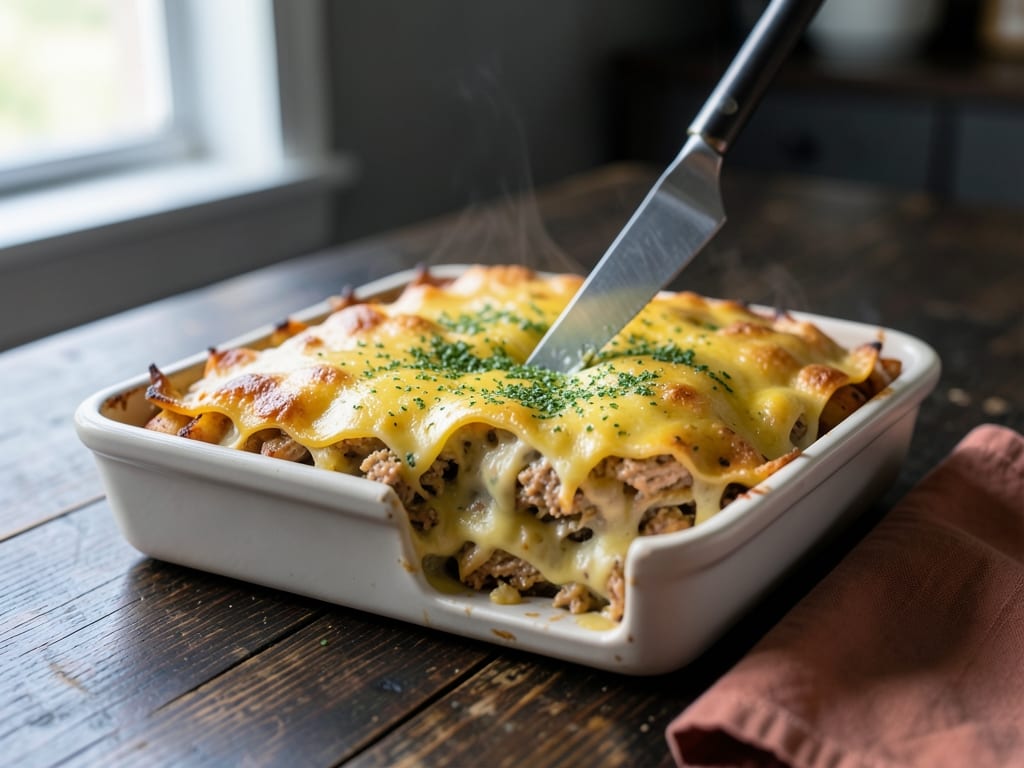
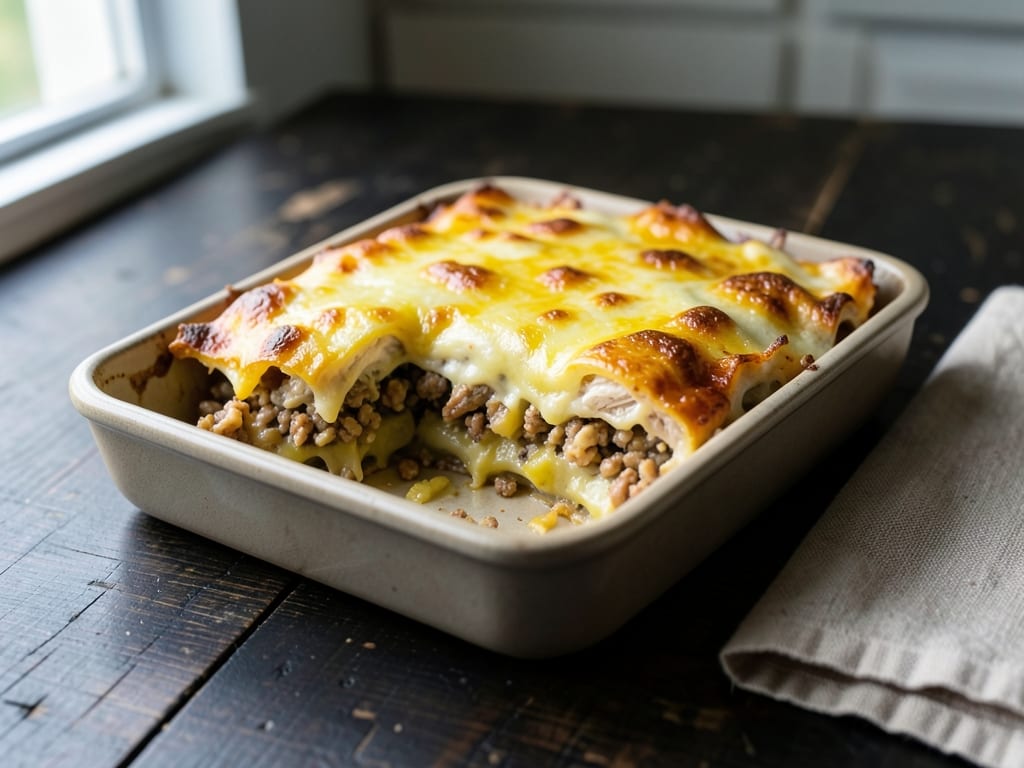
Indian Samosa Potato and Pea Lasagna
A creative fusion lasagna inspired by Indian samosas, featuring layers of spiced potato and pea filling, crispy phyllo sheets, and a cooling yogurt-cilantro sauce. Golden, flaky layers give way to a fragrant, cumin-scented potato mixture with fresh peas and aromatic spices. Serve warm with a cooling yogurt drizzle and fresh cilantro.
- Prep
- 35 min
- Cook
- 40 min
- Wait
- 15 min
- Total
- 1 hr 30 min
- Makes
- One 9×13-inch (23×33 cm) lasagna, 6 servings
Steps
Before you start
- Preheat your oven to 375°F (190°C)
- Have all spices measured and ready before you start cooking
- Cube potatoes uniformly so they cook at the same rate
- Thaw peas if using frozen; pat dry to remove excess moisture
Make the filling
- Heat 3 tablespoon (45 ml) of oil in a large skillet over medium-high heat.
- Once shimmering, add 1 teaspoon (5 g) cumin seeds and toast for 30 seconds until fragrant.
- Add the diced onion and cook for 4–5 minutes, stirring often, until softened and lightly golden.
- Stir in the 1 tablespoon (15 ml) ginger-garlic paste and cook for 1 minute.
- Add the diced potatoes, 0.75 teaspoon (1.5 g) ground coriander, 0.5 teaspoon (1 g) turmeric, and 0.5 teaspoon (1 g) chili powder.
- Stir well to coat the potatoes evenly.
+ Show details− Hide details
Ready when: Onions softened and lightly golden, potatoes coated with spices
Tip: Toast the cumin seeds briefly to release their essential oils—this amplifies the samosa flavor
Cook potatoes until tender
- Reduce heat to medium-low.
- Add 1 cup (240 ml) of water and stir.
- Cover the skillet with a lid and cook for 12–15 minutes, stirring occasionally, until the potatoes are just fork-tender but still hold their shape.
- The liquid should reduce to about 2 tablespoons (30 ml) at the bottom.
+ Show details− Hide details
Ready when: Potatoes are easily pierced with a fork but not falling apart; minimal liquid remains
Tip: Don't overcook the potatoes or they'll turn mushy when baked. They'll continue to soften in the oven
Finish the filling
- Stir in the 1 cup (150 g) thawed peas and 0.5 cup (30 g) fresh cilantro.
- Season generously with kosher salt and freshly ground black pepper to taste.
- Cook uncovered for 1 minute, stirring gently, then remove from heat and let cool for 5 minutes.
- The filling should be moist but not wet.
+ Show details− Hide details
Ready when: Peas are heated through, cilantro is incorporated, filling is warm but cool enough to handle
Tip: If the filling is too wet, drain off excess liquid before assembling to prevent a soggy lasagna
Prepare the yogurt sauce
- In a small bowl, whisk together the 1 cup (240 ml) Greek yogurt, 0.25 cup (15 g) fresh cilantro, 1 tablespoon (15 ml) fresh lime juice, and a pinch of kosher salt.
- If using, stir in the 2 tablespoon (10 g) fresh mint.
- Set aside at room temperature.
+ Show details− Hide details
Ready when: Sauce is smooth and well combined
Tip: Make the sauce just before baking so the cilantro stays bright green and fresh
Preheat and prepare the dishOven 375°F / 190°C
- Preheat your oven to 375°F (190°C).
- Lightly brush the bottom of a 9×13-inch (23×33 cm) baking dish with some of the 6 tablespoon (90 ml) melted ghee or clarified butter.
- Set the baking dish and remaining ghee nearby.
+ Show details− Hide details
Ready when: Oven is preheated; dish is lightly buttered
Tip: Use a pastry brush for even, thin coating of ghee to prevent sogginess
Layer the first phyllo base
- Lay one phyllo sheet flat in the prepared baking dish, allowing it to overhang slightly on the sides.
- Brush lightly with melted ghee.
- Repeat with 2 more phyllo sheets, brushing each with ghee, for a total of 3 sheets forming the bottom crust.
+ Show details− Hide details
Ready when: Three phyllo layers are stacked and ghee-brushed
Tip: Keep unused phyllo covered with a damp towel so it doesn't dry out and crack
Add first filling layer
- Spread half of the cooled potato-pea filling (about 2 cups or 400 g) evenly over the phyllo base, leaving a ½-inch (1.25 cm) border on all sides.
- Smooth with the back of a spoon.
+ Show details− Hide details
Ready when: Filling is evenly distributed and smooth
Tip: Don't overfill or the layers will crack and separate during baking
Layer the middle phyllo section
- Place 3 more phyllo sheets on top, brushing each with melted ghee before layering.
- Press gently to seal the filling underneath.
+ Show details− Hide details
Ready when: Three phyllo layers are stacked, brushed, and gently pressed
Tip: Gentle pressure helps the layers adhere without crushing the delicate filling
Add second filling layer
- Spread the remaining potato-pea filling (about 2 cups or 400 g) evenly over the middle phyllo section, again leaving a ½-inch (1.25 cm) border.
+ Show details− Hide details
Ready when: Remaining filling is evenly distributed
Tip: Reserve some phyllo pieces if they tear; you can patch visible gaps before baking
Layer the top phyllo crust
- Finish with 3 final phyllo sheets on top, brushing each generously with the remaining melted ghee.
- Fold any overhanging phyllo edges inward and brush those with ghee as well.
- You should have a sealed, butter-phyllo package.
+ Show details− Hide details
Ready when: Top is fully covered with phyllo; all exposed edges are brushed with ghee
Tip: Brush the final phyllo layer generously—this is what gives you that crispy, golden top
Score and bakeOven 375°F / 190°C
- Using a sharp knife, lightly score the top phyllo into 6 equal portions (do not cut all the way through; just mark the top 1–2 layers).
- This makes serving easier and allows steam to escape.
- Bake in the preheated 375°F (190°C) oven for 35–40 minutes, until the top is deep golden brown and crispy.
- You should hear a faint crackle if you tap the top.
+ Show details− Hide details
Ready when: Top is deep golden brown and crispy; steam escapes from the scored sections
Tip: Don't skip the scoring—it's traditional for samosa-style pastries and prevents shattering when you cut
Rest and serve
- Remove the lasagna from the oven and let it rest for 5 minutes before serving.
- This allows the filling to set slightly and the layers to firm up.
- Cut along the scored lines and serve warm, drizzling each portion with a spoonful of the cilantro-yogurt sauce.
- Garnish with extra fresh cilantro if desired.
+ Show details− Hide details
Ready when: Lasagna has cooled slightly and can be cut cleanly; filling is set
Tip: Use a serrated knife and a gentle sawing motion for clean cuts through the crispy phyllo without shattering
Good to know
Tips
- Toast the cumin seeds in the hot oil before adding onions—this unlocks their aromatic oils and deepens the samosa flavor.
- Keep unused phyllo covered with a damp kitchen towel while assembling. Phyllo dries out in minutes and becomes brittle.
- If your phyllo tears while handling, don't discard it. Patch small tears with a piece of ghee-brushed phyllo before the next layer goes on.
- For extra crisp phyllo, brush the top layer more generously than the inner layers. The edges of the dish will crisp up faster than the center.
Make ahead
The filling can be made up to 1 day ahead: cool completely, cover, and refrigerate. Bring to room temperature before assembling. The assembled (unbaked) lasagna can be covered and refrigerated for up to 4 hours; add 5–10 minutes to the baking time if baking from cold.
Storage & reheating
Store leftover lasagna covered in the refrigerator for up to 3 days. Reheat gently in a 350°F (175°C) oven for 10–12 minutes, covered with foil to prevent the phyllo from over-browning. Do not microwave, as it will soften the crispy phyllo. The lasagna does not freeze well due to the phyllo texture.
Substitutions
- phyllo pastry sheets → Thin sheets of puff pastry (thaw if frozen) or even thin-rolled dough rounds. Puff pastry will yield a less delicate, buttery crust but is easier to work with. The texture and samosa authenticity will differ slightly.
- Yukon Gold potatoes → Russet or red potatoes, cut into slightly smaller cubes. Russets are starchier and may become softer; cut smaller to ensure even cooking. Red potatoes hold their shape very well and are a good alternative.
- fresh cilantro, finely chopped → Fresh parsley or a mix of parsley and mint. This will change the traditional Indian flavor profile. Use the same quantities but expect a milder, less peppery taste.
- ghee or clarified butter, melted → Extra-virgin olive oil or neutral vegetable oil. Olive oil will give a different flavor; the phyllo will still crisp but lack the traditional samosa richness. Use the same amount.