Indian Jalebi with Orange & Cardamom Syrup
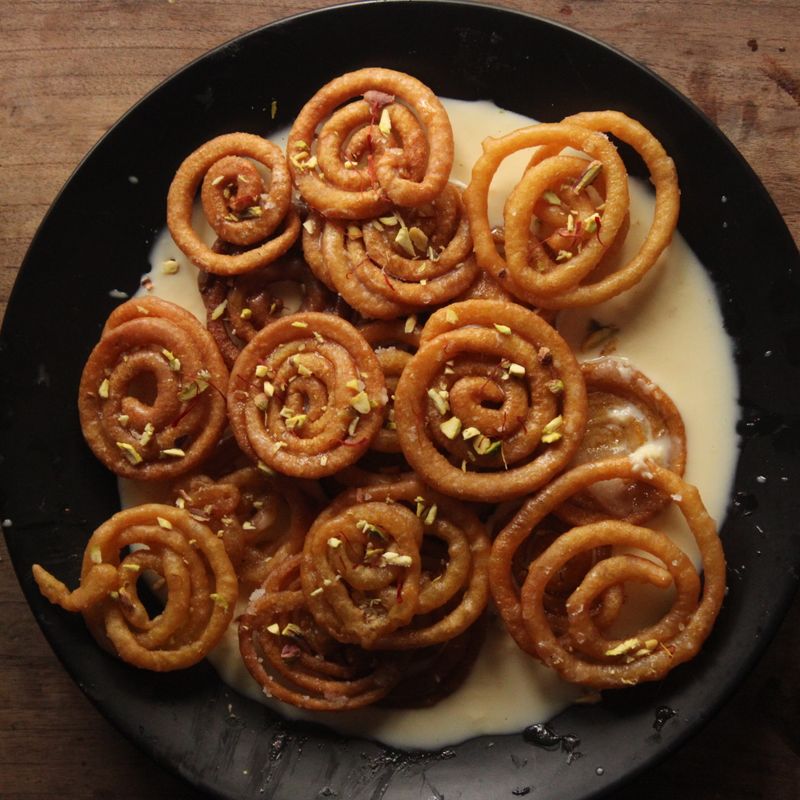
Crispy, golden fried spirals soaked in a fragrant orange and cardamom sugar syrup infused with saffron. Traditionally served warm and enjoyed fresh, these Indian sweets are perfect for festivals, celebrations, or as an indulgent teatime treat. The syrup seeps into the crispy pastry, creating a contrast of textures and a burst of citrus-spiced flavor.
- Prep
- 30 min
- Cook
- 25 min
- Wait
- 45 min
- Total
- 1 hr 40 min
- Makes
- 24 jalebi spirals (12 servings)
Steps
Before you start
- Have all ingredients measured and ready before you start frying—the piping must be quick and confident
- Heat the oil to exactly 320°F (160°C) before piping; use a candy/deep-fry thermometer
- Test the syrup temperature with a small sample spiral first to ensure it's at the right thickness
- Keep the piping bag warm and filled to prevent the batter from cooling and becoming too stiff
Make the syrup base
- In a medium saucepan, combine 1 cup (240 ml) water and 2 cups (400 g) sugar.
- Bring to a boil over medium-high heat, stirring until the sugar dissolves completely.
- Once boiling, stop stirring.
- Add the lemon juice, crushed saffron threads, and crushed cardamom pods.
- Reduce heat to medium-low and simmer for 8–10 minutes until the syrup thickens slightly and reaches a one-thread consistency (it should drip in a single thin strand when cooled briefly).
- Remove from heat.
- Stir in the orange zest, orange juice, and vanilla (if using).
- Set aside to cool completely—the syrup will thicken more as it cools.
- Strain out the cardamom pods and larger saffron particles if you prefer a cleaner syrup, or leave them for visual appeal.
+ Show details− Hide details
Ready when: Syrup drips in a thin single strand from a spoon; it will coat the fried spirals without being runny or too thick
Tip: Don't skip the cooling step—hot syrup won't soak into the jalebi as well, and room-temperature syrup gives the best texture contrast
Prepare the batter
- Sift the 1.5 cups (180 g) maida flour into a large bowl.
- Add the baking soda, ground turmeric, and sea salt.
- Whisk together until evenly combined.
- In a separate small bowl, whisk the yogurt until smooth, then add 1 tablespoon (15 ml) oil and ¼ cup (60 ml) room-temperature water.
- Pour the wet ingredients into the dry ingredients and whisk until you have a thin, lump-free batter with the consistency of thin crème pâte or melted ice cream (slightly thinner than pancake batter).
- The batter should flow easily through the piping tip without being watery.
- If too thick, add water 1 tablespoon at a time; if too thin, sift in a bit more flour.
- Let the batter rest at room temperature for 5 minutes to allow the baking soda to activate.
+ Show details− Hide details
Ready when: Batter is smooth, lump-free, and flows like thin crème pâte; no flour streaks remain
Tip: The consistency matters—too thick and the spirals won't pipe smoothly; too thin and they'll spread flat and become greasy. Test by piping a small spiral into a bowl of water first
Heat the oilOven 320°F / 160°C
- Pour 3 quarts (2.8 liters) of neutral oil into a large heavy-bottomed pot (at least 4 quarts in capacity).
- Insert a candy/deep-fry thermometer into the oil.
- Heat over medium-high heat until the oil reaches exactly 320°F (160°C).
- Maintain this temperature throughout frying—if the temperature drops below 310°F (154°C), the jalebi will absorb too much oil and become greasy; if it rises above 330°F (166°C), the outside will brown too quickly and the inside won't cook through.
- Use the thermometer to monitor constantly.
+ Show details− Hide details
Ready when: Oil reaches 320°F (160°C) as confirmed by thermometer
Tip: Use a thermometer—eyeballing the oil temperature is the most common cause of jalebi failure. If oil splatters and pops when a drop of batter hits it, it's likely too hot
Pipe the first spiral
- Fill the piping bag fitted with a 3/16-inch (5 mm) round or star tip with batter.
- Carefully pipe a spiral shape about 2 inches (5 cm) in diameter directly into the hot oil.
- Start from the center and spiral outward in a clockwise motion, then close the spiral by piping back to the center.
- This creates a delicate, lacy shape.
- Immediately move on to piping the next spiral in a different area of the pot, leaving space between spirals (they shouldn't touch).
- You should be able to fry 3–4 spirals at a time depending on your pot size.
- Work quickly and confidently—hesitation makes uneven spirals.
+ Show details− Hide details
Ready when: Spirals are piped cleanly and float on the surface; edges just begin to lighten in color
Tip: The piping bag must stay warm so the batter flows smoothly. Dip the piping tip briefly in warm oil between spirals if batter begins to thicken
Fry the first side
- As soon as you've piped 3–4 spirals, let them fry undisturbed for 45–60 seconds.
- The bottoms will turn golden and the spirals will become crispy.
- The oil will bubble gently around them.
+ Show details− Hide details
Ready when: Bottom surfaces are golden brown and crispy; edges lift slightly from oil
Tip: Resist the urge to flip too early—letting them stay still ensures even crisping on the first side
Flip and fry the second side
- Using a slotted spoon or spider strainer, gently flip each spiral.
- Fry the second side for another 45–60 seconds until it is also golden brown and crispy.
+ Show details− Hide details
Ready when: Both sides are even golden brown and feel crispy when lifted slightly
Tip: Flip gently to avoid breaking the delicate spirals; the spider strainer or slotted spoon is gentler than tongs
Remove and drain
- Lift the cooked jalebi out of the oil using the slotted spoon and place on a clean kitchen towel or paper towels to drain briefly (about 10 seconds).
- While still hot, immediately transfer to a large shallow dish (a 9×13-inch baking dish works well) and begin pouring the cooled syrup over them.
- The hot jalebi will absorb the syrup readily.
+ Show details− Hide details
Ready when: Jalebi are removed from oil and drained; placed in soaking dish
Tip: The window between frying and soaking is critical—syrup must soak while jalebi are still warm (above 140°F / 60°C) for best absorption, but the jalebi shouldn't be so hot that they fall apart
Soak in syrup
- Pour enough of the prepared syrup over the drained jalebi to coat them generously—they should be half-submerged in syrup.
- If needed, add a bit more syrup.
- The jalebi will drink in the syrup over the next 15–20 minutes as they cool to room temperature.
- Occasionally spoon extra syrup over the spirals to ensure even soaking.
- After 20 minutes, the jalebi are ready to serve or can be covered and held at room temperature for up to 4 hours.
+ Show details− Hide details
Ready when: Jalebi have cooled to room temperature and feel slightly soft (no longer crispy on the outside, but the interior is crunchy); syrup has been mostly absorbed
Tip: Warm syrup soaks in faster and more thoroughly than cold syrup, giving you the signature texture: a crispy exterior giving way to a syrup-soaked, crunchy interior
Garnish and serveOven 300°F / 150°C
- If desired, sprinkle the chopped pistachios over the jalebi just before serving.
- Arrange them on a serving platter or plate.
- Serve at room temperature or slightly warm (reheat gently in a 300°F/150°C oven for 5 minutes if they've cooled completely and you'd like them warm).
- Pour any remaining syrup from the dish over the top.
+ Show details− Hide details
Ready when: Jalebi are plated and ready to eat
Tip: Jalebi are best eaten within a few hours of making while they retain the most delightful contrast between crispy exterior and syrup-soaked interior
Good to know
Tips
- Invest in an accurate deep-fry or candy thermometer—maintaining 320°F (160°C) is the single biggest factor in achieving the correct texture. Too cold and they're greasy; too hot and they burn before cooking through.
- Practice piping the spiral shape before you begin frying. You can pipe test spirals into a bowl of room-temperature water to get the motion down without wasting oil.
- Don't rinse the frying oil after use—strain out debris and reuse for 2–3 batches before discarding. Fresh oil can overheat quickly, so reusing one batch helps maintain stable temperature.
- Jalebi are an interactive snack in Indian cuisine—traditionally served on a small leaf plate and eaten warm, torn into pieces, with fingers. Embrace the sticky sweetness!
Make ahead
The syrup can be made up to 2 days ahead and stored, covered, in the refrigerator. Warm it gently before using. The batter is best made fresh just before frying, but can be covered and refrigerated for up to 2 hours—bring it back to room temperature and add a splash of water if it has thickened before piping.
Storage & reheating
Room temperature: Covered in an airtight container for up to 4 hours. After that, they begin to soften significantly. Refrigerator: Stored in an airtight container for up to 2 days, though texture deteriorates. To refresh, place on a baking sheet and warm gently in a 300°F (150°C) oven for 5 minutes. Freezer: Not recommended, as the syrup-soaked texture doesn't freeze well and becomes soggy upon thawing. Best served fresh.
Substitutions
- maida flour (all-purpose flour works as substitute) → All-purpose flour. Maida flour is refined wheat flour without bran; all-purpose flour works well and produces a nearly identical texture in jalebi
- fresh orange juice, strained → Rose water (1–2 teaspoons instead) or an equal amount of additional water plus 1 teaspoon rose extract. Rose water is traditional in many Indian jalebis; omit orange zest if you choose this option and use only rose water
- saffron threads → A pinch of ground turmeric or a few drops of yellow food coloring. Saffron gives color and a delicate flavor; turmeric provides color but alters the taste slightly
- green cardamom pods → 2–3 cloves, 1 star anise pod, or ½ cinnamon stick. These spices impart different warm flavors; use the same weight and crush before adding to the syrup