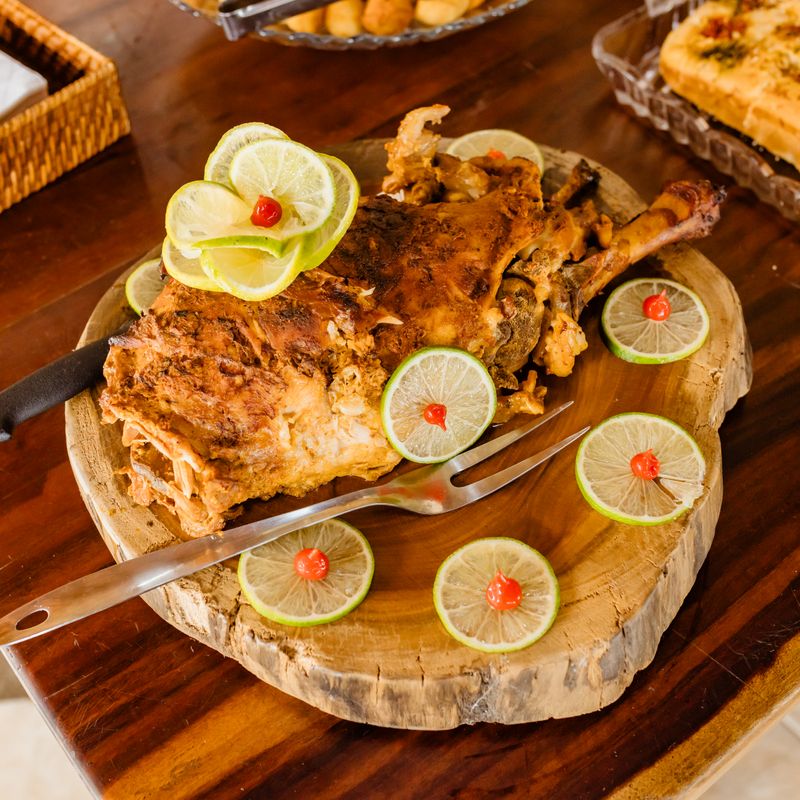
Honduran Sazón Roasted Lamb Shoulder
A slow-roasted lamb shoulder infused with Honduras's signature sazón seasoning—a vibrant blend of cumin, coriander, and achiote—brightened with garlic, lime, and fresh cilantro. The meat roasts low and slow until fork-tender, developing a deeply flavored, mahogany crust while staying juicy inside. Serve with warm tortillas, pickled onions, and rice to soak up the aromatic pan juices.
- Prep
- 20 min
- Cook
- 3 hr
- Wait
- 30 min
- Total
- 3 hr 50 min
- Makes
- 1 lamb shoulder (5–6 lb), serves 6
Steps
Before you start
- Remove lamb from fridge 1 hour before roasting so it reaches closer to room temperature
- Preheat oven to 325°F (163°C) for at least 15 minutes
- Have all spices measured and garlic minced ready before you begin the rub
Make the sazón rub
- In a small bowl, combine ground cumin, ground coriander, achiote powder, minced garlic, lime juice, olive oil, kosher salt, black pepper, and dried oregano.
- Stir with a fork until the mixture forms a thick, spreadable paste.
- The achiote should be fully dissolved into the oil and lime juice, creating a deep brick-red color.
+ Show details− Hide details
Ready when: Mixture is thick, evenly combined, and brick-red in color
Tip: If the paste seems too dry, add another 1 tbsp of lime juice. The sazón rub should coat the meat without running off.
Season the lamb
- Pat the lamb shoulder dry with paper towels.
- Score the fatty skin side in a crosshatch pattern, making shallow cuts ¼ inch deep and 1 inch apart—this helps the rub penetrate and the fat to render.
- Rub the sazón paste all over the lamb, working it into the cuts and under any loose flaps of skin.
- Ensure the entire surface is covered, including the undersides.
+ Show details− Hide details
Ready when: Lamb is evenly coated in a thick rub with no dry spots
Tip: Use all of the rub. Don't be shy—the spices will form a flavorful crust during roasting.
Set up the roasting pan
- Place the sliced onion in the bottom of a large roasting pan (16×12 inches) and add the chicken or lamb broth.
- The onions will create a flavor base and prevent sticking.
- Place the seasoned lamb shoulder, skin-side up, directly on top of the onions.
+ Show details− Hide details
Ready when: Lamb is positioned skin-side up on a bed of onions with broth
Tip: Use a roasting pan that allows at least 2 inches of clearance on all sides—the lamb needs room for air circulation.
Roast uncovered (first 2 hours)Oven 325°F / 165°C
- Place the pan in a preheated 325°F (163°C) oven.
- Roast uncovered for 2 hours, basting the lamb with the pan juices every 30 minutes.
- This initial phase develops a deep, mahogany-colored crust while the inside begins to cook through.
- The pan should be hot enough that you hear a gentle sizzle when the juices hit the meat.
+ Show details− Hide details
Ready when: Skin is deep mahogany brown; pan juices are beginning to caramelize
Tip: Baste every 30 minutes without fail—this keeps the surface moist and browns it evenly.
Cover and continue roasting (remaining time)Oven 325°F / 165°C
- After 2 hours, tent the lamb loosely with aluminum foil to prevent the crust from burning while the meat finishes cooking.
- Continue roasting at 325°F (163°C) for another 90 minutes to 2 hours, basting every 45 minutes.
- The internal temperature should reach 160°F (71°C) for medium doneness (still slightly pink) or 170°F (77°C) for well-done.
- Total roasting time is usually 3 to 3.5 hours, depending on the exact shape and thickness of your shoulder.
+ Show details− Hide details
Ready when: Internal temperature reaches 160–170°F; meat pulls apart easily with a fork
Tip: Use a meat thermometer inserted into the thickest part without touching bone. If the crust is darkening too fast, lower the oven to 300°F (149°C).
Rest the roast
- Remove the lamb from the oven and transfer it to a clean cutting board.
- Loosely tent it with foil and let it rest for 25–30 minutes.
- This allows the juices to redistribute throughout the meat, making it juicier when carved.
- While the lamb rests, strain the pan juices through a fine-mesh sieve into a small saucepan, pressing the softened onions to extract their flavor.
- Discard the solids or reserve them for another use.
+ Show details− Hide details
Ready when: Lamb is warm and juices have pooled around the meat
Tip: Don't skip this step—resting reduces moisture loss when carving and makes the meat more tender.
Warm the pan sauce
- Place the strained pan juices in a small saucepan over medium heat and warm through, about 3–5 minutes.
- Taste and adjust seasoning with a pinch of salt and pepper if needed.
- If the sauce seems thin, you can simmer it for another 2–3 minutes to reduce and concentrate the flavor.
- The sauce should be savory, amber-colored, and enriched with rendered lamb fat.
+ Show details− Hide details
Ready when: Sauce is steaming and has a glossy sheen; flavor is rich and savory
Tip: Don't over-reduce the sauce or it will become too salty. Taste as you go.
Carve and serve
- Carve the lamb shoulder into thick slices, following the natural muscle seams where possible.
- Arrange on a warm serving platter, pour some of the pan sauce over the meat, and garnish generously with fresh cilantro.
- Serve with lime wedges on the side, along with warm tortillas, white rice, and pickled onions if desired.
+ Show details− Hide details
Ready when: Lamb slices cleanly and reveals a warm pink interior (160°F) or fully cooked (170°F)
Tip: If the meat is difficult to carve, your knife may be dull. Use a sharp carving knife or knife steel to sharpen before slicing.
Good to know
Tips
- Achiote (annatto) is essential to authentic Honduran sazón flavor—order it online or find it at a Latin grocery store; it's inexpensive and keeps indefinitely.
- Buy a bone-in shoulder rather than a boneless one; the bone adds deep flavor to the pan sauce and helps the meat cook more evenly.
- Basting every 30 minutes is not optional. It's the key to a mahogany crust and moist interior.
- Serve with warm flour or corn tortillas, white rice, and simple pickled red onions (onions sliced, tossed with lime juice, salt, and a pinch of sugar) for an authentic Honduran meal.
Make ahead
"The lamb can be rubbed with sazón up to 8 hours ahead; wrap tightly and refrigerate. Bring to room temperature 1 hour before roasting. The pan sauce can be made ahead and refrigerated for up to 3 days; gently reheat over low heat."
Storage & reheating
"Refrigerate leftovers in an airtight container for up to 4 days. Reheat gently in a 300°F (149°C) oven, covered with foil, for 15–20 minutes until warm, or slice and warm briefly in a skillet over medium-low heat with a splash of broth. Freeze carved meat with pan sauce in a freezer container for up to 2 months; thaw overnight in the fridge and reheat as above."
Substitutions
- achiote (annatto) powder → ½ tsp smoked paprika plus ½ tsp ground turmeric. This mimics achiote's color and earthy warmth, though the flavor will be slightly less distinctive. Achiote is preferred but harder to find outside Latin markets.
- chicken or lamb broth → Beef broth or additional lamb broth. Beef broth adds deeper richness; use whichever you have on hand.
- fresh cilantro leaves → Fresh parsley or a mix of parsley and mint. Cilantro is traditional, but parsley or mint provide freshness if cilantro is unavailable or you prefer a milder flavor.
- fresh lime juice → Fresh lemon juice or a mix of lime and orange. Lime is brightest, but lemon works well. Orange adds sweetness; use half the amount.
More roasts
See all →
Find more like this
- Meal
- Dinner
- Cuisine
- Tex-Mex
- Main ingredient
- Lamb Shoulder
- Method
- Oven