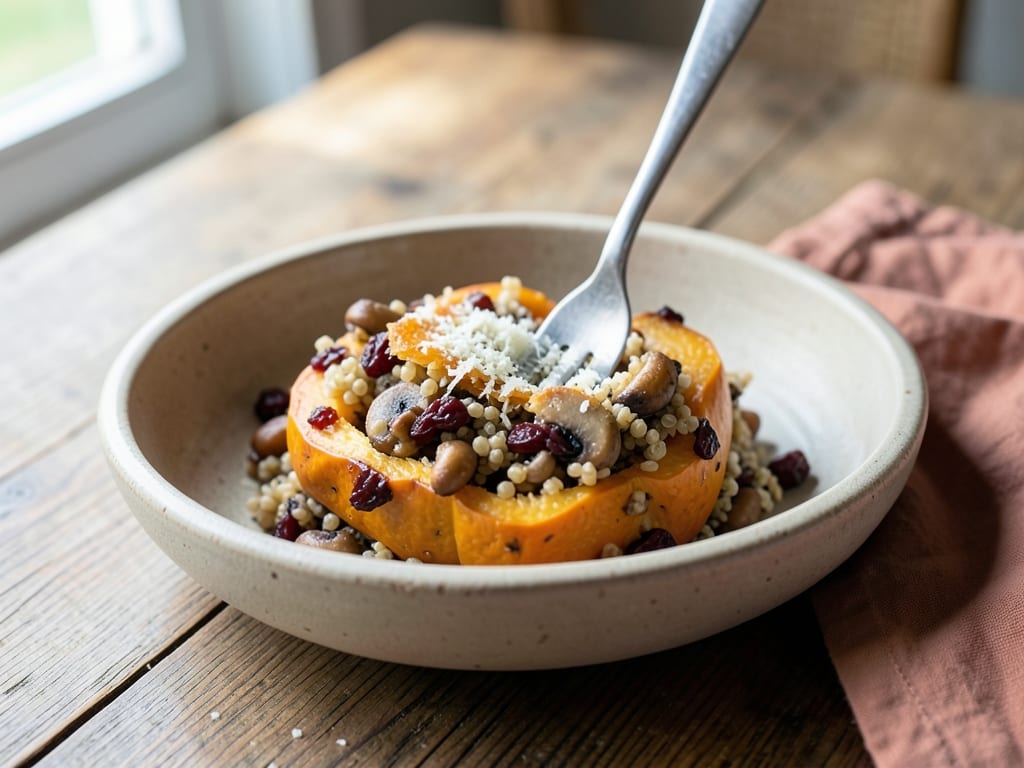
Holiday Wild Rice and Quinoa Stuffed Pumpkin
A festive vegetarian centerpiece featuring a roasted small sugar pumpkin halved and filled with an earthy, nutty stuffing of wild rice, fluffy quinoa, sautéed mushrooms, roasted chestnuts, and tart dried cranberries, finished with fresh sage and thyme. The pumpkin flesh becomes sweet and tender, forming an elegant edible bowl.
- Prep
- 25 min
- Cook
- 1 hr 10 min
- Wait
- 10 min
- Total
- 1 hr 45 min
- Makes
- 1 stuffed pumpkin (2 halves, serves 4 as a main course with extra filling)
Steps
Before you start
- Preheat oven to 400°F (200°C) before beginning
- Choose a sugar pumpkin that sits flat and weighs 3–4 lbs (1.4–1.8 kg)
- Prepare all vegetables (mise en place) before you start cooking
- Have vegetable broth ready and measured out
Preheat and Prepare PumpkinOven 400°F / 205°C
- Preheat the oven to 400°F (200°C).
- Wash the pumpkin thoroughly under cold running water and pat dry with a kitchen towel.
- Using a sharp knife, carefully cut the pumpkin in half lengthwise, cutting through the stem.
- Use a sturdy spoon or pumpkin scoop to scrape out the seeds and stringy fibers from inside each half, creating an even, clean cavity.
- Brush the entire outer surface and the inside of each pumpkin half lightly with olive oil.
- Sprinkle the inside and outside generously with salt and pepper.
- Line a large baking sheet with parchment paper or foil, then place the pumpkin halves cut-side down on the sheet, spacing them a few inches apart.
+ Show details− Hide details
Ready when: Pumpkin halves are brushed, seasoned evenly, and arranged cut-side down on the baking sheet
Tip: Choose a pumpkin with a naturally flat bottom so it sits stably; dry the interior cavities completely with a paper towel to prevent excess moisture during roasting
Roast Pumpkin and Start Wild RiceOven 400°F / 205°C
- Place the pumpkin halves in the preheated 400°F (200°C) oven.
- While the pumpkin roasts, pour 1 cup of the vegetable broth into a medium pot and bring it to a boil over medium-high heat.
- Add the wild rice, stir once, and return to a boil.
- Reduce the heat to medium-low, cover the pot with a lid, and simmer gently for 40 minutes.
- Do not stir the wild rice during cooking; this allows the grains to cook evenly.
+ Show details− Hide details
Ready when: Wild rice grains are tender and fully cooked (taste one to confirm); pumpkin flesh begins to soften when pierced with a fork
Tip: Avoid stirring wild rice while simmering, as this releases excess starch and creates a mushy texture
Prepare and Sauté Vegetables
- While the pumpkin and wild rice cook, dice the yellow onion and celery into small, uniform 1/4-inch pieces.
- Heat 1.5 tablespoons of olive oil in a large skillet over medium heat.
- When the oil shimmers, add the diced onion and celery to the pan and sauté for 5–7 minutes, stirring occasionally, until the onion becomes translucent and the celery softens.
- Add the minced garlic and cook for another minute until fragrant.
+ Show details− Hide details
Ready when: Onion is translucent; celery is tender; garlic is fragrant and light golden
Tip: Chop vegetables into uniform sizes so they cook at the same rate and create an evenly textured filling
Brown Mushrooms
- Chop the mushrooms into bite-sized pieces (about 1/2-inch chunks).
- Add them to the skillet with the softened vegetables and increase the heat to medium-high.
- Cook for 8–10 minutes, stirring occasionally, until the mushrooms release their liquid into the pan, then reabsorb it, creating a lightly browned, slightly caramelized texture.
- The pan should look relatively dry with the mushrooms taking on light golden color.
+ Show details− Hide details
Ready when: Mushrooms are light golden brown; any excess liquid has evaporated; pieces are tender
Tip: Don't crowd the pan or stir constantly; letting mushrooms sit for 1–2 minutes allows them to brown rather than steam
Cook Quinoa
- Rinse the quinoa under cold running water in a fine-mesh strainer, stirring gently with your fingers until the water runs completely clear (this removes saponins, which can taste bitter).
- Pour the remaining 0.5 cups of vegetable broth into a small pot and bring to a boil over medium-high heat.
- Add the rinsed quinoa, stir once, and return to a boil.
- Reduce heat to low, cover with a lid, and simmer for 15 minutes.
- Remove the pot from heat and let stand, covered, for 5 minutes.
- Fluff the quinoa gently with a fork.
+ Show details− Hide details
Ready when: Liquid is fully absorbed; grains are fluffy and translucent with a small spiral visible on each grain; quinoa releases from the bottom of the pot easily
Tip: Rinsing quinoa is essential; even 'pre-rinsed' varieties benefit from a final rinse to remove bitterness
Flip Pumpkin and Continue RoastingOven 400°F / 205°C
- At the 40-minute mark, carefully remove the baking sheet from the oven.
- Using tongs or an oven mitt, gently flip the pumpkin halves so they are now cut-side up.
- The flesh should be partially tender and beginning to soften, but the walls should still hold their shape.
- Return the baking sheet to the oven at 400°F (200°C) and roast for another 10–15 minutes until the pumpkin is soft enough to easily pierce with a fork but still structurally intact.
+ Show details− Hide details
Ready when: Pumpkin flesh yields easily to a fork; edges are beginning to curl inward; flesh is soft but not collapsing
Tip: If the pumpkin is browning too quickly on the outside, loosely cover it with aluminum foil for the remaining roasting time
Combine Grains and Vegetables
- Once the wild rice is fully cooked and the quinoa has been fluffed, transfer both to a large mixing bowl.
- Pour the sautéed mushroom and vegetable mixture from the skillet into the bowl with the grains.
- Add the roasted chestnuts, dried cranberries, chopped fresh sage, and thyme leaves.
- Using a large spoon or spatula, gently fold all the components together, being careful not to break up the cooked grains.
- Season the mixture with salt and pepper to taste, starting conservatively and adjusting as needed.
- If the mixture seems a bit dry, add 1–2 tablespoons of extra vegetable broth or water to help bind it.
+ Show details− Hide details
Ready when: All ingredients are evenly combined; no streaks of unmixed grain or vegetables visible; mixture is moist but not wet or clumpy
Tip: Fold gently to avoid breaking the wild rice grains and quinoa, which will turn to mush if overworked; the texture should be distinct, not uniform paste
Stuff and Bake PumpkinOven 375°F / 190°C
- Remove the pumpkin from the oven and reduce the oven temperature to 375°F (190°C).
- Divide the grain and vegetable filling evenly between the two pumpkin halves, spooning it into the cavity and mounding it gently.
- It's okay if some filling overflows slightly onto the baking sheet and piles up above the rim.
- Return the stuffed pumpkin halves to the oven and bake at 375°F (190°C) for 15–20 minutes until the filling is heated through and the top is lightly golden.
+ Show details− Hide details
Ready when: Filling is heated through (a fork inserted into the center comes out warm); top of filling is lightly golden; pumpkin flesh is very soft but not collapsing
Tip: If you prefer a crisper, more caramelized top on the filling, increase the oven temperature to 400°F for the last 3–5 minutes, or place under the broiler for 1–2 minutes, watching closely to prevent burning
Cool, Garnish, and Serve
- Remove the baking sheet from the oven and let the stuffed pumpkin rest at room temperature for 5–10 minutes.
- This allows the filling to set slightly and makes the pumpkin easier to handle and serve.
- Carefully transfer each pumpkin half to a serving plate or shallow bowl.
- If desired, garnish each half with a sprinkle of grated parmesan cheese.
- Serve warm, with extra filling spooned on the side for each guest.
+ Show details− Hide details
Ready when: Pumpkin halves are still warm but stable; filling has set enough to hold its shape
Tip: A pumpkin half can be delicate once fully cooked, so use two utensils (a sturdy spoon and fork) when eating to avoid breaking through the sides
Good to know
Tips
- Cutting a pumpkin can be challenging; if the skin is very hard, microwave the whole pumpkin for 2–3 minutes to soften it slightly, which makes slicing easier and safer.
- The pumpkin half becomes the serving vessel, so choose one that looks attractive when carved. You can save extra seeds for roasting as a snack.
- For a vegan version, omit the parmesan cheese or use a plant-based alternative; the filling is naturally vegan without it.
- This dish pairs beautifully with a crisp white wine (such as Sauvignon Blanc) or a light red (Pinot Noir), and a simple green salad balances the richness of the grains and chestnuts.
Make ahead
Prepare the filling completely through step 7 up to 2 days ahead; store in an airtight container in the refrigerator. Roast the pumpkin just before serving, then stuff and bake. Alternatively, prepare everything 4–6 hours ahead and reheat the stuffed pumpkin, covered with foil, at 350°F (175°C) for 15 minutes until warmed through.
Storage & reheating
Refrigerate leftovers in an airtight container for up to 3 days. The pumpkin flesh softens further as it cools; reheat gently in a 350°F (175°C) oven for 10–15 minutes, covered with foil, until warmed through. To freeze, store the cooked filling separately (without the pumpkin) for up to 2 months; thaw in the refrigerator overnight and reheat on the stovetop with a splash of broth until warm.
Substitutions
- roasted chestnuts → toasted walnuts or pecans. Use the same amount; chestnuts are prized for their sweetness and tender texture, but nuts offer a similar richness and add crunch. Toast raw nuts in a 350°F (175°C) oven for 8–10 minutes for best flavor.
- dried cranberries → dried cherries, currants, or dried apricots (diced). These dried fruits provide tartness and color. If using apricots, reduce the amount to 1/4 cup as they are sweeter and more robust in flavor.
- wild rice → farro, spelt berries, or a mix of wild rice and brown rice (1/4 cup each). Wild rice is prized for its nutty flavor and firm texture; substitutes offer similar earthiness and chew. Adjust cooking time to match the grain used (farro: 30 min; spelt: 45 min).
- fresh sage leaves → dried sage (2/3 teaspoon) or fresh marjoram. Sage's warm, slightly peppery flavor is classic for fall dishes. Dried sage is concentrated; use one-third the amount of fresh. Marjoram offers a gentler herbal note.
More roasts
See all →
Find more like this
- Meal
- Dinner
- Cuisine
- American
- Occasion
- Thanksgiving
- Season
- Fall