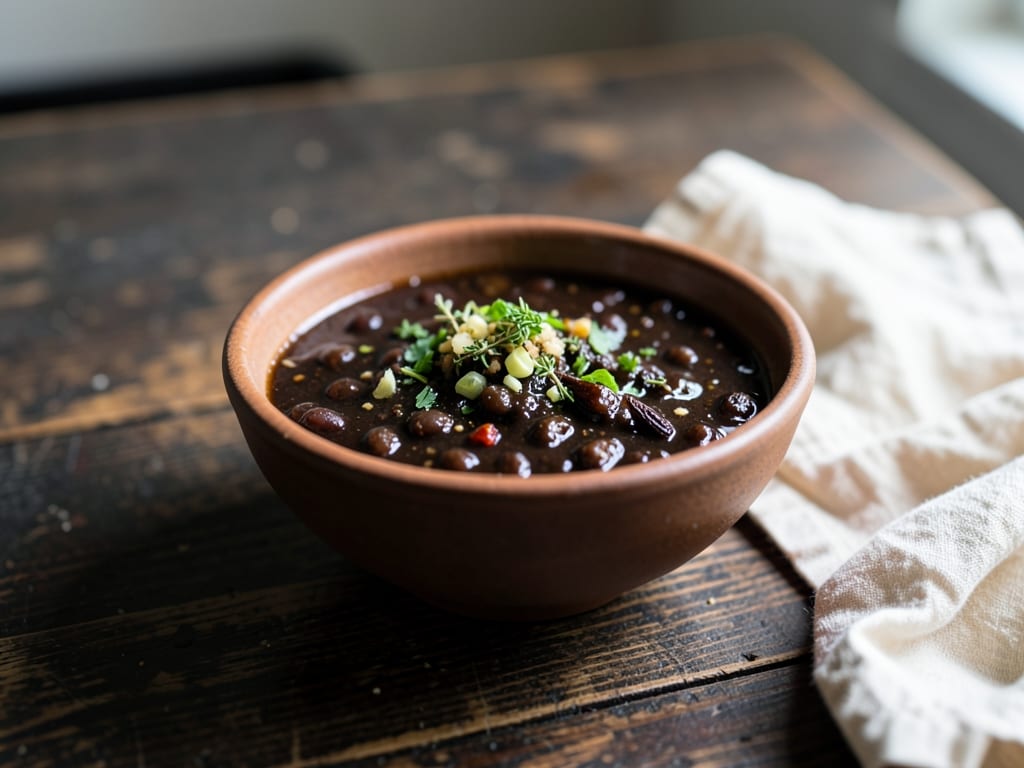
Haitian Sos Pwa Black Bean Sauce
A thick, savory Haitian black bean sauce infused with epis—a vibrant aromatic paste of scallions, garlic, cilantro, and fresh thyme—rounded out with smoky whole cloves and the gentle heat of a scotch bonnet pepper. Simmered until rich and deeply flavored, then blended to your preferred consistency. This versatile sauce is traditionally served over white rice, djondjon, boiled plantains, or cornmeal, and works beautifully as a vegan main or side dish.
- Prep
- 15 min
- Cook
- 20 min
- Wait
- 18 min
- Total
- 53 min
- Makes
- About 4 cups (960 ml), serves 6 as a side
Steps
Before you start
- Have all aromatics roughly chopped and measured before you start cooking, so you can work efficiently when the pot is on heat.
- If using dried black beans rather than canned, cook and drain them ahead of time.
- Prepare your blender or immersion blender so it's ready for the final step.
Prepare the epis
- In a food processor, combine the scallions, garlic, cilantro, parsley, fresh thyme, and whole scotch bonnet pepper.
- Pulse for 30 seconds to 1 minute until the mixture is finely chopped and paste-like, scraping down the sides as needed with a rubber spatula.
- The epis should look like a coarse, thick paste with no large chunks of any single ingredient.
- This aromatic base is the soul of your sos pwa.
+ Show details− Hide details
Ready when: The mixture is uniform, finely chopped, and paste-like with no large vegetable chunks visible.
Tip: Avoid over-processing, or the epis will become watery and the fresh herbs will lose their bright flavor. Stop as soon as you reach a thick paste.
Sauté the onion
- Heat the olive oil in a large pot (5-quart or larger) over medium heat for about 1 minute until it shimmers.
- Add the diced yellow onion and stir occasionally.
- Cook for 4–5 minutes until the onion is soft and translucent with light golden color at the edges.
- The onion should yield easily when pierced with a spoon.
+ Show details− Hide details
Ready when: The onion is soft, translucent, and beginning to turn golden at the edges.
Tip: Keep the heat at medium and stir occasionally to avoid browning, which would create a bitter note. You want a gentle, savory base, not caramelized onion.
Bloom the epis
- Add the prepared epis paste to the pot with the onion.
- Stir constantly with a wooden spoon for 2–3 minutes.
- The mixture will darken slightly and release a complex, fragrant aroma as the raw vegetable taste cooks out.
- You'll notice the pot smells rich and herbaceous—this indicates the epis is blooming and developing its full flavor profile.
+ Show details− Hide details
Ready when: The epis darkens to a deeper shade and releases a rich, fragrant, complex aroma; nothing sticks to the pot.
Tip: Stir constantly throughout this step to prevent the delicate herbs and garlic from catching and burning on the pot bottom.
Deepen with tomato paste
- Add the tomato paste to the pot.
- Stir continuously for 1–2 minutes, allowing it to cook into the mixture and darken slightly in color.
- This brief cooking step—called blooming—removes any raw, tinny taste and concentrates the tomato's natural sweetness and depth.
- The entire mixture should look richer and more complex.
+ Show details− Hide details
Ready when: The tomato paste has darkened and is fully incorporated into the aromatic base; the mixture smells savory and slightly sweet.
Tip: Blooming the tomato paste is a crucial flavor-building technique—don't skip this step or your sauce will taste thin and acidic.
Build the sauce
- Pour the drained and rinsed black beans into the pot, followed by the vegetable stock.
- Add the whole cloves and dried thyme.
- Stir well to combine everything.
- Increase the heat to medium-high and bring the mixture to a gentle simmer, about 2–3 minutes.
- Once small bubbles begin to break the surface regularly, reduce the heat to medium-low for the long simmer.
+ Show details− Hide details
Ready when: The liquid is at a gentle simmer with small bubbles breaking the surface regularly, not a rolling boil.
Tip: Keep the scotch bonnet whole at this stage so it infuses the sauce gently without falling apart or overpowering it with too much capsaicin.
Simmer until thick
- Reduce heat to medium-low and maintain a gentle simmer for 15–20 minutes, stirring occasionally (every 3–4 minutes) to prevent sticking on the bottom.
- The sauce will gradually reduce as excess liquid evaporates, and it will thicken visibly.
- You'll notice the beans beginning to soften and break down slightly, and the liquid will take on a darker, richer color.
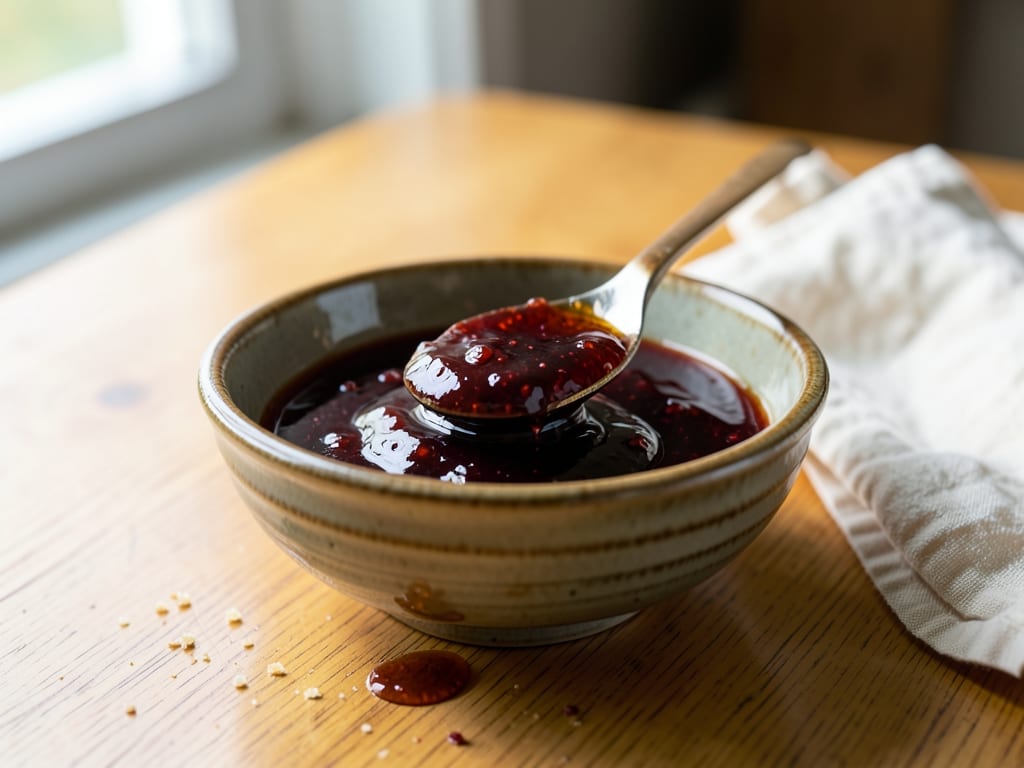
- By the end, the sauce should coat the back of a spoon without immediately running off—thick enough to mound slightly when spooned but still pourable.
+ Show details− Hide details
Ready when: The sauce coats the back of a spoon and doesn't immediately run off; it's thick but pourable, and tastes rich and deeply flavored.
Tip: If the sauce reduces too quickly or begins to stick badly, lower the heat to low. A thicker, more paste-like consistency is traditional, but you can stop at any point that suits your preference.
Blend and season
- Remove the pot from heat.
- Using a slotted spoon, carefully remove and discard the whole cloves and the scotch bonnet pepper.
- Taste the sauce and season generously with salt and freshly ground black pepper to your liking.
- The sauce should taste savory, rich, and complex with a subtle background heat and brightness from the fresh herbs.
- For a smooth sauce, use an immersion blender submerged in the pot and blend for 2–3 minutes until completely smooth.
- For a chunky or partially chunky sauce (more traditional), pulse the immersion blender just a few times to break up only some of the beans, leaving visible whole beans for a creamy texture with body.
- If using a regular blender, carefully transfer the sauce in batches to the blender, blend to your desired consistency, and pour back into the pot.
- Be cautious with hot liquid—hold the lid loosely or cover with a kitchen towel.
+ Show details− Hide details
Ready when: The sauce is blended to your preferred consistency (smooth, partially chunky, or chunky); it's well-seasoned and tastes balanced, savory, and deeply flavored.
Tip: If blending hot liquid in a regular blender, never seal the lid completely, as pressure and steam will build. Use a towel or hold the lid loosely. Never fill the blender more than halfway. Work in batches if necessary to avoid splashing hot sauce.
Good to know
Tips
- Keep the whole scotch bonnet pepper intact while simmering to infuse gentle heat without breaking apart or overwhelming the sauce. If you want more heat infusion, carefully split the pepper lengthwise with a knife to expose the seeds, then remove it before serving. Add a pinch of cayenne pepper at the very end if you want more bite.
- The sauce's final thickness depends on how long you simmer it and how much you blend it. For a thinner, pourable sauce, simmer for 15 minutes and blend it smooth. For a thick paste, go up to 20 minutes and leave it chunky. All versions are authentic—adjust to suit your preference.
- Sos Pwa is traditionally served over white rice, djondjon rice (rice cooked with Haitian black mushroom, if you can find it), polenta, cornmeal, or with boiled plantains and fried plantains. A squeeze of fresh lime juice (or bitter orange, naranja agria, if you can find it) stirred in just before serving brightens the flavors and is very traditional. It's hearty enough to serve as a vegan main dish and pairs beautifully with fresh avocado, a crisp salad, or pickled vegetables.
- For a more 'wet' sauce with more gravy, use 2½ cups stock instead of 2 cups, or simmer for just 10 minutes. For a drier, thicker sauce, simmer longer or reduce the liquid.
Make ahead
The epis can be prepared 1–2 days ahead and refrigerated in an airtight container. The finished sauce keeps up to 4 days refrigerated or up to 3 months frozen. Thaw frozen sauce overnight in the refrigerator before reheating.
Storage & reheating
Room temperature: up to 2 hours. Refrigerator: up to 4 days in an airtight container. Freezer: up to 3 months in an airtight, freezer-safe container. Reheat gently on the stovetop over medium-low heat, stirring occasionally, for 5–8 minutes until warmed through. If the sauce has thickened significantly during chilling, thin it with a splash of vegetable stock or water when reheating. Alternatively, reheat in the microwave in a microwave-safe bowl, stirring every 30 seconds, for 2–3 minutes.
Substitutions
- Fresh scotch bonnet pepper (or habanero) → Habanero pepper, jalapeño, or dried red chiles (such as piment d'Espelette or ancho). Habaneros are similar in heat and flavor profile. Jalapeños are milder and less fruity. Dried chiles add deeper, smokier notes but less bright heat. Adjust the quantity to match your preferred heat level.
- Fresh cilantro leaves and tender stems → Additional fresh parsley (double the amount) and a tablespoon of fresh culantro if available, or increase thyme. Cilantro is essential to authentic epis, but if you strongly dislike it, the sauce can still be excellent with extra parsley, culantro, and thyme.
- Canned black beans → Cooked dried black beans (equivalent amount), kidney beans, pinto beans, or chickpeas. Canned beans are convenient. Fresh-cooked dried beans have a richer, fuller flavor if you have time. Different beans will change the sauce's character slightly.
- Tomato paste → Tomato sauce (¼ cup / 60 ml), canned crushed tomatoes (½ cup / 120 ml), or no tomato at all. If using tomato sauce, reduce the vegetable stock to 1¾ cups (420 ml). If using crushed tomatoes, reduce the stock to 1½ cups (360 ml). Without tomato, the sauce will be less rich but still delicious.
More sauces
See all →
Find more like this
- Meal
- Dinner
- Cuisine
- Caribbean
- Main ingredient
- Black Beans
- Method
- Stovetop
- Quick & Easy
- Easy