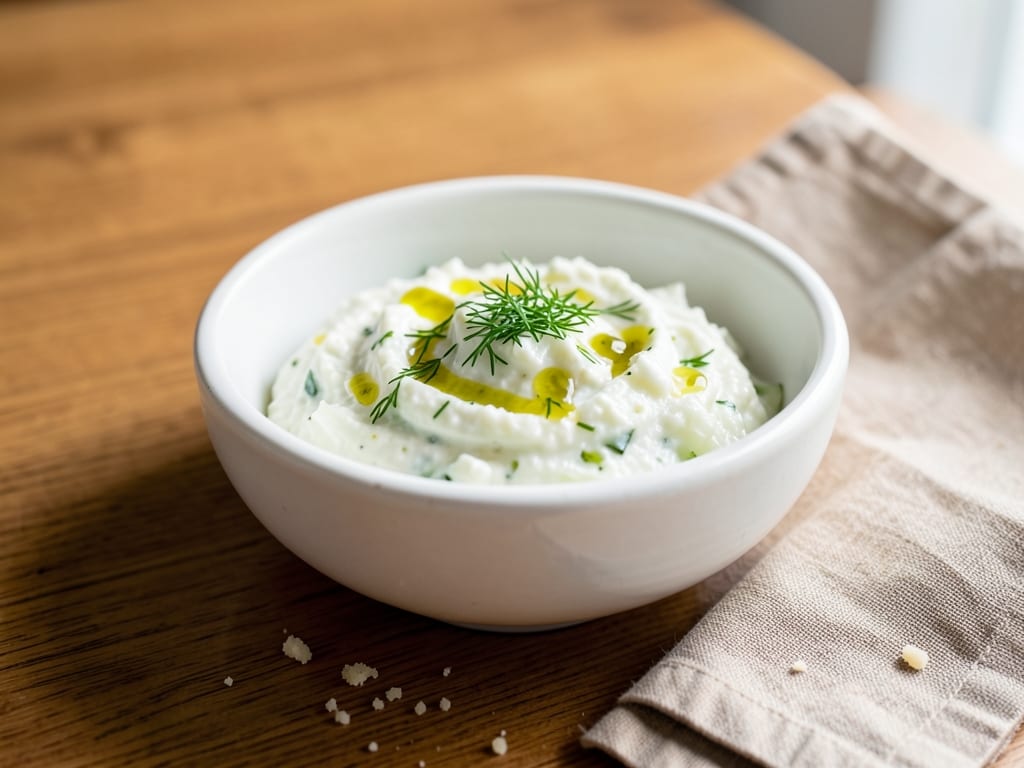
Classic Greek Avgolemono Sauce
A silky, bright egg-lemon sauce made by whisking lemon juice into eggs and tempering them with hot chicken stock. A little cornstarch keeps it smooth and stable, so it drapes beautifully over dolmades, poached chicken, fish, or steamed vegetables.
- Prep
- 13 min
- Cook
- 11 min
- Wait
- 2 min
- Total
- 26 min
- Makes
- About 2 cups (480 ml) sauce, enough for 6 servings
Steps
Before you start
- Take the eggs out of the fridge 30 minutes ahead so they come to room temperature. Cold eggs are more likely to curdle.
- Use unsalted or low-sodium stock. Regular stock can make the finished sauce too salty once it is seasoned.
- Have everything measured and within reach before you start. The tempering step needs both hands and your full attention.
- Squeeze the lemons yourself. Bottled juice tastes flat and sharp in this sauce.
Zest and juice lemons
- Finely grate the zest from the lemons first, if using, then halve and squeeze them.
- Strain out the seeds and measure ⅓ cup (80 ml) juice.
- Set the juice and zest aside.
- Crack the 3 room-temperature eggs into a large heatproof bowl.
+ Show details− Hide details
Ready when: You have ⅓ cup (80 ml) of seed-free juice measured.
Tip: Zest before juicing. Zesting a squeezed lemon half is awkward.
Make cornstarch slurry
- In a small bowl, stir the cornstarch into ¼ cup (60 ml) of cold chicken stock with a fork until no lumps remain.
+ Show details− Hide details
Ready when: The mixture looks smooth and milky with no dry clumps at the bottom.
Tip: Cornstarch settles quickly, so re-stir it right before you add it.
Heat the stock
- Pour 1¾ cups (420 ml) chicken stock into the saucepan.
- Set over medium heat and bring to a gentle simmer, about 5 minutes.
+ Show details− Hide details
Ready when: Small bubbles break steadily around the edge of the pan and steam rises.
Thicken the stock
- Re-stir the slurry, then pour it into the simmering stock while whisking.
- Keep whisking and cook for 1 to 2 minutes at a gentle simmer, then remove the pan from the heat.
+ Show details− Hide details
Ready when: The stock turns slightly glossy and lightly coats the back of a spoon, like thin cream.
Tip: Cooking the cornstarch for a full minute removes any starchy taste.
Cool the stock briefly
- Let the thickened stock stand off the heat for 2 minutes so it is hot but no longer bubbling.
- Keep the whisk nearby.
+ Show details− Hide details
Ready when: The surface is still and steaming, with no bubbles.
Tip: Skipping this rest is the most common reason the eggs scramble when tempered.
Whisk eggs and lemon
- Whisk the eggs vigorously for about 1 minute until pale yellow and frothy.
- In a thin stream, whisk in the lemon juice and zest, if using, until fully blended.
+ Show details− Hide details
Ready when: The mixture is pale, frothy and uniform, with no visible streaks of egg white.
Tip: Set the bowl on a damp kitchen towel so it doesn't slide while you whisk.
Temper the eggs
- Whisking the egg mixture constantly, add the hot stock ¼ cup (60 ml) at a time, pouring in a slow trickle.
- Repeat with 4 ladlefuls, then slowly whisk in the remaining stock from the pan.
+ Show details− Hide details
Ready when: The mixture is warm, smooth and pale gold, with no cooked egg bits.
Tip: If you see any flecks of cooked egg, stop pouring and whisk hard. You can strain them out later.
Gently cook the sauceOven 160°F / 70°C
- Pour the mixture back into the saucepan.
- Cook over low heat, stirring constantly with a spatula and scraping the bottom and corners, for 3 to 4 minutes.
- Never let it boil.
- Remove from the heat as soon as it reaches 160°F (71°C).
+ Show details− Hide details
Ready when: The sauce reaches 160°F (71°C) and coats the back of a spoon so a finger swipe leaves a clean line.
Tip: Boiling after the eggs are added can make the sauce curdle. If it starts to look grainy, pull it off the heat and whisk hard.
Season and finish
- Off the heat, whisk in the butter, if using, the salt and white pepper.
- Taste and add more salt if needed.
- For the smoothest texture, pour through a fine-mesh strainer.
- Stir in the dill, if using, and serve warm.
+ Show details− Hide details
Ready when: The sauce is glossy, pourable, tangy and well seasoned.
Tip: Add salt gradually. The flavor sharpens as the sauce sits.
Good to know
Tips
- Temper slowly. Adding the hot stock in a thin trickle while whisking is the single most important step for a smooth sauce.
- Keep the final cooking heat low. The sauce is done at 160°F (71°C), well below a simmer.
- For a looser sauce, whisk in 1 to 2 tablespoons more warm stock. For a thicker one, cook 1 minute longer at 160°F (71°C), but do not boil.
- Strain the finished sauce if you want a very silky texture. This also removes any stray bits of cooked egg.
Make ahead
"Make the sauce up to 1 day ahead and cool it quickly, then refrigerate in a covered container with plastic wrap pressed on the surface. Reheat gently as described under storage."
Storage & reheating
Serve right away for the best texture. Room temperature: no more than 2 hours. Refrigerator: up to 2 days in an airtight container. Freezer: not recommended, because the sauce separates when thawed. To reheat, warm in a saucepan over low heat, stirring constantly, until just steaming (about 130°F / 55°C). Do not let it boil.
Substitutions
- low-sodium chicken stock → Vegetable stock. Gives a vegetarian sauce with a slightly sweeter, lighter flavor. Use a low-sodium stock.
- cornstarch → Arrowroot powder (same amount). Gives a glossier finish. Do not overcook it, as it can turn slimy.
- unsalted butter → Extra-virgin olive oil (1 tbsp / 15 ml). Gives a more traditional Greek flavor and keeps the sauce dairy-free.
- fresh dill → Fresh flat-leaf parsley. Gives a milder herb flavor if you don't like dill.