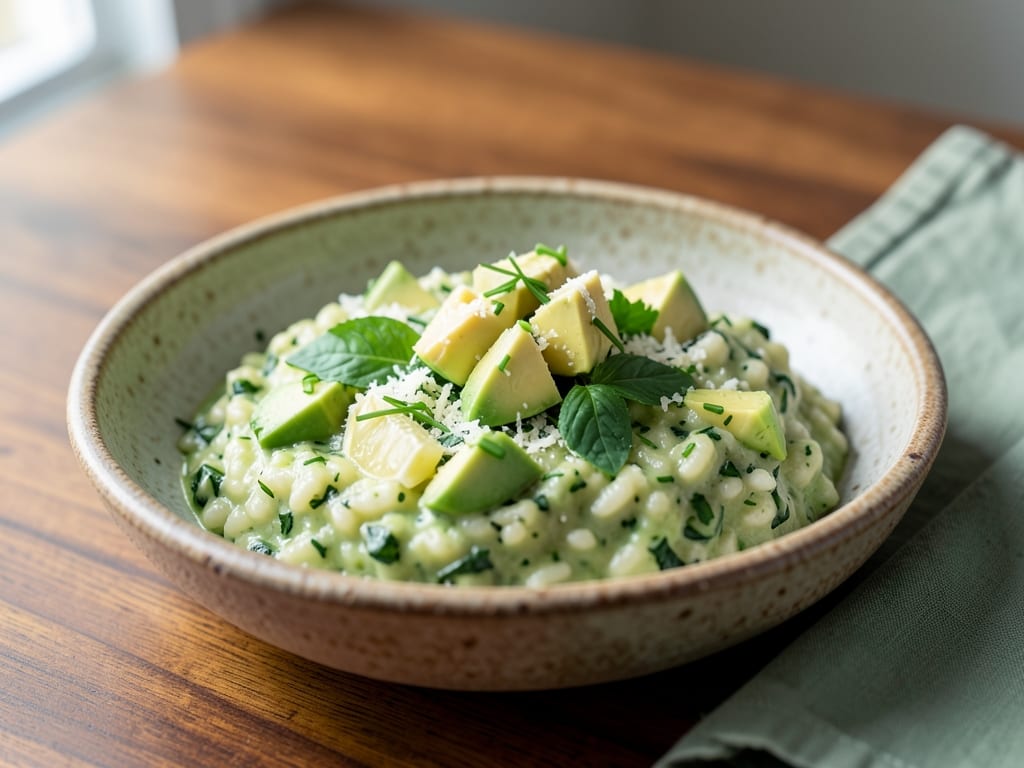
Green Goddess Risotto with Herbs and Avocado
Creamy arborio risotto finished with a vivid blend of parsley, basil, chives, spinach and avocado, then brightened with lemon and topped with diced avocado. The herbs go in off the heat so the color stays bright green.
- Prep
- 20 min
- Cook
- 35 min
- Wait
- 2 min
- Total
- 57 min
- Makes
- 4 generous main-course servings (about 1⅓ cups / 300 g each)
Steps
Before you start
- Risotto needs near-constant stirring for the last 20 minutes, so have every ingredient chopped, measured and within reach before you turn on the heat.
- Use a ripe avocado that yields slightly to gentle pressure. Cut the topping avocado just before serving so it does not brown.
- Use low-sodium broth, since the broth reduces and the Parmesan adds salt. Taste before adding any extra salt at the end.
- Use a block of Parmesan and grate it finely yourself. Pre-grated cheese melts less smoothly. Check that the Parmesan is made with vegetarian rennet if you need strictly vegetarian.
Heat the broth
- Pour the vegetable broth into a medium saucepan and set it over medium heat.
- Bring it to a bare simmer, then reduce the heat to low so it stays steadily hot (small bubbles at the edges, not boiling hard).
- Keep it on the back burner with a ladle nearby.
+ Show details− Hide details
Ready when: Small bubbles break around the edges of the pan and steam rises.
Tip: Hot broth keeps the rice cooking at a steady pace. Cold broth stalls the cooking and makes the rice gummy.
Blend the green puree
- While the broth heats, combine the parsley, basil, chives, spinach, avocado flesh, 3 tablespoons olive oil, lemon juice, lemon zest and ¼ cup (60 ml) of the hot broth in a blender.
- Blend on high for 30 to 45 seconds, scraping down the sides once, until completely smooth.
- Season with a pinch of salt and a few grinds of pepper.
- Set aside at room temperature.
+ Show details− Hide details
Ready when: The puree is silky, thick like a loose pesto, with no visible flecks of leaf.
Tip: Do not add the puree to the pan while it is on the heat. Prolonged heat turns the herbs a dull olive color.
Soften the onion
- Set a wide, heavy 4-quart (3.8 L) saucepan over medium heat.
- Add 2 tablespoons olive oil and 1 tablespoon butter.
- When the butter foams, add the diced onion and ½ teaspoon salt.
- Cook, stirring often, for 5 to 6 minutes.
- Add the garlic and cook 30 seconds more.
+ Show details− Hide details
Ready when: The onion is soft and translucent with no browning, and the garlic smells fragrant.
Tip: If the onion starts to brown, lower the heat. Browned onion would muddy the fresh green flavor.
Toast the rice
- Add the arborio rice to the pan.
- Stir constantly for 2 minutes so every grain is coated in fat and lightly toasted.
+ Show details− Hide details
Ready when: The edges of the grains turn translucent while the centers stay white and opaque, and the rice smells slightly nutty.
Add the wine
- Pour in the white wine.
- Stir steadily until the wine has been absorbed and the pan looks almost dry when you drag the spoon across the bottom, about 2 minutes.
+ Show details− Hide details
Ready when: The sharp wine smell has cooked off and the spoon leaves a clear trail on the bottom of the pan.
Add broth gradually
- Reduce the heat to medium-low.
- Add about ¾ cup (180 ml) hot broth, enough to just cover the rice.
- Stir frequently, and when the pan is almost dry again, add another ladleful.
- Repeat, keeping the risotto at a gentle bubble, for 18 to 20 minutes.
- Stir every 20 to 30 seconds, scraping the corners.
- You will use nearly all of the broth.
+ Show details− Hide details
Ready when: The mixture looks creamy and loose, and a spoon dragged through leaves a trail that slowly closes.
Tip: If the rice is bubbling violently or sticking, lower the heat. If it barely bubbles, raise it slightly.
Taste for doneness
- After 18 minutes of broth additions, taste a few grains.
- The rice should be tender on the outside with a slight firmness in the center (al dente).
- If it is still chalky, add another ½ cup (120 ml) broth and cook 2 to 3 minutes more.
- When done, the risotto should be loose and flowing, as it will thicken as it rests.
- Turn off the heat.
+ Show details− Hide details
Ready when: The grains are tender with a tiny bite at the center, and the risotto slowly spreads when you tilt the pan.
Tip: If you run out of broth, use hot water instead.
Stir in the finishing touches
- With the pan off the heat, add the cold butter cubes and Parmesan and stir vigorously for 1 minute until melted and creamy.
- Scrape in the green puree and fold until evenly green.
- Taste and add salt, pepper or an extra squeeze of lemon if needed.
- If too thick, loosen with a splash of hot broth.
+ Show details− Hide details
Ready when: The risotto is glossy, uniformly bright green and flows like thick porridge.
Tip: Adding the cold butter and cheese off the heat makes the sauce creamy rather than greasy.
Rest briefly
- Cover the pan and let the risotto rest for 2 minutes so the rice relaxes and the texture settles.
+ Show details− Hide details
Ready when: The risotto is slightly thicker but still loose enough to slump on a plate.
Top and serve
- Cut the second avocado into ½-inch (1 cm) cubes.
- Spoon the risotto into 4 warm shallow bowls.
- Top with the diced avocado, sliced chives, extra Parmesan, a few grinds of pepper and pepitas if using.
- Serve immediately.
+ Show details− Hide details
Tip: Risotto firms up quickly as it cools, so serve right away in warmed bowls.
Good to know
Tips
- Use arborio, carnaroli or vialone nano rice. Long-grain rice will not release enough starch to make a creamy sauce.
- Keep stirring and keep the broth additions small. The friction of stirring rubs starch off the rice and creates the creamy texture without cream.
- Aim for a risotto that is slightly looser than you want on the plate; it thickens within a minute or two.
- Dice the topping avocado at the last minute and toss with a squeeze of lemon if you need to hold it for a few minutes.
Make ahead
The green puree (without the avocado, which browns) can be blended up to 1 day ahead and refrigerated in a covered jar with plastic wrap pressed on the surface; blend in the avocado flesh just before using. Risotto itself is best made and served fresh.
Storage & reheating
Room temperature: no more than 2 hours. Fridge: cool quickly and store in an airtight container for up to 2 days (the color will darken slightly). Freezer: not recommended because the avocado and rice texture degrade. Reheat in a skillet over low heat with a splash of broth or water, stirring until creamy and hot, about 4 minutes. Add fresh diced avocado after reheating.
Substitutions
- dry white wine, such as sauvignon blanc → Additional vegetable broth plus 1 tablespoon white wine vinegar or lemon juice. Use ½ cup (120 ml) broth and add the acid at the same time to replace the wine's brightness.
- Parmesan cheese → Pecorino Romano or a vegan hard cheese. Pecorino is saltier, so reduce the added salt. Use nutritional yeast (3 tbsp) and olive oil in place of butter for a dairy-free version.
- fresh basil leaves → Fresh tarragon (½ cup) or additional parsley. Tarragon gives a more classic green goddess flavor but is stronger, so use less.
- unsalted butter → Extra-virgin olive oil. Use 2 tablespoons (30 ml) for a dairy-free finish; the risotto will be slightly less rich.
More risotto
See all →
Find more like this
- Meal
- Dinner
- Cuisine
- Mediterranean
- Method
- Stovetop