
Greek Phyllo Triangles with Walnut Honey and Mastic
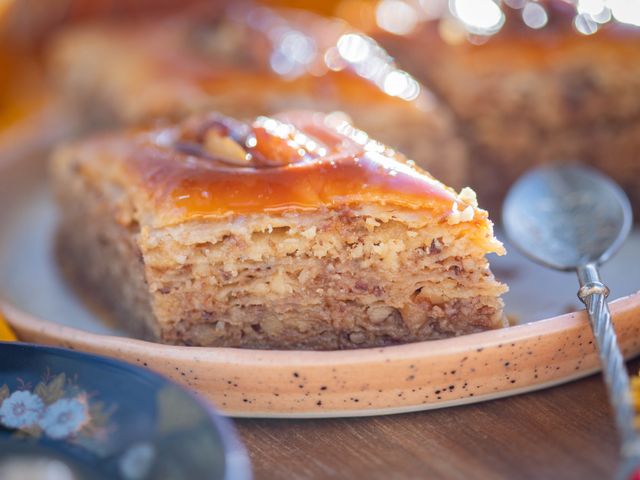
Crispy, buttery phyllo pastry folded into triangles and filled with a fragrant mixture of toasted walnuts, honey, and mastic—a pine-scented gum resin that brings authentic Greek flavor. These pastries are baked until golden and brushed with more honey and a sprinkle of cinnamon for a simple, elegant finish. Perfect for serving with Greek coffee or as a light dessert.
- Prep
- 25 min
- Cook
- 22 min
- Wait
- 5 min
- Total
- 52 min
- Makes
- 12 phyllo triangles
Steps
Before you start
- Remove phyllo dough from the freezer 30 minutes before baking and let it thaw at room temperature, still in its package
- Preheat your oven to 350°F (175°C)
- Have a damp kitchen towel ready to cover the phyllo sheets as you work to prevent them from drying out
- Crush mastic gum crystals by placing them in a mortar with 1 teaspoon of sugar and grinding until fine, or pulse in a spice grinder
Toast and chop walnuts
- Place the 1½ cups (180 g) of walnut halves and pieces in a large dry skillet over medium heat.
- Toast for 3–4 minutes, stirring frequently, until fragrant and lightly darkened.
- Do not let them burn.
- Transfer to a cutting board and chop into pieces roughly the size of lentils—small enough to hold filling together but with some texture.
- Set aside to cool for 2 minutes.
+ Show details− Hide details
Ready when: Walnuts are fragrant and 1–2 shades darker, and they smell toasted
Tip: Don't skip toasting—raw walnuts taste dull in this delicate pastry. Watch closely to avoid bitterness.
Mix walnut-honey filling
- In a shallow bowl, combine the toasted chopped walnuts, ⅓ cup (110 g) honey, ½ teaspoon (1 g) crushed mastic gum, and ¼ teaspoon (0.5 g) ground cinnamon.
- Stir gently until the filling is evenly combined and feels slightly tacky.
- The mastic should be fully dissolved or distributed so there are no grainy pieces.
- Let the mixture rest for 1 minute.
+ Show details− Hide details
Ready when: Filling is uniform in color, evenly moistened, and fragrant with mastic
Tip: Mastic gum may look grainy at first; stir thoroughly. A very fine powder integrates better than larger crystals.
Prepare the workspaceOven 350°F / 175°C
- Line a large baking sheet with parchment paper.
- Set your bowl of melted ¼ cup (115 g) butter and pastry brush within arm's reach.
- Lay one sheet of phyllo dough on a clean, flat work surface, with the long edge (18 inches / 46 cm) closest to you.
- Cover the remaining phyllo sheets with a damp kitchen towel to keep them from drying out as you work.
- Preheat the oven to 350°F (175°C) if not already done.
+ Show details− Hide details
Tip: Phyllo dries out within seconds if left uncovered. The damp towel is essential—wring it out so it's moist but not dripping.
Fold first phyllo strip
- Take the first phyllo sheet and fold it lengthwise in half, bringing the far long edge toward you.
- Gently press the fold to seal it lightly.
- Using your pastry brush, brush the top surface very lightly with melted butter—just enough to coat, not soak.
- You should use about ½ teaspoon per sheet.
+ Show details− Hide details
Ready when: Phyllo folded evenly and brushed with a thin, even layer of butter
Tip: Use a light hand with butter; too much makes phyllo soggy rather than crispy. A pastry brush lets you control the amount.
Place and fold filling
- Place about 2 tablespoons (30 g) of walnut-honey filling near the bottom left corner of the buttered phyllo strip, about 1 inch (2.5 cm) from the edges.
- Fold the phyllo over the filling at a 45° angle to form a triangle, then fold the point back up along the edge.
- Continue folding along the entire length of the strip, rotating the triangle at each fold, like folding a flag.
- The final triangle should be neat, compact, and fully enclosed.
- Brush the outside lightly with butter.
+ Show details− Hide details
Ready when: Triangle is compact, fully sealed, and all corners are tucked in
Tip: Folding evenly ensures the phyllo crisps uniformly. Keep folds tight so the filling doesn't escape during baking.
Place on baking sheet
- Transfer the completed phyllo triangle to the prepared baking sheet, seam-side down.
- Repeat the folding process with the remaining 11 phyllo sheets and filling, arranging the triangles on the baking sheet in a single layer with about ½ inch (1 cm) of space between each one.
- The baking sheet should fit all 12 triangles comfortably.
+ Show details− Hide details
Ready when: All 12 triangles are on the baking sheet, evenly spaced, and brushed with butter
Tip: Work quickly so the phyllo doesn't dry out. If phyllo tears, just patch it with a small piece from a trimmed corner and brush butter over the repair.
Bake until goldenOven 350°F / 175°C
- Place the baking sheet in the preheated 350°F (175°C / 160°C convection) oven.
- Bake for 18–22 minutes, until the phyllo is deep golden brown and crisp.
- You should see light golden color after 12 minutes; continue baking until the color deepens.
- The phyllo should feel very crispy when you tap one gently with your finger, and you may smell a faint toasted-nut aroma.
+ Show details− Hide details
Ready when: Phyllo is deep golden brown, crisp to the touch, and makes a slight crackle sound
Tip: If the phyllo is browning too quickly on the edges, place a sheet of foil loosely over the tray for the last 5 minutes, but remove it before the final finish.
Brush with warm honey and cinnamon
- Remove the baking sheet from the oven and place it on a heat-safe surface.
- While the phyllo triangles are still warm, use a pastry brush to lightly brush each triangle with warm ¼ cup (85 g) honey.
- Work quickly but gently so the phyllo doesn't break.
- Sprinkle a tiny pinch of the remaining ¼ teaspoon (0.5 g) ground cinnamon evenly over all the triangles.
+ Show details− Hide details
Ready when: Triangles are lightly glazed with honey and dusted with cinnamon
Tip: Brush warm triangles gently to avoid shattering the crispy phyllo. Cold triangles won't accept the honey glaze as well.
Cool and serve
- Allow the phyllo triangles to cool on the baking sheet for 5 minutes before transferring them to a serving plate or airtight container.
- They will continue to crisp as they cool.
- Serve at room temperature, preferably within 2 hours of baking, while the phyllo is still at its crispest.
+ Show details− Hide details
Ready when: Triangles are firm and crisp enough to pick up without bending
Tip: These are best eaten the same day. If they soften in storage, you can recrisp them in a 300°F (150°C) oven for 3–4 minutes.
Good to know
Tips
- Mastic gum is essential for authentic flavor but can be hard to find—check Greek or Middle Eastern markets, specialty spice shops, or online retailers. Always crush it with a tiny amount of sugar in a mortar and pestle; this prevents it from clumping and distributes it evenly.
- Phyllo dough is delicate but forgiving; small tears or wrinkles won't affect the final result. If a sheet tears badly, save it for patching other sheets or discard it. One or two extra sheets in the box covers any mistakes.
- The key to crispy phyllo is light, even brushing of butter and a moderate oven temperature. Too much butter makes it greasy; too-high heat burns the exterior before the interior crisps.
- For serving, these are perfect with strong Greek or Turkish coffee, a glass of ouzo, or simply on their own. They can also be made ahead and served at room temperature for a picnic or gathering.
Make ahead
Prepare the walnut-honey filling up to 8 hours ahead; cover and refrigerate. Bring to room temperature before assembling. Unbaked phyllo triangles can be assembled up to 2 hours ahead, layered on a baking sheet, covered loosely with plastic wrap, and refrigerated; bake from cold (add 2–3 minutes to baking time). Do not freeze unbaked triangles as phyllo becomes brittle when frozen.
Storage & reheating
Room temperature: Store in an airtight container for up to 24 hours, but phyllo is crisper the day it's made. Refrigerator: Not recommended as the phyllo will absorb moisture and soften. Freezer: Baked triangles can be frozen in an airtight container for up to 2 weeks; thaw at room temperature for 30 minutes and recrisp in a 300°F (150°C) oven for 3–4 minutes before serving.
Substitutions
- mastic gum crystals → 2 strips of lemon zest (finely minced) or 1/2 teaspoon of ground cardamom. Mastic gum is traditional and adds a unique pine-like aroma. Lemon zest or cardamom provides aromatic depth, but the flavor will be noticeably different and more familiar.
- walnut halves and pieces → 1½ cups (180 g) finely chopped almonds or a 50/50 mix of walnuts and pistachios. Almonds will be milder and slightly sweeter. Pistachios add richness and a subtle savory note. Avoid very coarsely chopped nuts as they may puncture the phyllo.
- honey → ½ cup (120 g) of maple syrup or ⅓ cup (80 g) honey plus 2 tablespoons of orange juice. Maple syrup is darker and earthier. Orange juice adds brightness and prevents the filling from being overly sweet. Adjust total liquid based on consistency.
- unsalted butter, melted → ¼ cup (60 ml) of olive oil or clarified ghee. Olive oil is traditional in some Greek preparations and adds a fruity note. Ghee has a higher smoke point and deeper flavor. Both crisp phyllo well, though butter gives the best traditional flavor.
More pastries
See all →



Find more like this
- Meal
- Dessert
- Cuisine
- Greek
- Diet
- VegetarianHalal
- Method
- Oven