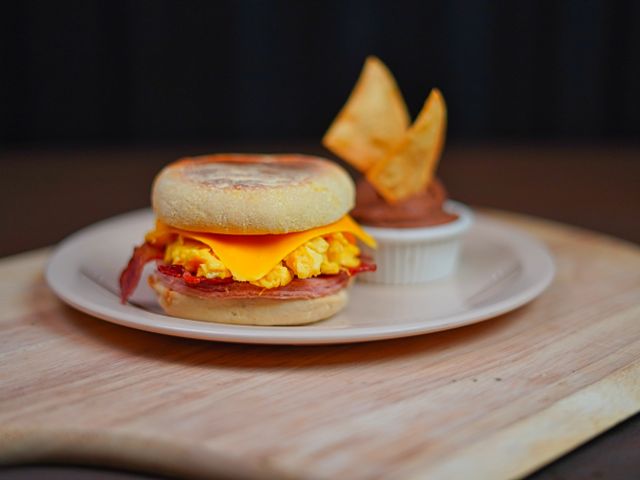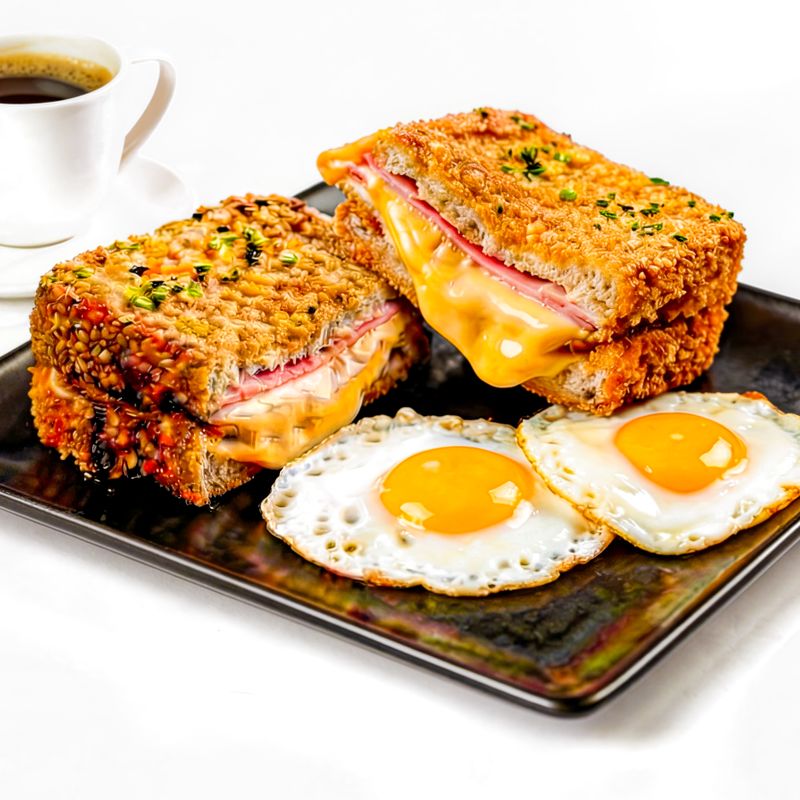
French Toast Breakfast Sandwich with Sausage and Egg
Thick, custardy maple French toast stands in for the bun in this sweet-and-savory breakfast sandwich. Each one holds a juicy sausage patty, a fried egg with a set white and jammy yolk, and melted sharp cheddar, finished with a drizzle of maple syrup.
- Prep
- 15 min
- Cook
- 40 min
- Total
- 55 min
- Makes
- 4 sandwiches
Steps
Before you start
- Use thick-cut bread, about ¾ inch (2 cm) thick. Day-old or lightly stale slices soak up custard without falling apart. If your bread is fresh, dry the slices on a wire rack for 30 minutes first.
- Set out the eggs and milk, unwrap the cheese slices, and crack the 4 fried eggs into 4 separate small cups before you start. Everything moves quickly once the pan is hot.
- Cooking order is sausage, French toast, then eggs. The finished sausage and toast wait in a 200°F (95°C) oven for about 20 to 25 minutes, so keep the sausage covered with foil and the toast uncovered on a rack.
- The pan is wiped clean after the sausage, so the toast tastes of butter and maple, not sausage. Have paper towels and tongs ready.
- Have an instant-read thermometer ready to check the sausage.
Heat the ovenOven 200°F / 95°C
- Position a rack in the middle of the oven and heat it to 200°F (95°C).
- Set a wire rack inside a rimmed baking sheet (or use the bare sheet) and put it in the oven to warm.
- Set the ovenproof plate nearby for the sausage.
+ Show details− Hide details
Ready when: Oven is at 200°F (95°C).
Tip: Keep the oven at 200°F (95°C) or lower. Hotter will dry out the toast.
Whisk the custard
- In a shallow dish, whisk the 3 custard eggs, milk, 1 tbsp maple syrup, vanilla, cinnamon and ¼ tsp salt for about 30 seconds, until the mixture is completely smooth and no streaks of egg white remain.
+ Show details− Hide details
Ready when: Custard is uniform in color with no visible egg white strands.
Cook the sausageOven 200°F / 95°C
- Roll each sausage portion into a ball, then press it into a patty about 3½ inches (9 cm) wide and ½ inch (1.25 cm) thick.
- Press a shallow dimple into the center of each.
- Heat the skillet over medium heat for 1 minute.
- Add the patties and cook 4 to 5 minutes per side, pressing lightly once after flipping, for 9 to 10 minutes total.
- Move the patties to the ovenproof plate, cover loosely with foil and set it in the oven.
- Pour all the fat out of the skillet and wipe the pan completely clean with paper towels so the toast does not pick up sausage flavor.
+ Show details− Hide details
Ready when: Both sides deep golden brown and an instant-read thermometer reads 160°F (71°C) in the center.
Tip: If the crust darkens before the center hits 160°F (71°C), lower the heat to medium-low. Foil keeps the patties moist while they wait, about 20 to 25 minutes.
Soak first four slices
- Lay 4 slices of bread in the custard dish.
- Soak 20 seconds, flip, and soak another 20 seconds.
- Lift each slice, let the excess drip back into the dish for a couple of seconds, and set it on a plate.
- Leave the remaining 4 slices dry for now.
+ Show details− Hide details
Ready when: Slices are heavy and damp at the edges but hold their shape with a slightly drier center, and are not dripping.
Tip: Soaking too long makes the toast soggy. Dry bread can soak up to 30 seconds per side; soft fresh bread needs less.
Fry first batchOven 200°F / 95°C
- Heat the clean skillet over medium-low heat for 1 minute.
- Add 1½ tbsp (21 g) butter and swirl until it foams.
- Add the 4 soaked slices and cook 3 minutes per side, flipping once.
- Move the toast to the rack in the oven, arranged in a single layer.
+ Show details− Hide details
Ready when: Both sides deep golden brown, with a slightly springy center and no wet raw custard when pressed.
Tip: If the butter browns darkly or smokes, lower the heat.
Fry second batchOven 200°F / 95°C
- Wipe out any burnt butter bits with a paper towel.
- Soak the remaining 4 slices the same way (20 seconds per side).
- Add the remaining 1½ tbsp (21 g) butter to the skillet over medium-low heat, swirl until foamy, and cook the slices 3 minutes per side.
- Move them to the rack in the oven.
- Wipe the skillet clean again.
+ Show details− Hide details
Ready when: Both sides deep golden brown and springy to the touch.
Tip: Soak this batch just before it goes in the pan, not earlier, so the bread doesn't turn soggy.
Fry eggs, first pair
- Return the clean skillet to medium-low heat.
- Melt ½ tbsp (7 g) of the egg butter and swirl to coat.
- Slide in 2 eggs from their cups, leaving space between them.
- Sprinkle a small pinch of salt and some pepper over each.
- Cook 2 minutes, until the whites are mostly set.
- Lay a cheddar slice over each egg, cover with the lid and cook 1 to 2 minutes more.
- Slide the eggs onto a plate and tent loosely with foil while you cook the second pair.
+ Show details− Hide details
Ready when: Whites fully opaque with no clear, runny white near the yolk; yolk still glossy and jammy; cheese is glossy and slumping over the egg.
Tip: For fully set yolks, cook 2 to 3 minutes longer under the lid (see the doneness temperatures). Do this for young children, pregnant guests, older adults or anyone with a weak immune system.
Fry eggs, second pair
- Add the remaining ½ tbsp (7 g) egg butter to the same skillet over medium-low heat and swirl.
- Cook the last 2 eggs exactly as before: salt and pepper, 2 minutes uncovered, then cheddar slices and the lid for 1 to 2 minutes.
+ Show details− Hide details
Ready when: Whites fully opaque, yolk glossy and jammy, cheese glossy and slumping.
Assemble and serve
- Take the toast and sausage from the oven.
- Set 4 slices of French toast on a board and drizzle each with ½ tbsp (7 ml) maple syrup.
- Top each with a sausage patty, then a cheese-topped egg.
- Drizzle each stack with another ½ tbsp (7 ml) syrup over the egg, then cover with a second slice of toast.
- Press gently and cut in half if you like.
- Serve right away with any extra syrup for dipping.
+ Show details− Hide details
Ready when: Sandwich is hot throughout with the cheese still melted.
Tip: Eat these while hot. The toast softens as it sits against the egg and syrup.
Good to know
Tips
- Use a lower heat than you think you need for the French toast. The custard needs several minutes to set in the middle before the outside gets dark.
- Drain each soaked slice well. Excess custard turns into a soggy, eggy layer that never quite cooks.
- Keep the sausage patties thinner than a burger so they fit neatly between the slices and cook through quickly.
- Salty sausage and cheese balance the sweetness well. If your sausage is heavily seasoned, use only half the salt on the eggs.
Make ahead
Cook the sausage patties and French toast up to 2 days ahead. Cool completely, then refrigerate in separate airtight containers. Reheat the toast on a rack at 375°F (190°C) for 6 to 8 minutes, and the sausage in a skillet or microwave until steaming hot (165°F / 74°C). Fry the eggs fresh right before serving.
Storage & reheating
Best eaten immediately. Do not leave cooked sandwiches at room temperature for more than 2 hours. Assembled sandwiches keep in the fridge in an airtight container for up to 2 days; reheat wrapped in foil at 350°F (175°C) for 15 to 20 minutes until hot throughout. Freeze cooked, unassembled French toast and sausage for up to 2 months, separated by parchment. Reheat the French toast from frozen in a 375°F (190°C) oven for 8 to 10 minutes or in a toaster. Fully set eggs reheat better than jammy ones.
Substitutions
- thick-cut brioche or Texas toast → Challah or thick-sliced white sandwich bread. Challah works nearly identically. Thinner sandwich bread should soak only 10 seconds per side so it doesn't tear.
- bulk breakfast sausage → Turkey or plant-based breakfast sausage patties. Turkey sausage must reach 165°F (74°C). Plant-based patties follow package timing and may need a little oil in the pan.
- sharp cheddar cheese slices → Gruyère, Swiss or pepper jack. Use the same weight. Pepper jack adds some heat to balance the syrup.
- whole milk → Half-and-half or unsweetened oat milk. Half-and-half gives a richer custard. Oat milk works for dairy-free cooking, but also swap the butter for oil.