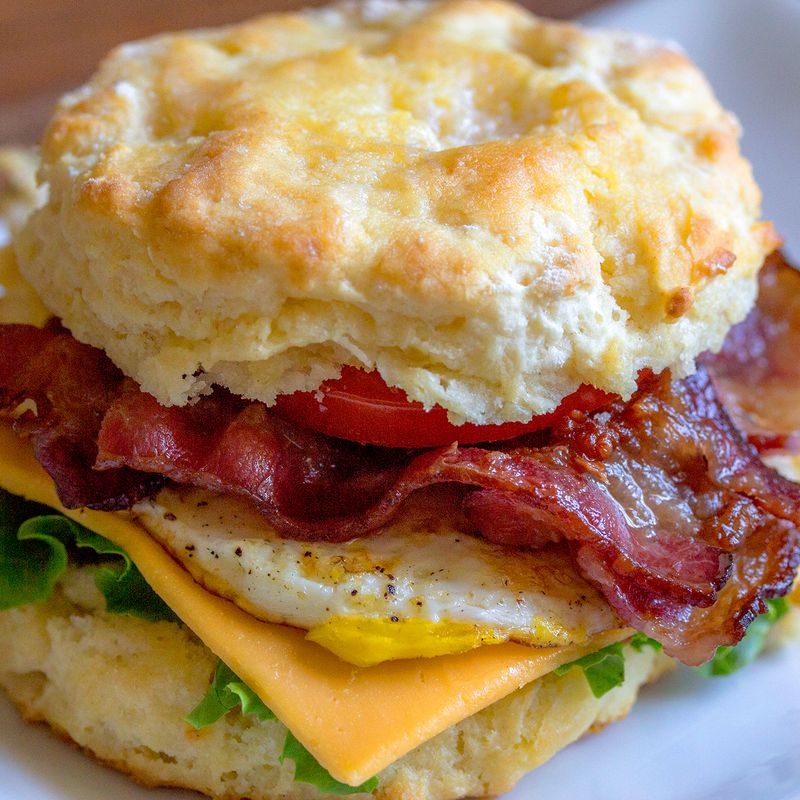
Biscuit Breakfast Sandwich with Sausage Patty and Egg
Tall, flaky buttermilk biscuits are split and stacked with a juicy, sage-spiced homemade sausage patty, a fully set fried egg and melty sharp cheddar. Everything comes from scratch, and the patties and biscuits can both be prepped ahead.
- Prep
- 30 min
- Cook
- 35 min
- Wait
- 15 min
- Total
- 1 hr 20 min
- Makes
- 6 sandwiches
Steps
Before you start
- Cube the butter for the biscuits and have the buttermilk cold from the fridge. Cold fat is what makes biscuits flaky.
- Use ground pork with about 20% fat. Leaner pork makes dry, crumbly patties.
- The timeline is about 80 minutes: 15 minutes of chilling, 17 minutes of baking, then about 15 minutes to cook the sausage and eggs while the biscuits cool slightly.
- Clear a rack in the middle of the oven and line a rimmed baking sheet with parchment.
Chill butter, shape pattiesOven 425°F / 220°C
- Position a rack in the middle of the oven and heat to 425°F (220°C).
- Spread the cubed cold butter on a plate and freeze for 15 minutes.
- While it chills, put the pork, kosher salt, sage, black pepper, smoked paprika, brown sugar, red pepper flakes (if using) and cold water in a bowl.
- Mix with your hands for about 30 seconds, just until the seasonings are evenly distributed and the mixture looks slightly tacky.
- Divide into 6 portions of about 75 g each.
- Shape each into a patty about 3½ inches (9 cm) wide and ½ inch (1 cm) thick, pressing a shallow dimple in the center.
- Place on a plate, cover and refrigerate.
+ Show details− Hide details
Ready when: Butter cubes feel hard and cold; patties are uniform and hold together
Tip: Overmixing makes the sausage rubbery, so stop as soon as the spices are evenly spread.
Whisk dry ingredients
- In a large bowl, whisk the flour, baking powder, baking soda, fine sea salt and sugar for 20 seconds until evenly combined.
+ Show details− Hide details
Ready when: No streaks of baking powder or soda remain
Cut in the butter
- Add the frozen butter cubes to the flour.
- Toss to coat, then press each cube flat between your thumb and fingers into a thin flake.
- Keep going and work quickly for about 3 minutes.
- Stop when most pieces are the size of large flat flakes and a few are the size of a pea or almond.
+ Show details− Hide details
Ready when: Mixture looks shaggy with visible flat butter pieces, not sandy
Tip: If the butter starts to feel soft or greasy, put the bowl in the freezer for 5 minutes.
Mix and fold dough
- Make a well in the center and pour in the cold buttermilk.
- Stir with a fork or spatula about 15 strokes until it forms a very shaggy dough with a few dry patches.
- Turn it out onto a well-floured counter.
- Pat into a rough 8×6-inch (20×15 cm) rectangle.
- Fold it in thirds like a letter, rotate 90 degrees, and pat out again.
- Repeat the fold twice more (3 folds total).
- Finally pat the dough into a rectangle about 1 inch (2.5 cm) thick.
+ Show details− Hide details
Ready when: Dough holds together, is slightly sticky and shows streaks of butter
Tip: Don't knead. Overworking develops gluten and gives tough, short biscuits.
Cut and brush biscuits
- Dip the 3-inch (7.5 cm) cutter in flour.
- Press straight down without twisting, and cut 4 rounds from the dough.
- Gently gather the scraps, pat to 1 inch (2.5 cm) thick and cut 2 more rounds for 6 total.
- Arrange on the parchment-lined baking sheet with the sides just touching.
- Brush the tops with the melted butter.
+ Show details− Hide details
Ready when: Six evenly thick rounds with straight sides
Tip: Twisting the cutter seals the edges and stops the biscuits rising tall.
Bake the biscuitsOven 425°F / 220°C
- Bake on the middle rack at 425°F (220°C) for 15 to 18 minutes.
- Rotate the pan front to back once at the 10-minute mark.
- They are done when they have risen about double and the tops are deep golden brown.
- Move to a wire rack or towel-lined plate.
+ Show details− Hide details
Ready when: Tall, deep golden tops and bottoms; sides look dry and set
Tip: Don't open the oven in the first 10 minutes or the steam that lifts the layers escapes.
Brown sausage patties
- Heat the 12-inch skillet over medium heat for 2 minutes.
- Add the patties in a single layer without crowding (cook in two batches if needed).
- Cook for 4 to 5 minutes without moving them, until the underside is deep brown.
- Flip and cook another 4 minutes.
- Check that the center of each patty reaches 160°F (71°C) on an instant-read thermometer.
- Move to a plate and tent with foil.
- Pour off all but about 1 teaspoon of the fat, leaving the browned bits in the pan.
+ Show details− Hide details
Ready when: Deep brown crust and 160°F (71°C) in the center, with clear juices
Tip: Don't press down on the patties as they cook, or the juices will run out and they'll dry.
Fry the eggs
- Reduce the heat to medium-low.
- Add the 1 tablespoon butter to the same skillet and swirl until it melts and foams.
- Crack in as many eggs as fit without touching (do 2 batches if needed).
- Season with salt and pepper.
- Cook for about 2 minutes until the whites are set, then flip gently with a spatula and cook 1 to 2 minutes more.
- Break the yolk lightly with the spatula tip if you want it fully cooked.
- The whites should be fully opaque and the yolk firm, which is a safe 160°F (71°C).
+ Show details− Hide details
Ready when: Whites are fully opaque with no clear patches; yolk is firm to the touch
Tip: Keep the heat gentle. High heat makes the whites rubbery with crispy, lacy edges.
Melt cheese and assemble
- Lay a slice of cheddar over each egg in the pan, cover with a lid or baking sheet and cook 1 minute off the heat until the cheese is soft and starts to slump.
- Split the biscuits in half horizontally with a serrated knife or your fingers.
- Place a sausage patty on each bottom half, then top with a cheesy egg, folding the edges to fit.
- Add the biscuit tops and serve right away.
+ Show details− Hide details
Ready when: Cheese is glossy and drooping over the egg edges
Tip: If your biscuits are cold, warm them in a 350°F (175°C) oven for 3 minutes before filling.
Good to know
Tips
- Press the cutter straight down and lift straight up. Biscuits cut this way rise higher with distinct layers.
- Place the biscuits so their sides touch on the pan. They support each other and rise taller.
- Use a thermometer for the patties. Color alone is unreliable because spices and paprika brown the meat early.
- For an extra-special touch, brush the finished biscuit tops with a little melted butter and a drizzle of hot honey or maple syrup.
Make ahead
Shape the patties up to 1 day ahead, cover and refrigerate. Bake the biscuits up to 1 day ahead, cool completely and store airtight at room temperature, then rewarm at 350°F (175°C) for 5 to 8 minutes. Or freeze fully assembled sandwiches (see storage).
Storage & reheating
Biscuits keep covered at room temperature for 1 day. Assembled sandwiches keep in the fridge for up to 3 days, wrapped individually in foil. Reheat wrapped in foil at 350°F (175°C) for 15 to 20 minutes, or unwrap, wrap in a damp paper towel and microwave at 50% power for 1 to 1½ minutes. Freeze wrapped sandwiches for up to 2 months and thaw in the fridge overnight before reheating. Cooked patties alone freeze for 3 months.
Substitutions
- buttermilk → 1 cup (240 ml) whole milk mixed with 1 tablespoon lemon juice or white vinegar. Let it sit 5 minutes until slightly curdled, then chill before using.
- ground pork (about 20% fat) → 1 pound (454 g) ground turkey thigh plus 1 tablespoon olive oil. Adds fat that turkey lacks; cook to 165°F (74°C) instead of 160°F.
- sharp cheddar cheese slices → American, pepper jack or Gruyère slices. American melts the smoothest; pepper jack adds heat.
- all-purpose flour → Southern soft-wheat flour such as White Lily. Gives a softer, more tender crumb; use the same weight.
More breakfast sandwiches
See all →
Find more like this
- Meal
- Breakfast
- Cuisine
- Southern
- Main ingredient
- CheddarGround PorkEggs
- Quick & Easy
- Make Ahead