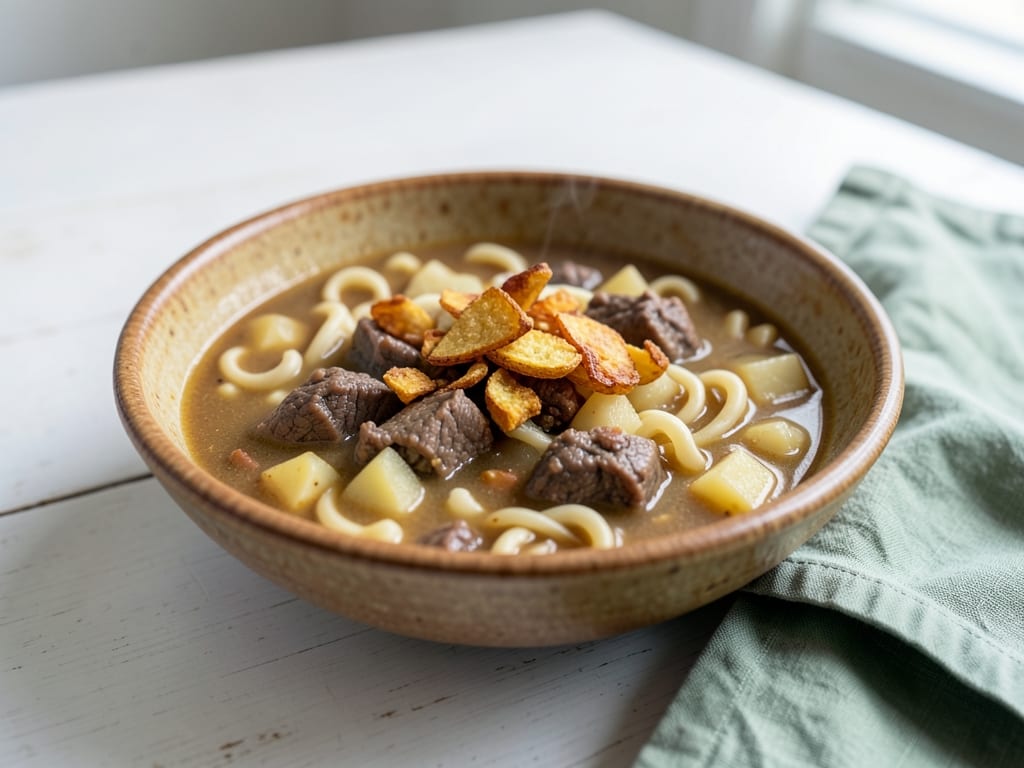
French Leek and Potato Noodle Soup
A rustic French-style vegetable soup with tender leeks, potatoes, and egg noodles simmered in savory chicken broth. Finished with a touch of cream and fresh parsley for a comforting bowl that's both simple and satisfying.
- Prep
- 10 min
- Cook
- 35 min
- Total
- 45 min
- Makes
- 4 servings (about 10 cups)
Steps
Before you start
- Have a 5-quart pot or Dutch oven ready
- Read through the recipe to plan your timing
- Wash leeks thoroughly—grit hides between the layers
- Gather all ingredients before you begin
Clean and slice leeks
- Cut off and discard the dark green tops from the leeks, keeping only the white and light green parts.
- Slice the leeks lengthwise down the middle, then crosswise into ½-inch rings.
- Place the rings in a colander and rinse thoroughly under cold running water, separating them gently with your fingers to remove any grit trapped between the layers.
- Set aside.
+ Show details− Hide details
Ready when: Leeks are sliced into rings and thoroughly rinsed of all grit
Tip: Slicing lengthwise first exposes the layers so grit rinses away more easily than if you just slice crosswise
Cut potatoes
- Peel the potatoes with a vegetable peeler and cut them into ½-inch cubes.
- Place the cubed potatoes in a bowl of cold water to prevent browning while you continue prepping.
+ Show details− Hide details
Ready when: All potatoes are peeled and cut into uniform ½-inch cubes
Sauté leeks in butter
- Melt the butter in a large pot or Dutch oven (at least 5-quart capacity) over medium heat.
- Add the cleaned leeks and cook, stirring occasionally, for 4–5 minutes until they are soft and translucent, especially at the pale white base.
- Watch that they don't brown; if they start to color, reduce the heat slightly.
+ Show details− Hide details
Ready when: Leeks are soft and translucent, especially at the white bases
Tip: If the leeks start to brown, lower the heat immediately—this is a gentle sauté, not a deep sear
Add broth and vegetables
- Pour the chicken broth into the pot.
- Drain the potatoes and add them along with the bay leaf and thyme.
- Stir well to combine and bring the mixture to a boil over medium-high heat, which will take about 8 minutes.
+ Show details− Hide details
Ready when: Liquid is at a rolling boil with visible bubbles breaking the surface continuously
Simmer soup
- Once boiling, immediately reduce the heat to medium-low and simmer gently, uncovered, for 12–15 minutes until the potatoes are very tender and break apart easily when pierced with a fork.
- Stir occasionally but gently—vigorous stirring will break the potatoes into small pieces.
+ Show details− Hide details
Ready when: Potatoes are very tender and collapse easily when pierced with a fork
Tip: Keep the simmer gentle and steady; too vigorous a boil will break up the potatoes excessively and make the soup cloudy
Add and cook noodles
- Stir in the dried egg noodles and adjust the heat to medium if needed to maintain a gentle boil.
- Cook the noodles for 6–8 minutes, stirring occasionally to prevent them from sticking together or to the pot bottom, until they are tender and cooked through with no white, raw center visible.
+ Show details− Hide details
Ready when: Noodles are fully tender with no raw center remaining when bitten
Tip: Stir the noodles frequently in the first minute to prevent clumping; egg noodles stick easily to each other and the pot bottom
Season and serve
- Remove the bay leaf from the pot and discard it.
- Taste the soup and season generously with sea salt and black pepper to your preference.
- If desired, stir in the heavy cream for added richness and a silky texture.
- Ladle the soup into serving bowls and top each portion with a pinch of fresh chopped parsley.
+ Show details− Hide details
Ready when: Soup is well-seasoned, bay leaf is removed, and ready to serve
Tip: Always remove and discard the bay leaf before serving—it's a choking hazard and not meant to be eaten
Good to know
Tips
- When cleaning leeks, the grit hides between the layers. Slice them lengthwise first so you can rinse thoroughly between the layers—don't just rinse them whole and slice
- Yukon Gold potatoes are waxy and hold their shape better than russets; they won't fall apart as easily during simmering, though some breaking is normal and desirable for rustic texture
- If you don't have cream on hand, finish the soup with a pat of cold butter stirred in at the end—it adds richness and silkiness without the dairy tang
- This soup thickens slightly as it cools and sits. When reheating, thin it with a splash of broth or water to return it to a soupier consistency
Make ahead
This soup can be made up to 1 day ahead. After cooking through step 5 (simmering the potatoes), let cool and refrigerate. When ready to serve, reheat gently over medium heat, then add the noodles and cook as directed in step 6. This helps maintain the noodles' texture better than if they were cooked and stored overnight.
Storage & reheating
Room temperature: up to 2 hours in an airtight container. Refrigerator: up to 3 days in an airtight container; reheat gently on the stovetop over medium heat, stirring occasionally, and add a splash of broth or water if thickened. Freezer: up to 3 months in a freezer-safe container, though noodle texture may soften slightly; thaw overnight in the refrigerator and reheat on the stovetop.
Substitutions
- dried egg noodles → small pasta shells, bow-tie pasta (farfalle), or small elbow pasta. Use the same amount by weight and cook according to package directions; these pastas cook in about the same time as egg noodles
- heavy cream or crème fraîche → crème fraîche, sour cream, or Greek yogurt. Use the same amount; crème fraîche provides a tanginess similar to cream, while sour cream or yogurt add extra tang—stir in gently at the end to avoid breaking
- fresh thyme → Italian herb blend, herbes de Provence, or dried oregano. Use the same amount; herbes de Provence will give a more complex, traditional French flavor
- low-sodium chicken broth → vegetable broth. Creates a fully vegetarian version with similar flavor and richness; use the same amount