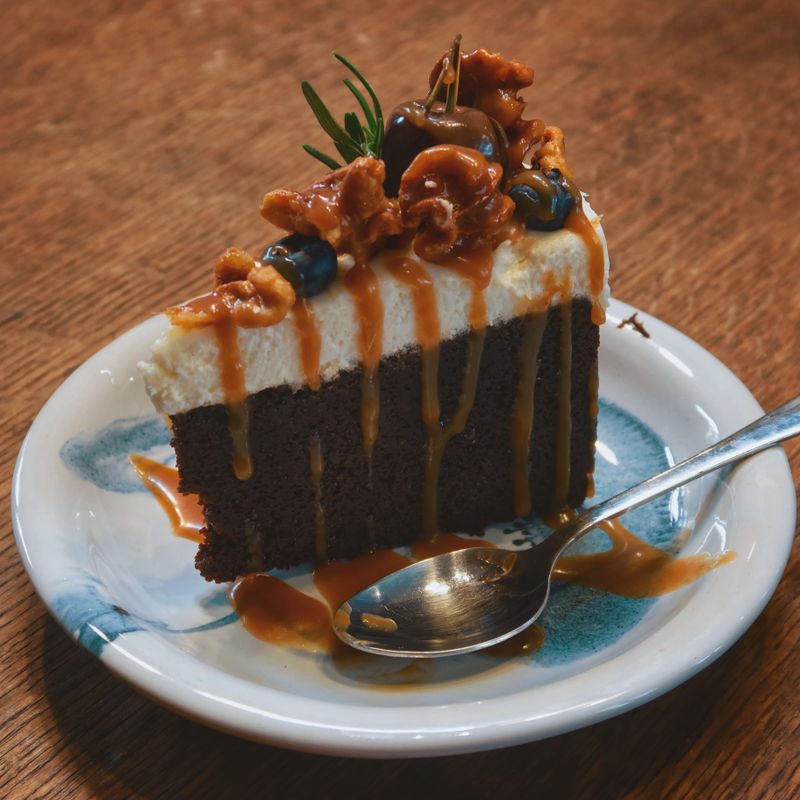
Eid Morning Walnut Caramel Layer Cake with Mascarpone Frosting
A showstopping two-layer cake celebrating Eid with a tender, nutty crumb enriched by walnuts and warm spices, sandwiched with silky mascarpone frosting and ribbons of homemade salted caramel. The caramel-walnut topping adds a luxurious finish. This cake strikes a perfect balance between indulgent and not too heavy—ideal for morning celebrations with family.
- Prep
- 30 min
- Cook
- 35 min
- Wait
- 1 hr 30 min
- Total
- 2 hr 35 min
- Makes
- 1 two-layer cake (10 slices)
Steps
Before you start
- Preheat oven to 350°F (175°C) and position a rack in the middle. Butter and flour two 8-inch (20 cm) round cake pans, or line with parchment. Bring eggs to room temperature (set out 30 minutes ahead). Toast walnuts lightly in a dry pan to deepen their flavor, then let cool completely before grinding.
- Read through the caramel step carefully; it goes from pale to dark quickly, so watch closely and remove from heat when it reaches a deep amber.
Mix dry ingredients
- In a medium bowl, whisk together 210 g cake flour, 7.5 g baking powder, 1.2 g baking soda, 3 g salt, 2.5 g cinnamon, 0.5 g nutmeg, and 0.5 g cardamom.
- Set aside.
+ Show details− Hide details
Tip: Sifting the dry ingredients ensures even distribution of leavening and spices throughout the cake.
Cream butter and sugar
- In a stand mixer or with a hand mixer, beat 170 g softened butter and 300 g sugar on medium speed for 3–4 minutes until light, fluffy, and pale.
- Scrape down the bowl occasionally.
+ Show details− Hide details
Ready when: Mixture is light, fluffy, and noticeably paler than when you started
Tip: Proper creaming incorporates air, which helps the cake rise and creates a tender crumb. Don't rush this step.
Add eggs and vanilla
- With the mixer on medium speed, add 3 room-temperature eggs one at a time, beating for about 20 seconds after each addition.
- Add 7.5 ml vanilla extract and mix for 30 seconds until combined.
- Scrape the bowl between additions.
+ Show details− Hide details
Ready when: Mixture looks smooth and emulsified; no streaks of egg white remain
Tip: Adding eggs one at a time ensures each incorporates fully. Room-temperature eggs emulsify better than cold eggs, preventing curdling.
Alternate dry and wet
- Reduce mixer speed to low.
- Add one-third of the dry mixture (about 70 g), mix for 10 seconds, then add half of the 120 ml yogurt, mix for 10 seconds.
- Repeat: add another third of dry (70 g), mix, add remaining yogurt, mix.
- Finish with the last third of dry ingredients (70 g) and mix until just combined.
- Scrape the bowl and fold gently by hand once or twice to ensure no pockets of flour remain, about 30 seconds.
+ Show details− Hide details
Ready when: Batter is smooth and homogeneous with no visible dry streaks
Tip: Alternating dry and wet prevents overmixing, which would develop gluten and result in a tough crumb. Mix until just combined—a few small lumps are fine.
Fold in walnuts
- Gently fold in 140 g of finely ground toasted walnuts using a rubber spatula with 8–10 folds, taking care not to deflate the batter.
- The mixture should be uniform throughout.
+ Show details− Hide details
Ready when: Walnuts are evenly distributed throughout the batter
Tip: Folding by hand preserves the air you just whipped in. Overmixing after adding nuts will toughen the cake.
Divide and bakeOven 350°F / 175°C
- Divide the batter evenly between the two prepared 8-inch (20 cm) pans (about 530 g per pan).
- Smooth the tops gently with an offset spatula.
- Place both pans in the preheated 350°F (175°C) oven in the middle rack.
- Bake for 33–37 minutes until a toothpick inserted into the center comes out with a few moist crumbs clinging to it.
+ Show details− Hide details
Ready when: Golden brown on top; toothpick inserted in center has a few moist crumbs but no wet batter
Tip: Underbake slightly—a slightly moist center keeps the cake tender once cooled. Overbaking dries it out. If your oven runs cool, it may take up to 40 minutes.
Cool in pans
- Remove both pans from the oven.
- Let the cakes cool in their pans for 15 minutes.
- Run a thin knife around the edges to loosen them, then invert each cake onto a wire cooling rack.
- Cool completely, about 45 minutes, until they feel cool to the touch.
+ Show details− Hide details
Ready when: Cakes are no longer warm to the touch and feel set and stable
Tip: Cooling in the pan for a few minutes sets the structure without shocking the cake with a sudden temperature change. Complete cooling is essential before frosting to prevent melting.
Make the caramelOven 350°F / 175°C
- Place 200 g sugar in a dry 9-inch (23 cm) skillet or heavy-bottomed saucepan over medium heat.
- Do not stir.
- Let it sit for 1 minute, then tilt and swirl the pan to move the sugar from the edges toward the center as it melts.
- After 2–3 minutes, you'll see clear liquid forming.
- Continue tilting and swirling (no stirring) until all the sugar is dissolved and the caramel is a deep amber color (about 350°F or 175°C on a thermometer), 5–7 minutes total.
- Remove from heat immediately.
+ Show details− Hide details
Ready when: Sugar transforms from clear liquid to deep amber, around 350°F (175°C); just before it turns black
Tip: Watch carefully during the last minute—the color goes from pale amber to burnt very quickly. Remove from heat as soon as it reaches deep amber; residual heat will continue cooking it.
Finish the caramel
- Add 70 g butter cubes to the hot caramel.
- Let it bubble and foam for 10 seconds, then remove from heat.
- Very slowly pour in 120 ml warm cream while stirring gently with a wooden spoon.
- The mixture will bubble vigorously—pour slowly to avoid overflow.
- Stir in 4.5 g fleur de sel.
- Let the caramel cool for 10–15 minutes until it reaches a warm but pourable consistency.
- You should have roughly 200 ml of caramel.
+ Show details− Hide details
Ready when: Caramel is warm but no longer steaming; it coats the back of a spoon and drips slowly
Tip: Adding cream to hot caramel causes violent bubbling. Pour very slowly and keep your face back to avoid steam burns. If the caramel seizes or becomes grainy, gently reheat over low heat while stirring.
Make the mascarpone frosting
- In a stand mixer or with a hand mixer, beat 450 g room-temperature mascarpone and 55 g softened butter on medium speed for 1 minute until smooth and combined.
- Add 240 g sifted powdered sugar in two batches, mixing on low speed.
- Add 5 ml vanilla extract.
- Beat on medium speed for 1–2 minutes until light and fluffy, being careful not to overmix (mascarpone can become grainy if overworked).
+ Show details− Hide details
Ready when: Frosting is smooth, pale, and holds soft peaks when you lift the beaters
Tip: Mascarpone is delicate; mix only until just combined and fluffy. Overmixing breaks down the cream and causes weeping or a grainy texture.
Level and layer the cakes
- Using a serrated cake knife, carefully level the top of each cooled cake layer by slicing off any doming with a gentle sawing motion.
- Place the first layer on a cake plate or board.
- Spread about 150 g of mascarpone frosting in an even layer over the top, leaving a 0.5-inch (1.25 cm) border.
- Drizzle about 3 tablespoons (45 ml) of the warm caramel (made in steps 8–9) in a thin spiral or wave pattern over the frosting.
- Place the second cake layer on top and gently press down.
+ Show details− Hide details
Ready when: Cake layers are stacked evenly; frosting is visible between layers and caramel drizzles are in place
Tip: Leveling the cakes ensures even, stable layers. A serrated knife works better than a regular knife for this. Take your time and use gentle pressure.
Frost and finish
- Spread the remaining mascarpone frosting evenly over the top and sides of the assembled cake with an offset spatula, making it as smooth or rustic as you prefer.
- Refrigerate for 30 minutes to firm up slightly.
- Just before serving, drizzle the remaining caramel (about 60–80 ml) over the top in decorative ribbons or lines.
- Scatter 85 g of toasted walnut halves over the top and caramel for garnish.
+ Show details− Hide details
Ready when: Cake is fully frosted and garnished; caramel drizzles are visible on top and sides
Tip: Refrigerating the frosted cake before the final caramel drizzle keeps the frosting firm so the warm caramel sits on top instead of sinking in. This gives a more elegant presentation.
Chill before serving
- Refrigerate the finished cake for at least 2–3 hours, or until ready to serve.
- The flavors meld beautifully as it sits, and the cake is easiest to slice when chilled.
- Let it sit at room temperature for 15–20 minutes before serving for the best flavor and texture.
+ Show details− Hide details
Ready when: Cake is cold to the touch and holds together cleanly when sliced
Tip: Chilling the cake firms the frosting and caramel, making neat slices possible. Bringing it to room temperature before serving restores tenderness and allows the full depth of walnut and spice flavors to shine.
Good to know
Tips
- Toast your own walnuts just before grinding to maximize flavor. Pre-ground walnuts can turn rancid quickly due to their high oil content. Lightly toast them in a dry skillet over medium heat for 3–4 minutes until fragrant, cool completely, then pulse in a food processor until finely ground—not powdery.
- The caramel is the star; don't skip it or rush it. The deep amber color (around 350°F / 175°C) is where the real flavor is. Pale caramel tastes one-dimensional. A candy thermometer takes the guesswork out if you're nervous.
- Mascarpone frosting is forgiving but delicate. Keep it cool and don't overbeat. If it starts to look grainy or weepy, briefly chill the mixing bowl and beaters in the freezer, then mix gently on low speed.
- This cake celebrates Eid with elegance and restraint—the spices are warm but not overwhelming. If you prefer bolder spice notes, increase the cinnamon to 1.5 tsp and the cardamom to 0.5 tsp, though taste carefully as you go.
Make ahead
You can bake the cake layers and make the caramel up to 2 days ahead. Wrap the cooled cake layers tightly in plastic wrap and store at room temperature. Store the caramel in an airtight container in the refrigerator; gently reheat in a microwave (15–20 seconds at 50% power) or in a heatproof bowl set over warm water until pourable. Assemble, frost, and decorate the cake up to 8 hours before serving for the best presentation.
Storage & reheating
Room temperature (loosely covered): up to 2 days. Refrigerator: up to 4 days in an airtight container or cake box. The frosting and caramel remain stable. To serve after refrigeration, let the cake sit at room temperature for 15–20 minutes. Freezer: You can freeze the unfrosted cake layers wrapped tightly in plastic and foil for up to 2 months. Thaw at room temperature for 3–4 hours before frosting.
Substitutions
- walnuts, finely ground → toasted pecans or hazelnuts, finely ground. Pecans and hazelnuts have a similar texture and richness. Use the same weight (140 g). The flavor will shift slightly—pecans are earthier, hazelnuts more delicate.
- mascarpone cheese → crème fraîche or a mixture of cream cheese and heavy cream (225 g cream cheese + 120 ml heavy cream whipped to soft peaks). Mascarpone's richness is hard to replicate exactly, but these options are close. Crème fraîche is tangier; the cream cheese mixture is lighter but may need an extra tablespoon of powdered sugar.
- plain Greek yogurt → sour cream or additional buttermilk. Both add moisture and tang. Use the same volume (120 ml). Sour cream will add a slight tang; buttermilk will make the cake more tender.
- ground cardamom → ground ginger (use 0.125 tsp, half the amount). Ginger is spicier and more forward. Use half the amount and taste the batter before baking to adjust. The cake will have a slightly different spice profile.
More cakes
See all →

Find more like this
- Meal
- Breakfast
- Main ingredient
- Cream Cheese
- Diet
- VegetarianHalal
- Method
- Oven
- Occasion
- Eid